The technology adoption curve is a model that describes how different groups of people adopt new technology over time, from early enthusiasts to reluctant late adopters. Originally developed by sociologist Everett Rogers in 1962, it remains one of the most practical frameworks for organizations planning software rollouts, change initiatives, and digital transformation programs.
Not everyone in an organization responds to new technology the same way. While some employees dive in on day one, others wait to see how their peers find it. A few resist until adoption becomes unavoidable. This is not a failure of communication or training. It is a predictable human pattern, one that organizations can plan for, rather than be caught off guard by.
Understanding the technology adoption curve gives leaders a framework to sequence their enterprise software rollout strategies, identify where resistance will surface, and deploy the right support at the right time for each group of users.
What Is the Technology Adoption Curve?
The technology adoption curve, also called the diffusion of innovations curve, illustrates how a new technology spreads through a population over time. Rather than assuming everyone adopts at once, it recognizes that people fall into distinct groups based on how quickly and willingly they embrace change.
The model takes the shape of a bell curve. Adoption starts slowly with a small group of enthusiasts, accelerates as the majority follows, then tapers off as the last resistors eventually come on board or do not.
For enterprise organizations, this curve applies directly to internal software rollouts. When a new ERP, CRM, or digital platform goes live, employees do not adopt it uniformly. Understanding which technology adoption stage each team is in determines what kind of support, communication, and guidance they actually need.
The 5 Stages Of The Technology Adoption Curve
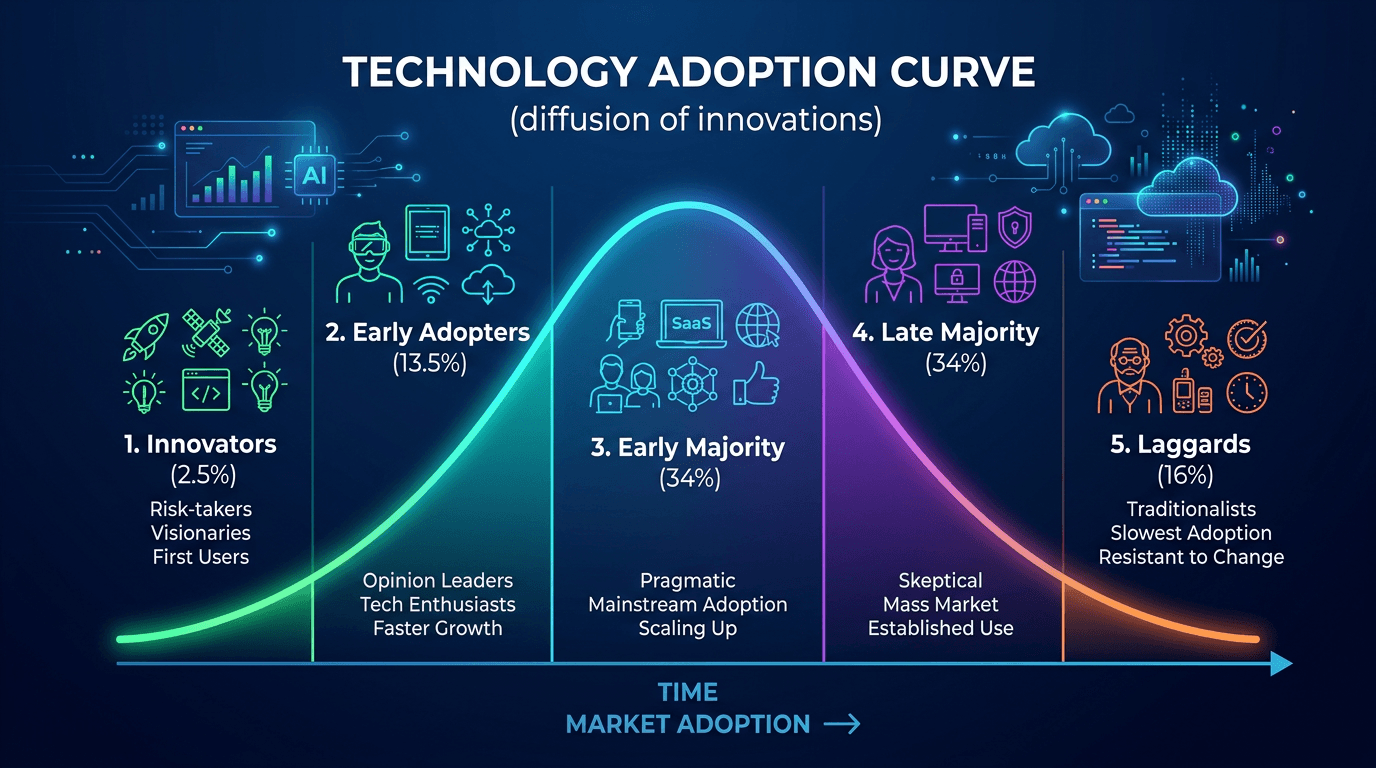
Rogers identified five distinct adopter groups, each with different motivations, risk tolerances, and support needs. Here is what each technology adoption stage looks like inside an enterprise rollout:
1. Innovators (2.5% of users)
Everett Rogers’ Diffusion of Innovations model identifies innovators as the first 2.5% of adopters in the technology adoption lifecycle. Innovators are the first to engage with a new tool, often before it is fully rolled out. They are technically curious, comfortable with ambiguity, and willing to accept rough edges in exchange for early access.
In an enterprise context, these are the employees who volunteer for pilot programs, explore features that have not been formally introduced, and provide the feedback that shapes the rollout for everyone else.
What they need: Early access and internal champion programs, direct feedback channels, and involvement in shaping the deployment. They are your internal champions, use them.
2. Early Adopters (13.5% of users)
According to Everett Rogers’ Diffusion of Innovations theory, early adopters represent 13.5% of the total adopter population.
Early adopters move quickly, but with more deliberation than innovators. They understand the strategic value of the new tool and are willing to invest time in learning it before it becomes standard practice. In an enterprise rollout, these are often team leads, department heads, or influential individual contributors who others look to for signals about whether a change is worth embracing.
What they need: Role-specific guidance for enterprise software adoption, clear visibility into the business case, and recognition for leading the way. Their visible success is what moves the next group.
3. Early Majority (34% of users)
The adoption curve classifies the early majority as 34% of users who adopt technology after seeing proven value and peer validation. The early majority represents the turning point for any rollout. They are pragmatic; they will adopt once they see evidence that the tool works for people like them, in workflows like theirs. They are not opposed to change, but they need proof before they commit.
What they need: Peer validation and in-app onboarding for pragmatic users, structured walkthroughs, and guided onboarding that connects the tool to their specific role and workflows, not generic training.
4. Late Majority (34% of users)
In Everett Rogers’ Diffusion of Innovations framework, the late majority accounts for 34% of adopters who typically adopt technology after it becomes mainstream. The late majority adopts out of necessity rather than enthusiasm. They are skeptical of change, often attached to existing processes, and adopt only once the tool has become the norm.
In enterprise environments, these are employees who continue using workarounds well into a rollout, not because they are obstructing progress, but because no one has given them a reason compelling enough to change their habits.
What they need: Persistent in-app guidance to reduce software switching friction, simplified workflows, and reassurance that help is available when they get stuck. Pressure alone does not work for this group; support does.
5. Laggards (16% of users)
Everett Rogers’ Diffusion of Innovations model defines laggards as the final 16% of adopters who are typically the most resistant to technological change.
Laggards are the last to adopt, and sometimes never do. They distrust change, value proven systems, and often have deep institutional knowledge of the tools they are being asked to leave behind. In industries such as healthcare, government, and financial services, laggards are disproportionately represented, and ignoring them poses compliance and productivity risks.
What they need: Simplified digital adoption strategies for resistant users, patience, highly simplified guidance, and a clear answer to the question they are always asking: How does this change benefit me, specifically, in my role?
Why Most Enterprise Rollouts Stall Between Technology Adoption Stages?
The biggest gap in any enterprise rollout is not between early and late adopters; it is between employees who adopt out of curiosity and those who will adopt only after seeing proof.
These two groups need entirely different things. The first group moves on to potential. The second moves on to evidence, specifically, evidence that the tool works for people in their role, doing their kind of work. The communication, training, and guidance that convinced the first group does nothing for the second.
This is where most enterprise software adoption programs lose momentum, and where in-app guidance platforms make the biggest difference.
Real-World Examples Of The Technology Adoption Stages
CRM Software
CRM platforms spent decades moving through the technology adoption curve in enterprise sales environments. Early innovators were sales leaders who saw the value of centralizing pipeline data. The early majority held back until cloud-based CRMs made deployment simpler and ROI more measurable. The late majority followed as mobile-first capabilities and industry-specific features reduced the learning curve. Today, with hundreds of CRM software vendors listed on online platforms, the market has firmly reached the late majority and laggard phase.
Cloud Computing
Cloud computing is one of the clearest examples of the technology adoption curve playing out at enterprise scale. Early adopters moved first, driven by cost and scalability potential. The early majority followed once ROI evidence mounted and vendor ecosystems matured.
89% of enterprises now use multiple cloud providers, making cloud one of the fastest technologies to move from early adopters to mainstream adoption. - Flexera State of the Cloud Report
Generative AI in the Enterprise
Generative AI is currently at the tipping point between early adopters and the early majority in enterprise environments. Innovators and early adopters, typically in IT, marketing, and product functions, have already integrated AI tools into daily workflows. The early majority is now engaging, driven by integrations into familiar tools like Microsoft 365 and Google Workspace that reduce the activation barrier. The late majority and laggards remain skeptical, waiting for clearer governance frameworks and proven ROI in their specific industry context.
88% of organizations are now regularly using AI in at least one business function, up from 78% just a year ago, a clear sign that generative AI has entered the early majority phase. - McKinsey Global Survey
How To Accelerate Technology Adoption At Each Stage
Understanding the curve is only useful if it changes how organizations plan and execute implementations. Here is what each technology adoption stage requires in enterprise practice:
• Identify your innovators early: Involve them in shaping the deployment. Their feedback improves the experience for everyone and creates internal credibility before the broader launch.
• Use early adopters as visible champions: When the early majority sees respected colleagues succeed with a tool, enterprise software adoption accelerates far faster than any communication campaign could achieve on its own.
• Build role-specific onboarding for enterprise software: Generic training does not move pragmatic users. In-app walkthroughs and tooltips tied to actual workflows give them the proof they need to commit.
• Support the late majority with persistent, low-friction in-app guidance: Contextual help widgets and AI-powered assistants reduce the effort of switching, making adoption the path of least resistance. Organizations should also track enterprise software adoption metrics such as feature usage, workflow completion, time-to-proficiency, and user engagement to identify adoption gaps and continuously improve rollout success.
• Give laggards a clear personal case for change: Focus on how the tool makes their specific job easier. Simplified workflows, patient guidance, and visible peer adoption eventually move even the most resistant users.
What Slows Technology Adoption Down?
Even well-planned implementations encounter resistance. The most common reasons adoption stalls at each stage of the curve are not technical; they are human:
• No visible proof of value for the early majority, who will not move without evidence from peers they trust.
• Generic training that fails to connect the tool to role-specific enterprise workflows.
• No in-the-moment support leaves users stranded when they get stuck during real tasks. Improving the digital employee experience (DEX) helps reduce friction by providing employees with contextual support exactly when they need it.
• Implementations that treat all employees the same, ignoring the fundamentally different needs of each adopter group.
• No feedback loop to surface where specific groups are struggling and adjust guidance accordingly.
The Role of Digital Adoption Platforms in Moving Users Through the Curve
Digital Adoption Platforms (DAPs) and LMS implement the operational layer that actually moves users through the technology adoption curve. Unlike traditional Learning Management Systems (LMS), they provide contextual, in-app guidance that helps employees learn while working instead of relying only on scheduled training sessions.
By delivering role-specific in-app guidance, contextual walkthroughs, and AI-powered assistance at the moment of need Measuring feature adoption in enterprise software enables organizations to understand which capabilities employees are actively using, where users struggle, and what additional guidance is needed to improve software adoption. digital adoption platforms address the specific barriers each adopter group faces without pulling employees away from their work or overwhelming support teams with repetitive queries.
For innovators and early adopters, they provide advanced guidance and self-serve depth. For the early majority, they deliver peer-relevant, role-specific proof. For the late majority and laggards, they reduce friction to the point where adoption becomes easier than resistance.
Conclusion
The technology adoption curve is not a prediction of failure; it is a map of human behavior. Every organization will have innovators, skeptics, and everyone in between. The difference between a rollout that stalls and one that succeeds is whether the organization plans for each group or pretends they are all the same.
Understanding which technology adoption stage your employees are in, what they need to move forward, and how to deliver that support in the context of their actual work is what separates technology deployment from technology adoption.
Frequently Asked Questions (FAQs)
1. What is the technology adoption curve?
The technology adoption curve is a model that describes how different groups of people adopt new technology over time. Developed by Everett Rogers in 1962, it divides adopters into five groups — Innovators, Early Adopters, Early Majority, Late Majority, and Laggards, each with different motivations, risk tolerances, and support needs.
2. What are the 5 stages of technology adoption?
The five stages are: Innovators (2.5%), who adopt first and embrace risk; Early Adopters (13.5%), who move quickly once they see strategic value; Early Majority (34%), who adopt after seeing peer proof; Late Majority (34%), who adopt out of necessity once the tool becomes the norm; and Laggards (16%), who are the last to adopt and often require the most support.
3. What are the technology adoption stages in an enterprise context?
The five stages: Innovators, Early Adopters, Early Majority, Late Majority, and Laggards, map directly onto employee behavior during a rollout. Each group has different motivations and needs different support. A one-size-fits-all approach fails most of them.
4. How do you accelerate technology adoption in an organization?
Identify internal champions early and make their success visible. Build role-specific in-app onboarding for enterprise software and deliver guidance inside the application at the moment of need. Use adoption analytics to track each adopter group and intervene before resistance sets in.
5. Why does technology adoption fail?
Generic training, no in-the-moment support, and no visible peer proof for the pragmatic majority. The technology is rarely the problem; moving people through each adoption stage is where most implementations lose momentum.