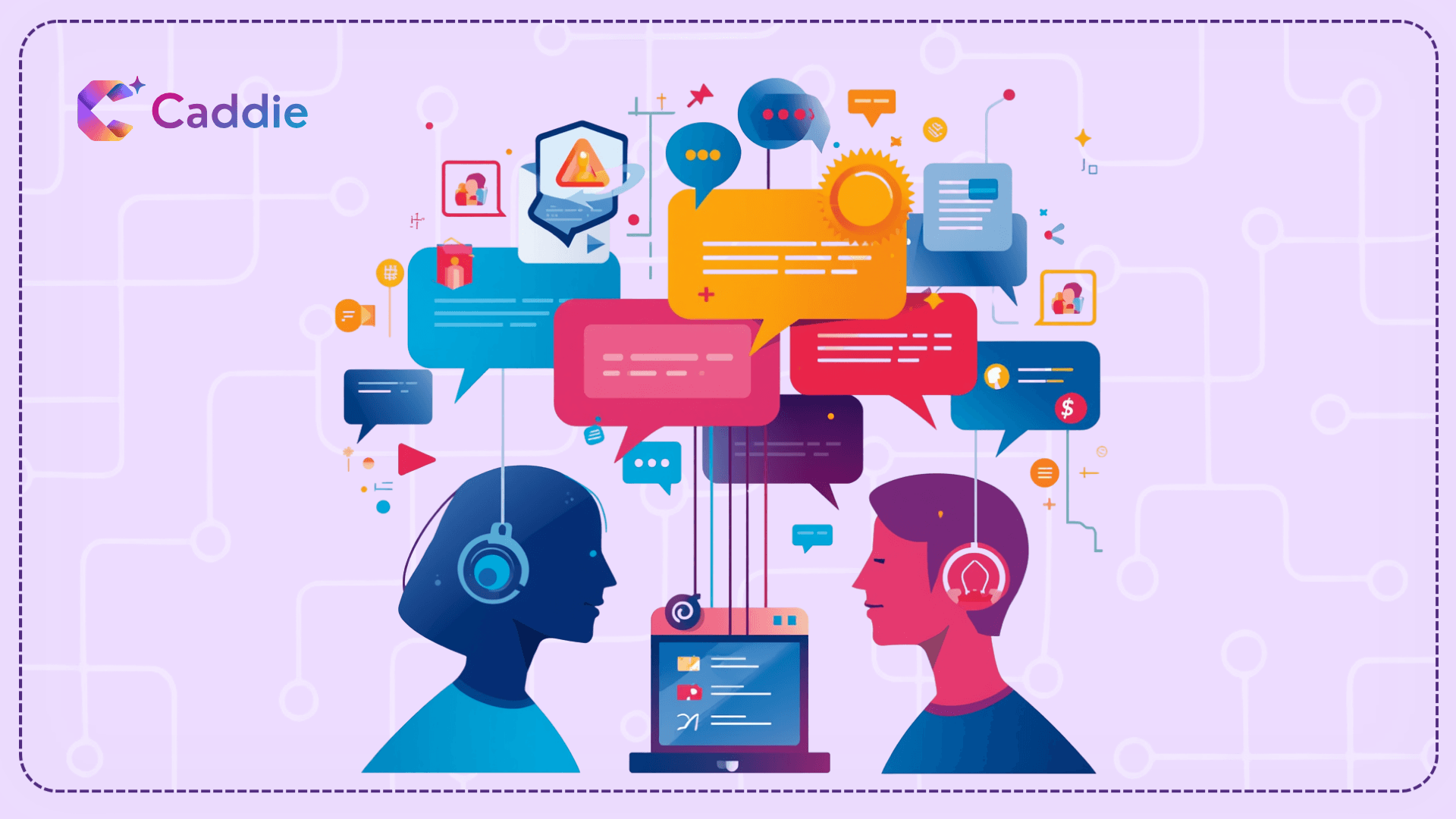
When you ask your phone's voice assistant about the weather, use a translation app to crack a foreign language, or get frustrated by a customer service chatbot that doesn’t quite understand your mood, you are interacting with Natural Language Processing (NLP).
But, what is natural language processing exactly?
Natural Language Processing is the science of teaching computers how to read, listen, and understand human language. You could call it the "translator" between humans and machines.
Our language is messy, it's full of slang, sarcasm, double meanings, and regional accents. Computers crave exact, unambiguous data. So, when someone asks what do you mean by natural language processing, it’s the field of study dedicated to bridging this massive gap. It enables software to infer meaning and intent based on patterns in language.
How Does NLP Work?
It isn’t easy to teach our language to a machine. While the math behind it is incredibly complex, the process can be broken down into two main parts:
Cleaning Up the Language: Computers are neat freaks. Before they can understand anything, the raw, unstructured mess of human language must be converted into something clean, sorted, and structured.
Using Algorithms: Once the data is clean, the computer uses smart math rules (called algorithms) to make sense of it.
Preprocessing: The Cleaning Stage
The first thing a traditional NLP pipeline does is take your sentence and chop it into small, manageable pieces, often using the following processes:
Tokenization: This is where the machine splits the sentence into individual words (called "tokens"). A sentence like "The cat sat" becomes three tokens: [The], [cat], [sat].
Stop Word Removal: Words like "and," "the," "is," and "at" appear constantly in English but rarely carry the core meaning of a sentence. NLP software often ignores these "stop words" to focus on the important words (like "cat" and "sat"). However, modern systems may keep stop words since it can change the meaning of a sentence.
Stemming & Lemmatization: This involves reducing a word to its root form. For instance, the machine knows that "running," "ran," and "runs" all basically mean "run." It simplifies words so it doesn’t have to learn thousands of tiny variations.
Part-of-Speech (POS) Tagging: Here, the machine acts like a grammar teacher. It identifies which word is the noun (cat), the verb (sat), the adjective, and so on.
Note that traditionally, NLP involved preprocessing + algorithms, but modern systems often learn directly from large amounts of raw text. Modern systems may use subwords or byte-pair units during tokenization, such as running becomes run + ning, instead of reducing a word to its root. They may skip steps like stemming and lemmatization and explicit POS tagging due to technical advancements in language understanding.
Algorithms: The Understanding Stage
Once the sentence is cleaned and sorted, the machine needs to interpret it. Natural language processing primarily uses two methods to do this:
Rule-Based Systems: These are simple systems that use a pre-set list of grammar rules written by human linguists. They are rigid but can be very accurate for simple, predictable tasks.
Machine Learning Systems: This is where Natural Language Processing in AI really shines. These models aren't taught rules. Instead, they are shown millions of examples of human language until they learn the patterns on their own. The more data they are trained on, the better they become at predicting meaning, understanding context, and capturing relationships between words.
NLP vs. NLU vs. NLG vs. NLQ
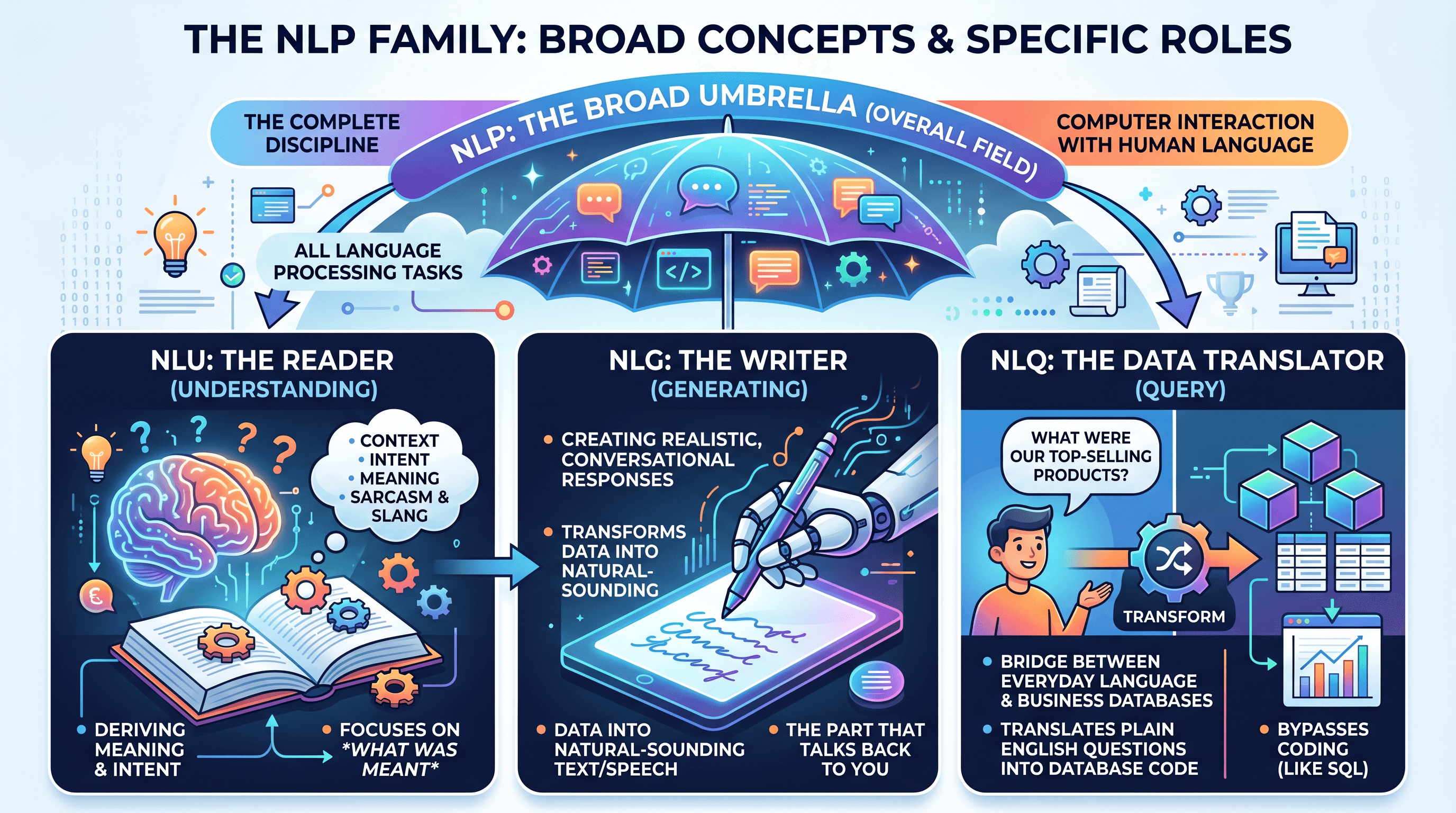
Wait! Aren't NLU, NLG, and NLQ the same thing? If you've been reading up on artificial intelligence, you’ve likely seen these terms pop up, perhaps even within this same series.
It is easiest to understand these by picturing Natural Language Processing (NLP) as a broad, encompassing "umbrella term" for the entire field. The other terms are more specific subsets that focus on one particular function of the "reading/understanding/generating" loop.
Here is a breakdown of how they compare.
NLP: The Broad Umbrella
As we have defined, NLP is the complete discipline focused on computer interaction with human language. It's the overall field of study that encompasses all language processing tasks, including understanding input and generating output. It is the "parent" term to everything else on this list.
NLU: The Reader (Understanding)
Natural Language Understanding (NLU) is a specific component within NLP. While NLP might break down the structure of a sentence, NLU’s only job is to derive the meaning and intent.
If NLP analyzes what was said, NLU focuses on what was meant. NLU is the brainpower that allows a machine to handle context, decipher sarcasm, and figure out your intent, even if you are using slang or making typos.
NLG: The Writer (Generating)
If NLU is the machine "reading," then Natural Language Generation (NLG) is the machine "writing."
NLG is the component of NLP responsible for creating realistic, conversational responses. It takes structured data from a computer system and transforms it into natural-sounding text or speech that a human can easily understand. It is the part of the AI that actually talks back to you.
NLQ: The Data Translator
Natural Language Query (NLQ) is a very specific type of NLP application. It acts as a friendly bridge between everyday language and structured business databases.
Historically, to get a custom report from a database, you needed to know a coding language like SQL. NLQ lets you bypass the code. It translates a question written in plain English (e.g., "What were our top-selling products last week?") into the database’s native code, retrieves the answer, and presents it back to you in your language.
Quick Comparison Summary
| Type | NLP (Umbrella Term) | NLU (Natural Language Understanding | NLG (Natural Language Generation) | NLQ (Natural Language Query) |
| Primary Goal | Bridge human-computer language gap. | Derive meaning and intent. | Write natural, human responses. | Ask questions about structured data. |
| Main Job | The overarching ecosystem. | Understanding Input Context. | Creating text/speech output. | Translating plain English to SQL. |
| Analogy | The entire field of linguistics. | Reading comprehension. | Creative writing. | Data transformation/retrieval. |
Key NLP Use Cases
Where might you find this technology in your everyday life? You encounter Natural Language Processing examples dozens of times a day, often without realizing it. Here are some of the most common applications.
Virtual Assistants & Chatbots
We use these daily. Modern voice assistants and smart home devices rely heavily on natural language processing to identify your spoken keywords, figure out what you want to do (e.g., "play a song," "set a timer"), and then use NLG to respond conversationally.
Machine Translation
Digital translation tools are classic NLP applications. They have analyzed millions of documents to learn the patterns, grammar rules, and vocabulary of different languages, allowing them to translate text instantly while (usually) maintaining the general meaning.
Sentiment Analysis
Businesses use this to know if customers are happy. Sentiment analysis tools can scan thousands of product reviews, social media comments, or customer service tickets to categorize them as "Positive," "Negative," or "Neutral." It helps brands track their reputation and identify issues quickly.
Spam Detection
Your email inbox is an excellent, everyday example of natural language processing in action. Spam filters have processed millions of emails to learn the semantic patterns of phishing attempts, typical spam keywords, and malicious links.
Text Summarization
NLP software can take a lengthy legal document, a massive financial report, or a 3,000-word news article and automatically distill it into a concise summary that hits the main points. This is incredibly useful for processing large volumes of documents.
Why NLP is Important for Businesses?
It isn't just a fun technological toy; it is a critical tool for modern business operations. Implementing this technology helps companies overcome the bottleneck of dealing with unstructured data. Most business data (emails, support tickets, reviews, recorded phone calls) is unstructured text or speech that computers traditionally find impossible to analyze at scale. Here's how it can help:
Scale Customer Service: Chatbots can handle a large portion of routine questions instantly, freeing up human agents for complex problems.
Gain Actionable Insights: Analyze all your customer feedback automatically to see what features people love or hate.
Automate Compliance: NLP tools can scan internal emails and documents to automatically flag potential regulatory violations or data privacy risks.
Challenges of Natural Language Processing
If natural language processing is so great, why does your chatbot still occasionally misunderstand you? The simple truth is that human language is complex, and teaching a computer to navigate nuance is extremely difficult.
Context & Ambiguity: The word "bank" means two completely different things in "the river bank" and "the financial bank." Context is easy for humans but difficult for a machine.
Idioms & Sarcasm: If you say "that’s just great" with a sarcastic tone, you mean the opposite of the dictionary definition. Sarcasm is an intense challenge for NLP algorithms.
Training Data Bias: NLP models are only as good as the examples they learn from. If the training data contains societal biases (e.g., relating certain jobs to certain genders), the resulting AI will likely replicate those same biases in its understanding and responses.
The Future of NLP
Despite the challenges, the pace of innovation is staggering. We are moving away from simple systems that require specific keywords and moving toward models that genuinely understand context and nuance.
The future of this technology will see:
More Fluent AI: Recent advancements in Generative AI are showing us the massive potential of Large Language Models (LLMs) to engage in authentic, sophisticated conversations.
Better Multilingual Understanding: NLP is advancing towards multi-lingual AI systems, capable of understanding and translating across multiple languages simultaneously, complete with their respective tonality, intonation, nuances, and other aspects.
Conclusion
Understanding what is natural language processing is the first step in understanding the true potential of artificial intelligence. It is the vital link that allows us to interact with machines using the most natural interface we have: our own language. From the simple spam filter in your inbox to the sophisticated chatbots transforming customer service, NLP applications are making our technology more efficient, more accessible, and significantly smarter.