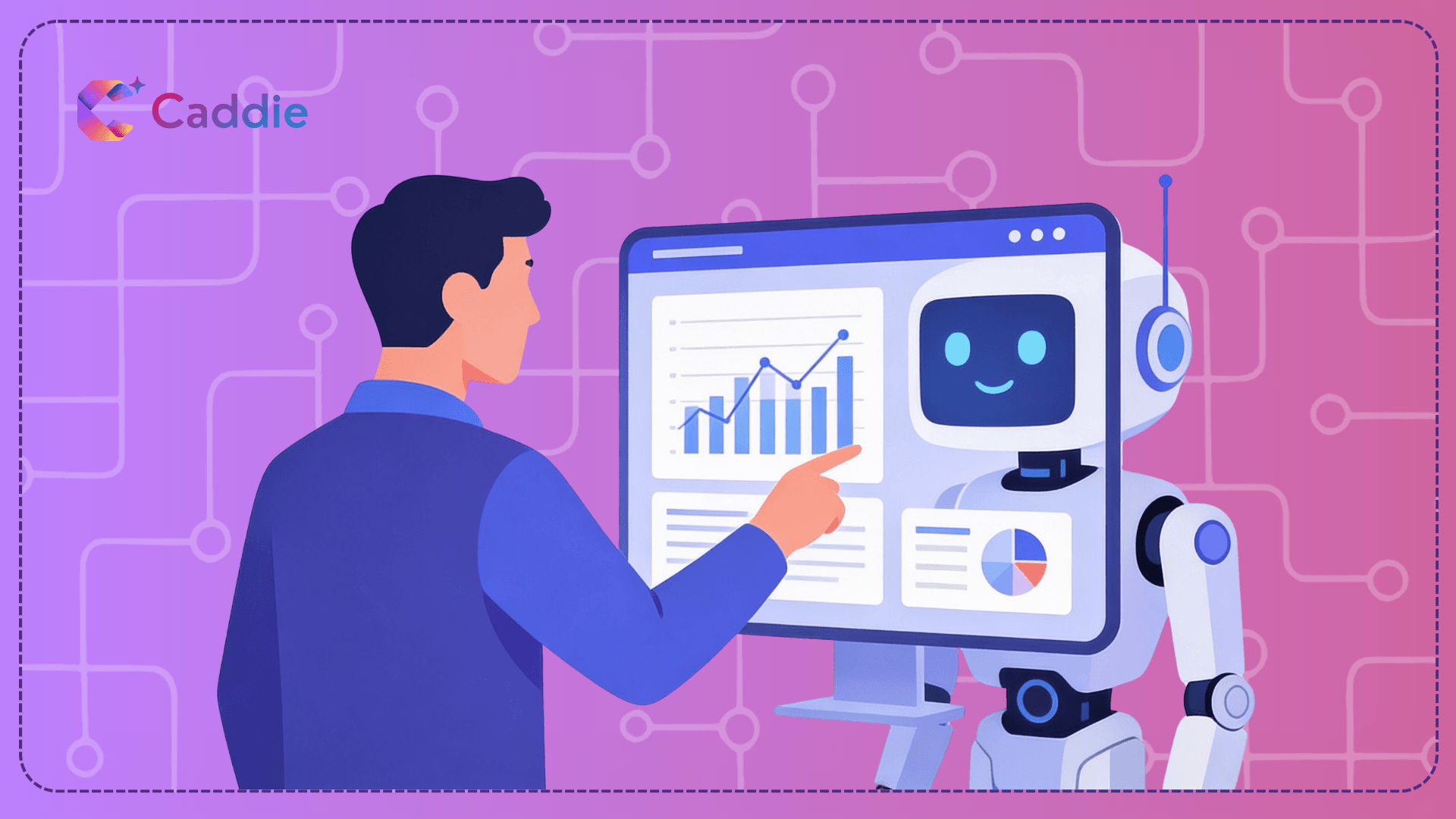
In simple words, conversational analytics is like having a super-smart AI chatbot on your computer or smartphone to analyze data and extract useful insights. Big companies use it in real-world, so their employees don’t have to be computer geniuses to understand their data. Anyone can just ask the AI a question in plain English, and it instantly builds a custom visual dashboard, giving them the exact answers they need to make smart business choices.
Imagine you manage a massive online retail company that ships thousands of orders a day. You have dozens of warehouses, and you need to know which products are selling fastest and in which regions. Normally, you’d have to download massive spreadsheets, filter through thousands of rows of numbers, and build your own charts to figure it out.
But what if you could just type a question into an AI chatbot, like: “Show me a chart of our top-selling wireless headphones in Europe this week.” The AI understands your question instantly and searches through all your sales data to create a colorful, easy-to-read dashboard. It might generate a bar graph showing that noise-canceling headphones are flying off the shelves!
So, what exactly do we mean by conversational analytics?
Conversational analytics is fundamentally changing how we interact with information. It moves us away from navigating complex software interfaces and toward having a dynamic, natural dialogue with our data. It allows non-technical users to ask questions in plain English (or any natural language) and receive instant, accurate, and visually supported answers grounded in their organization’s databases.
This guide explores what conversational analytics is, the technology powering it, and why it is rapidly becoming the cornerstone of AI-powered governance and enterprise strategy.
The Technology: Turning Complex Data Into Simple Answers
To understand why conversational analytics is so disruptive, we must look under the hood. Traditional analytics requires you to know how to navigate a BI tool or write Structured Query Language (SQL) to extract information from a database. Conversational analytics removes this barrier entirely by acting as an intelligent translator between human curiosity and machine data.
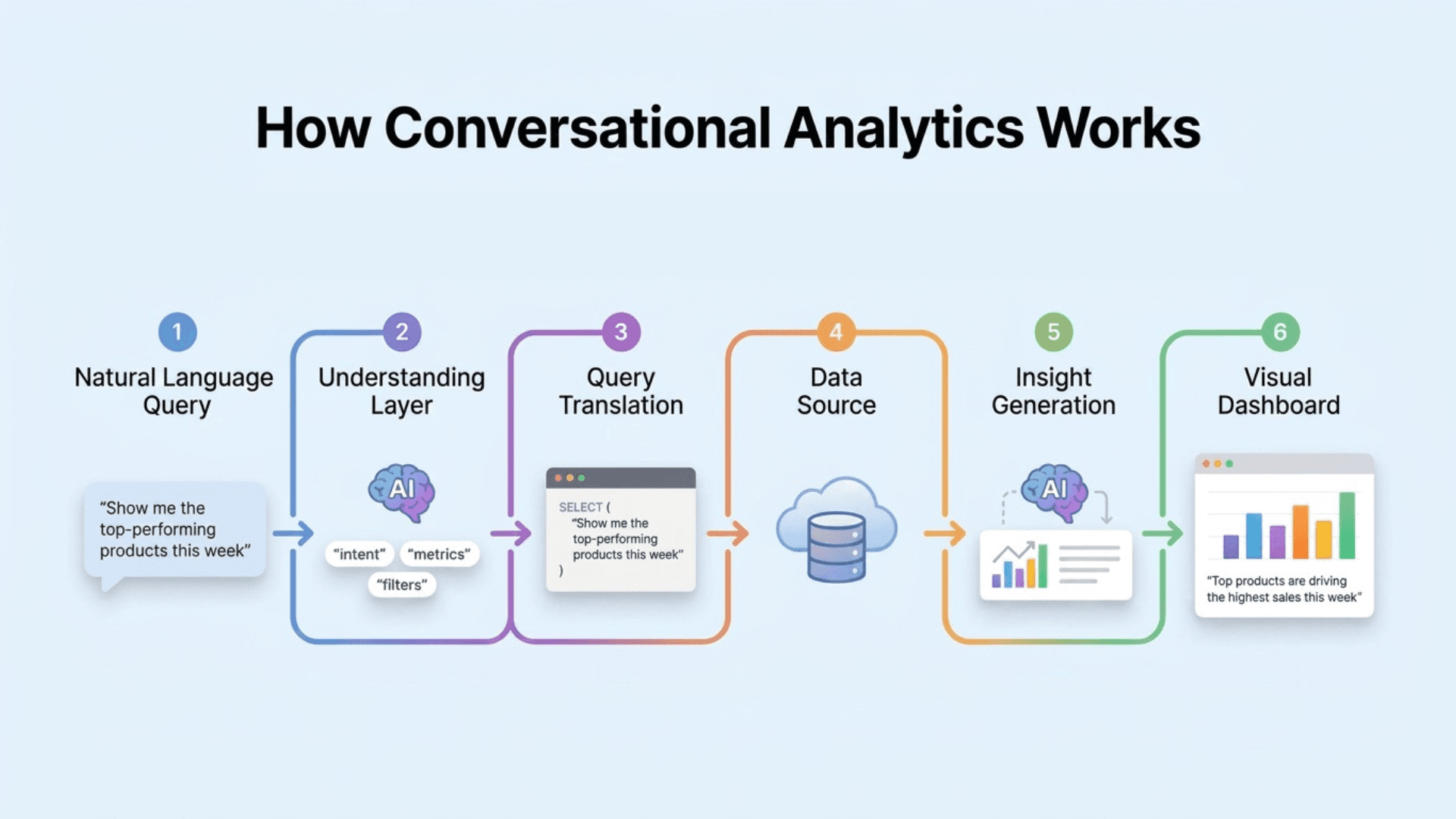
Bridging the Gap: How Natural Language Processing (NLP) Replaces SQL
At the core of conversational speech analytics is Natural Language Processing (NLP). When you type or speak a query like, "What were the top three performing product categories in Europe last month?," the NLP engine dissects the sentence. It identifies the intent (ranking), the metrics (sales performance), the dimensions (product categories), and the filters (Europe, last month). The system then autonomously translates this human intent into the complex SQL or API calls required to fetch the exact data from the underlying data warehouse.
Real-Time Processing: Moving from Static Reports to Dynamic Conversations
Unlike traditional reports that are generated in batches overnight or at the end of the month, conversational analytics operates in real time. Because the AI queries a live database the moment you ask a question, the insights reflect the absolute current state of the organization.
It supports follow-up questions. If the system answers the previous question about European sales, you can simply ask, "How does that compare to the same period last year?" The AI remembers the context of the conversation and instantly recalculates the data, creating a fluid, train-of-thought exploration process.
The AI Engine: Generating Actionable Recommendations Instantly
Fetching data is only half the battle; interpreting it is where true value lies. Modern conversational analytics platforms utilize generative AI to not only return numbers and charts but to provide written narratives explaining ‘why’ the numbers look the way they do. By analyzing historical trends and identifying statistical anomalies, the AI engine can offer actionable recommendations, effectively serving as an on-demand data analyst for every decision-maker in the organization.
Core Capabilities Of A Conversational Analytics Platform
While the underlying technology is complex, the user experience must be frictionless. A robust conversational analytics platform tailored for enterprise and governance typically features several core capabilities.
Plain-English Querying for Non-Technical Users
The most critical capability is the complete removal of the technical learning curve. As an executive, policymaker, or department head you don't need to understand data modeling, schema, or query languages. You simply need to know about your business. By typing questions as you would in a search engine or a chat window, it empowers you to independently explore data without relying on technical intermediaries.
Automated, On-the-go Visual Dashboard Generation
Human beings process visual information much faster than raw text or tables. When you ask a question, a conversational speech analytics platform doesn't just spit out a number; it determines the most effective way to visualize that answer. If you ask about a trend over time, the system generates a line chart. If you ask about geographical distribution, it spawns a heat map. These visual components are generated instantly and can be pinned to personal, dynamic dashboards that update automatically.
Proactive Insights: Moving Beyond "What Happened" to "What's Next"
Traditional BI is descriptive. It tells you what happened in the past. Conversational analytics brings predictive modeling to the table. The system can proactively alert you about emerging trends or anomalies before you even ask. For example, the platform might proactively notify a logistics director: "Shipping times in the Southeast region have increased by 15% over the past 48 hours, which historically correlates with a drop in customer satisfaction. Would you like to view alternative routing options?"
Enterprise-Grade Security and Data Governance
Security is paramount when opening up vast amounts of enterprise or government data to natural language querying. Conversational analytics platforms are built with rigorous, role-based access controls (RBAC). The AI only "sees" and answers questions based on the data the specific user is authorized to access. Furthermore, these platforms provide complete audit trails, ensuring that every query and data interaction is logged for compliance and governance purposes.
How Big Organizations Can Benefit From Conversational Analytics
Implementing conversational analytics is not merely an IT upgrade. It is a strategic transformation that fundamentally alters how an organization operates.
Accelerating Executive and Policy-Level Decisions
In both the boardroom and the cabinet room, speed is a massive competitive advantage. When leaders are forced to wait weeks for data reports, they often rely on intuition or outdated information to make critical calls. Conversational analytics provides the answers needed during the actual meeting. This real-time validation allows for immediate, confident, and data-backed decision-making.
Breaking Down Data Silos Across Departments
Large organizations suffer from fragmented data. Marketing uses one platform, finance uses another, and operations rely on a third. Conversational analytics platforms integrate with unified data warehouses, acting as a single pane of glass. A CEO can ask a question that requires joining data from marketing spend, sales revenue, and supply chain costs, and the AI handles the complex cross-departmental data synthesis instantly.
Enhancing Transparency in Public Sector and Corporate Governance
For government bodies and publicly traded companies, transparency and accountability are legally and ethically required. Conversational analytics allows auditors, oversight committees, and stakeholders to interrogate data directly. Instead of being handed a curated, potentially biased report, stakeholders can ask their own questions and verify the data for themselves, fostering a culture of transparency.
Eliminating the Wait Time for IT and Data Science Teams
Data scientists are some of the most expensive and highly trained professionals in an organization. Yet, they spend an exorbitant amount of time pulling basic reports and tweaking dashboard filters for business users. By democratizing data access through conversational AI, organizations can free up their data engineering and data science teams to focus on what they do best: building complex predictive models, optimizing data architecture, and driving genuine innovation.
How Conversational Analytics Works In The Real World
The versatility of conversational analytics means it can be applied to solve complex problems across virtually any large-scale operational environment.
Governments & Public Sector
Public administrators manage massive, complex datasets ranging from census information and tax revenues to public health statistics and infrastructure spending. Conversational speech analytics enables a city planner to ask, "Show me the correlation between public transit investment and local business growth in District 4 over the last five years." Policymakers can track the real-time impact of public initiatives, optimize the allocation of emergency resources, and provide transparent data access to the public.
Enterprises and Corporations
In the private sector, conversational analytics drives revenue and operational efficiency. A Chief Revenue Officer can ask, "Which product lines are underperforming their Q3 targets, and what is the primary cause?" A supply chain manager can inquire, "What is the immediate financial impact of switching our raw material supplier from Vendor A to Vendor B?" By making these insights instantly accessible, enterprises can pivot strategies swiftly in response to market volatility.
Large-Scale Organizations and NGOs
Global organizations and non-profits often operate across dozens of countries, dealing with multiple currencies, languages, and reporting standards. Conversational analytics helps unify these disparate metrics into a single, reliable narrative. Program directors can easily query global impact metrics, ensuring that donor funds are being utilized efficiently and effectively across varied geographical regions.
How to Prepare Your Organization
Transitioning to a conversational analytics model requires thoughtful preparation. While the AI handles the heavy lifting, the system is only as good as the foundation it is built upon.
Assess Your Current Data Readiness and Infrastructure
AI cannot make sense of chaotic, unstructured, or deeply siloed data. Before implementing a conversational interface, you must ensure that your organization's data is relatively clean and centralized. Migrating disparate databases into a modern cloud data warehouse (such as Snowflake, Google BigQuery, or Amazon Redshift) is often the necessary first step. The data must be structured and labeled in a way that an AI model can map accurately.
What to Look for in an AI Analytics Platform
Not all conversational AI tools are created equal. When evaluating platforms, you must prioritize accuracy and "hallucination" safeguards. In enterprise analytics, an AI making up an answer is unacceptable. The platform must be strictly constrained to your organization's verified data. Additionally, look for platforms that offer seamless integration with your existing tech stack, robust security protocols, and scalable architecture.
Fostering a Data-Empowered Culture at the Executive Level
Technology is only half the equation, adoption is the other. Many executives are accustomed to receiving highly polished, curated reports from their teams. Transitioning to a model where they interact directly with an AI requires a cultural shift. Your organization must provide training not just on how to use the tool, but on how to ask the ‘right’ questions. Cultivating a culture that trusts AI-driven insights, while still applying human critical thinking, is essential for long-term success.
What are the challenges of Conversational Analytics
Keeping the context
Conversations with AI chatbots should add value to your workflow. A conversational analytics platform that is inefficient at grasping and maintaining the context can quickly turn into a thorn on the side.
Natural language is ambiguous
It’s always important to get things right when dealing with the nuances of natural language. Because you may not want to sound like a command center when typing out their queries. Natural language can be ambiguous and include unusual grammar, which can make the AI chatbot’s and its underlying algorithm’s job more difficult.
The quality of data
A conversational analytics platform is as good as the data it feeds from. Basing the AI chatbot on poor-quality, less accurate data plagued with unclear information can influence results in a negative way.
Scalability
It’s important to have a system capable of handling large amounts of conversations in real-time as more users come onboard. It’s underlying algorithm and the backend infrastructure should be robust enough to deliver quality experience.
Conclusion
We are witnessing the phase out of the static dashboard era. The future of analytics is conversational, dynamic, and intuitive. By bridging the gap between complex databases and natural human language, conversational analytics empowers leaders to interact with their organization's data as easily as they would converse with a trusted advisor.
For governments, enterprises, and large-scale organizations, this technology is no longer a futuristic luxury; it is a strategic necessity. It accelerates decision-making, democratizes information, and ultimately transforms raw data into an organization's most valuable asset.