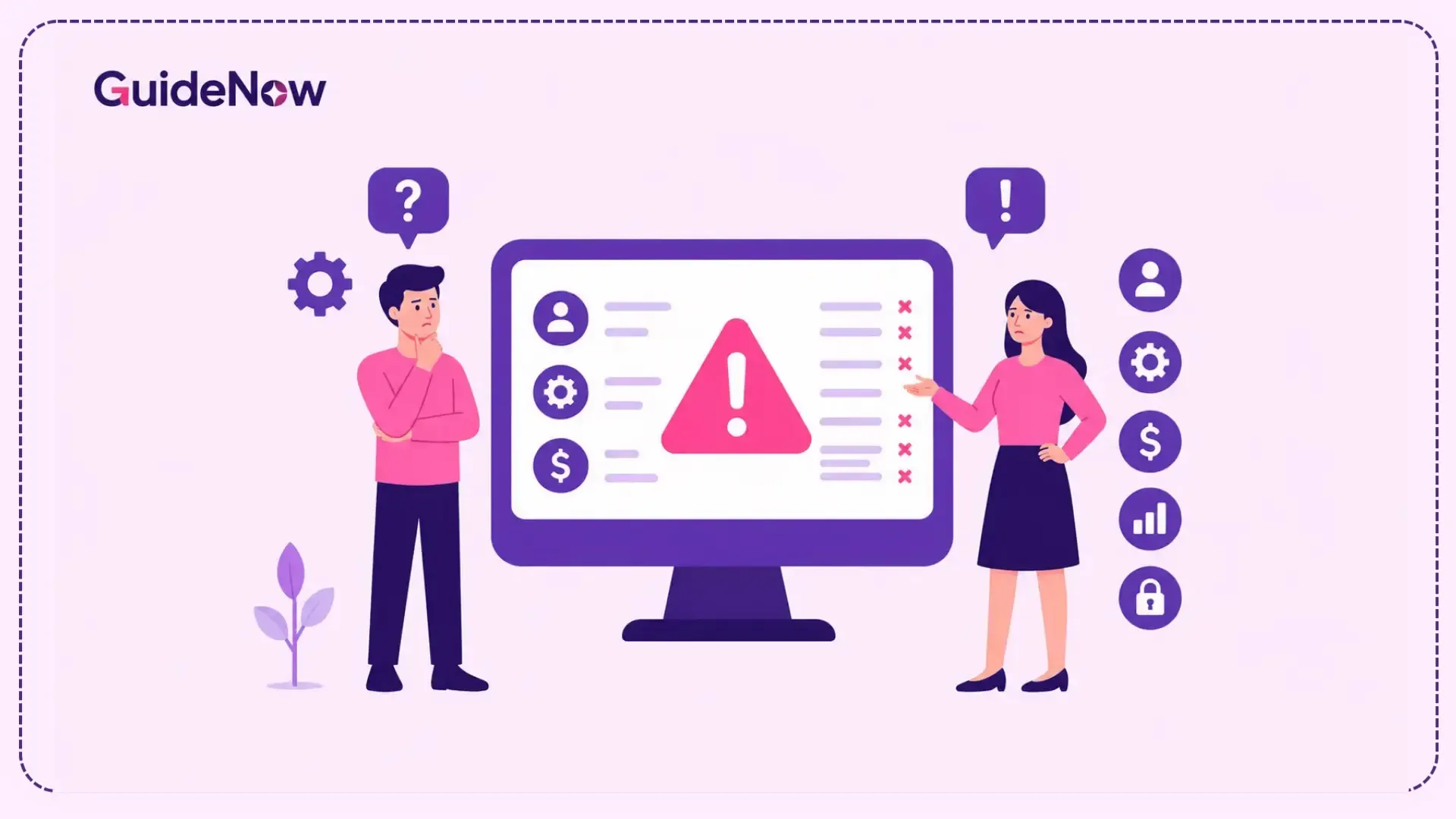
Digital Employee Experience (DEX) refers to the overall experience employees have when interacting with workplace technology, including enterprise applications, collaboration platforms, business systems, devices, and digital support tools. It measures how effectively these technologies enable employees to complete their work with minimal friction, helping improve productivity, engagement, and technology adoption.
Despite significant investments in digital transformation, many organizations continue to struggle with digital adoption, resulting in disconnected workflows and rising employee frustration.Many organizations face common software adoption challenges that prevent employees from fully embracing enterprise applications.Ask any CIO or Chief People Officer about their biggest operational challenges today, and they'll often describe the same issue: technology stacks keep expanding, yet employee productivity doesn't improve at the same pace. That gap has a name—and it's not simply a software problem. It's a digital employee experience problem.
The digital employee experience goes beyond the quality of individual tools. It encompasses how intuitive workplace applications are, how reliably they perform, how seamlessly they integrate with one another, and how much effort employees must invest to complete everyday tasks. A positive DEX empowers employees to work efficiently and confidently, while a poor digital experience creates unnecessary friction, reduces productivity, and limits the return on technology investments.
Defining Digital Employee Experience: More Than "Good Tech"
Digital employee experience encompasses the quality of an employee's interaction with every piece of workplace technology — from the device they turn on each morning to the enterprise applications they navigate throughout the day, the collaboration tools they use to connect with colleagues, and the self-service portals they depend on for HR, IT, and operational tasks.
It's a deceptively broad concept because it lives at the intersection of three disciplines that don't always talk to each other: IT (which manages the infrastructure), HR (which owns the employee lifecycle), and L&D (which is responsible for helping people actually become competent in the tools they're given). When these functions operate in silos, digital employee experience suffers — and employees feel it long before any dashboard reflects it.
A useful working definition: DEX is the degree to which workplace technology enables employees to do their best work without creating unnecessary friction, confusion, or frustration. By that measure, a technically sophisticated tool stack that employees find impenetrable scores poorly on DEX — and a modest tool stack that's well-designed, well-supported, and clearly explained can score very well.
The Core Components of Digital Employee Experience
Understanding what digital employee experience actually consists of is essential before any improvement effort can be meaningful. It has five distinct layers:
Device and infrastructure performance. Slow devices, unreliable networks, and fragmented identity management are the invisible tax on every knowledge worker's day. Even brilliant software fails when the foundation is unstable.
Application usability and adoption. How intuitive is each enterprise application? How well do employees actually know how to use the features they need? Unused functionality in a licensed tool is a direct financial loss — and a DEX failure. Understanding why enterprise software features go unused helps organizations identify adoption gaps before they impact productivity.
Workflow integration and tool connectivity. When applications don't share data smoothly, employees fill the gaps manually — copying between systems, maintaining parallel spreadsheets, sending information via email that should flow automatically. This is a major source of digital friction employee experience data captures.
Self-service capability. Can employees get IT support, HR answers, and operational approvals without waiting in queues or escalating tickets? Self-service capability directly affects both autonomy and time-to-resolution.
Learning and support at the point of work. When employees encounter something they don't know how to do inside an application, can they get the answer without leaving their workflow? Modern in-app guidance software provides contextual assistance exactly when users need it, reducing confusion and improving task completion. The accessibility of contextual help is often the difference between confident competency and persistent avoidance of critical features.
DEX Components at a Glance
| DEX Component | What It Covers | Primary Owner |
| Device & Infrastructure | Hardware, network, identity management | IT Operations |
| Application Usability | UX quality, feature adoption, proficiency | IT / L&D |
| Workflow Integration | Data flow between systems, automation | Enterprise Architecture |
| Self-Service Capability | IT helpdesk, HR portals, approvals | IT / HR |
| Point-of-Work Support | In-app guidance, contextual help, walkthroughs | L&D / Digital Adoption |
The Hidden Productivity Killer: Digital Friction
If DEX is the destination, digital friction is the obstacle. Learning how AI detects user friction enables organizations to proactively resolve usability issues before they affect employee productivity. Digital friction refers to any point in an employee's workday where technology slows them down, confuses them, or requires effort disproportionate to the value of the task. It's the spinning loading cursor, the six-click process that should take two, the enterprise application that behaves differently depending on which browser you use, the onboarding workflow that nobody fully understands three months after go-live.
Friction is insidious precisely because it's often invisible to the people who buy and manage technology. Administrators see dashboards, uptime metrics, and license utilization — they don't see the 90 seconds an employee wastes every time they try to run a specific report because nobody trained them on the shortcut. Multiply that by thousands of employees and hundreds of interactions per day, and you have a digital workplace employee productivity problem with a multi-million-dollar footprint that no single metric is capturing.
Identifying and reducing digital friction is one of the highest-leverage activities an enterprise can pursue — and it requires both behavioral analytics (where do users drop off or abandon tasks?) and qualitative feedback (what do employees actually say about their tool experience?) working together.
How Digital Employee Experience Differs from Employee Experience (EX)
These terms are sometimes used interchangeably, but the distinction matters strategically. Employee experience (EX) is the broader construct — it encompasses everything an employee feels and perceives across their entire tenure: culture, management quality, physical environment, compensation, growth opportunities, belonging.
Digital employee experience is the technology-specific subset of EX. It's not about whether employees feel valued or whether their manager gives good feedback — it's specifically about whether the digital environment they work in enables or frustrates their ability to do their jobs well.
The two are not independent. Research consistently shows that poor DEX is a significant driver of negative overall employee experience — particularly for knowledge workers whose entire output depends on digital tools. An employee who struggles with technology every day will report lower engagement, lower satisfaction, and higher intent to leave — even if other dimensions of their experience are positive. DEX is not the whole EX story, but for modern enterprises, it's an increasingly large chapter of it.
Improving Digital Employee Experience: Where to Actually Start
Improving digital employee experience is not primarily a procurement problem. Most enterprises don't have a DEX gap because they're missing a tool — they have a gap because existing tools are underused, poorly integrated, or inadequately supported. The improvement journey typically runs through five stages:
Measure before you fix. Digital experience analytics — application performance monitoring, adoption analytics, support ticket analysis, and structured employee feedback — give you a data-grounded picture of where friction lives. Without measurement, improvement efforts are guesswork.
Rationalize the stack. Tool proliferation is both a symptom and a cause of poor DEX. When employees have four overlapping tools for the same function, they don't know which to use, and none of them gets used well. Deliberate stack rationalization — fewer, better-integrated tools — often improves DEX without any new investment.
Close the adoption gap. Licensing a powerful enterprise application and expecting employees to self-discover its value is a failed strategy. Digital adoption platforms — which deliver in-application, step-by-step guidance at the moment employees need it — are one of the most direct mechanisms for closing the gap between tool availability and tool competency.
Redesign support for self-service. IT helpdesk queues are often a symptom of DEX failure. When employees can't answer a question or complete a process independently, they generate tickets. Redesigning support as a self-service layer embedded in workflows reduces both ticket volume and employee frustration simultaneously.
Establish a continuous feedback loop. DEX is not a project with an end date — it's an ongoing operational discipline. Regular pulse surveys, behavioral analytics reviews, and cross-functional DEX governance (IT + HR + L&D together) are what separate organizations with improving DEX from those that are perpetually reacting.
What Digital Employee Experience Tools Actually Do
The market for digital employee experience tools has expanded rapidly, and the category now includes several distinct types of technology that address different dimensions of DEX. Organizations evaluating employee enablement solutions often compare DAP vs LMS to understand which approach better supports enterprise software training and adoption:
| Tool Category | DEX Function | Example Use Case |
| Digital Adoption Platforms (DAP) | In-app guidance, walkthroughs, onboarding flows | Guide employees through a new ERP module step-by-step |
| Employee Experience Platforms | Unified intranet, communication, HR self-service | Single destination for announcements, policies, HR tasks |
| Digital Experience Monitoring (DEM) | Device & app performance analytics, endpoint visibility | Identify which applications cause the most latency complaints |
| IT Service Management (ITSM) | Ticket management, self-service IT support | Reduce helpdesk load via automated resolution flows |
| Collaboration Suites | Messaging, video, document co-authoring | Connect distributed teams without app-switching overhead |
No single platform covers all five DEX components described earlier. An employee digital experience platform — often positioned as a unified intranet or digital hub — can consolidate communication and self-service, but it doesn't replace the need for adoption support within individual enterprise applications or performance monitoring at the endpoint level.
A mature DEX strategy maps tool investments to specific friction points rather than purchasing category leaders and hoping they integrate. Organizations like GuideNow, which focus specifically on in-application adoption and guided onboarding, address a precise layer of the DEX stack — not the whole picture, but one of its most direct performance levers.
Building a DEX Strategy That Actually Connects to Business Outcomes
The reason many DEX strategy enterprise initiatives fail to gain traction is that they're framed as IT projects rather than business outcome initiatives. A DEX strategy that resonates at the leadership level connects technology investment to metrics that CFOs and COOs already care about:
Time-to-productivity for new hires (weeks to first independent task completion in core systems)
Effective employee software onboarding helps new hires become productive faster while improving confidence in enterprise applications.
Support ticket volume per employee (a direct measure of workflow friction)
Software license utilization (what percentage of a paid tool's features employees actually use)
Employee retention in technology-intensive roles (DEX quality correlates with quit rates in developer, analyst, and ops roles)
Process cycle times (how long does a procurement approval, expense submission, or customer case resolution actually take?)
These metrics transform DEX from an intangible experience concept into a set of operational numbers with clear improvement pathways. Tracking enterprise software adoption metrics enables organizations to measure software usage, engagement, and long-term adoption success. When the digital employee experience conversation moves from "our employees find the tools frustrating" to "our average time-to-productivity for ERP users is 11 weeks and we believe we can cut it to 6," investment decisions become tractable.
Conclusion: DEX Is Not a Perk — It's Infrastructure
Digital employee experience is the operating environment of modern work. Every hour your employees spend navigating broken workflows, relearning forgotten processes, waiting for IT support, or avoiding features they were never properly trained on is an hour of productivity that your technology investment was supposed to unlock — but didn't.
The organizations building durable advantages right now are the ones treating digital employee experience as foundational infrastructure — not an HR initiative, not a one-time onboarding project, not an IT ticket backlog to be managed. They're measuring it, funding it deliberately, and governing it across the IT, HR, and L&D functions together.
The question is no longer whether digital employee experience matters. Every piece of evidence — from productivity research to retention data to technology ROI analysis — says it does. The question is whether your organization is measuring it specifically enough to improve it systematically.
That specificity is where the real work starts.
Frequently Asked Questions(FAQ's):
1. What are the biggest challenges organizations face when improving digital employee experience?
The most common challenges include disconnected enterprise systems, low software adoption, inadequate employee training, fragmented support processes, poor workflow integration, and the absence of continuous user feedback. Addressing these issues requires collaboration between IT, HR, and business teams.
2. How can organizations identify technology friction before it impacts productivity?
Technology friction can be identified by analyzing application usage patterns, monitoring support tickets, collecting employee feedback, and tracking workflow completion rates. Combining these insights helps teams detect recurring issues early and improve everyday work experiences before productivity declines.
3. What should leaders evaluate before investing in employee enablement solutions?
Decision-makers should assess ease of deployment, compatibility with existing business applications, analytics capabilities, self-service functionality, scalability, security, and the ability to provide real-time assistance without disrupting employee workflows.
4. What should enterprises prioritize when building a digital employee experience strategy?
A successful DEX strategy should prioritize understanding employee workflows, simplifying technology ecosystems, improving software adoption, embedding contextual learning, automating repetitive processes, measuring user experience continuously, and aligning technology investments with business objectives.
5. How does workflow simplification contribute to operational efficiency?
Simplified workflows reduce unnecessary approvals, eliminate repetitive manual steps, minimize errors, and shorten task completion times. This allows employees to focus on higher-value work while improving overall business performance.