Employee turnover remains one of the most expensive challenges organizations face. While companies invest heavily in recruitment, technology, and workplace culture, many overlook a critical factor that directly influences retention: onboarding.
The latest Employee Onboarding Statistics show that the first few weeks and months of employment often determine whether a new hire becomes a long-term contributor or starts looking for another opportunity. Organizations that create structured onboarding journeys consistently report stronger retention, faster productivity, higher engagement, and better business outcomes.
As workplaces become increasingly digital, distributed, and AI-enabled, onboarding is evolving beyond orientation sessions and paperwork. Today's organizations are investing in personalized learning, contextual guidance, digital workflows, and continuous enablement to help employees succeed from day one.
This article explores the most important onboarding trends, research findings, and workforce insights shaping employee retention in 2026.
Why Employee Onboarding Matters More Than Ever in 2026
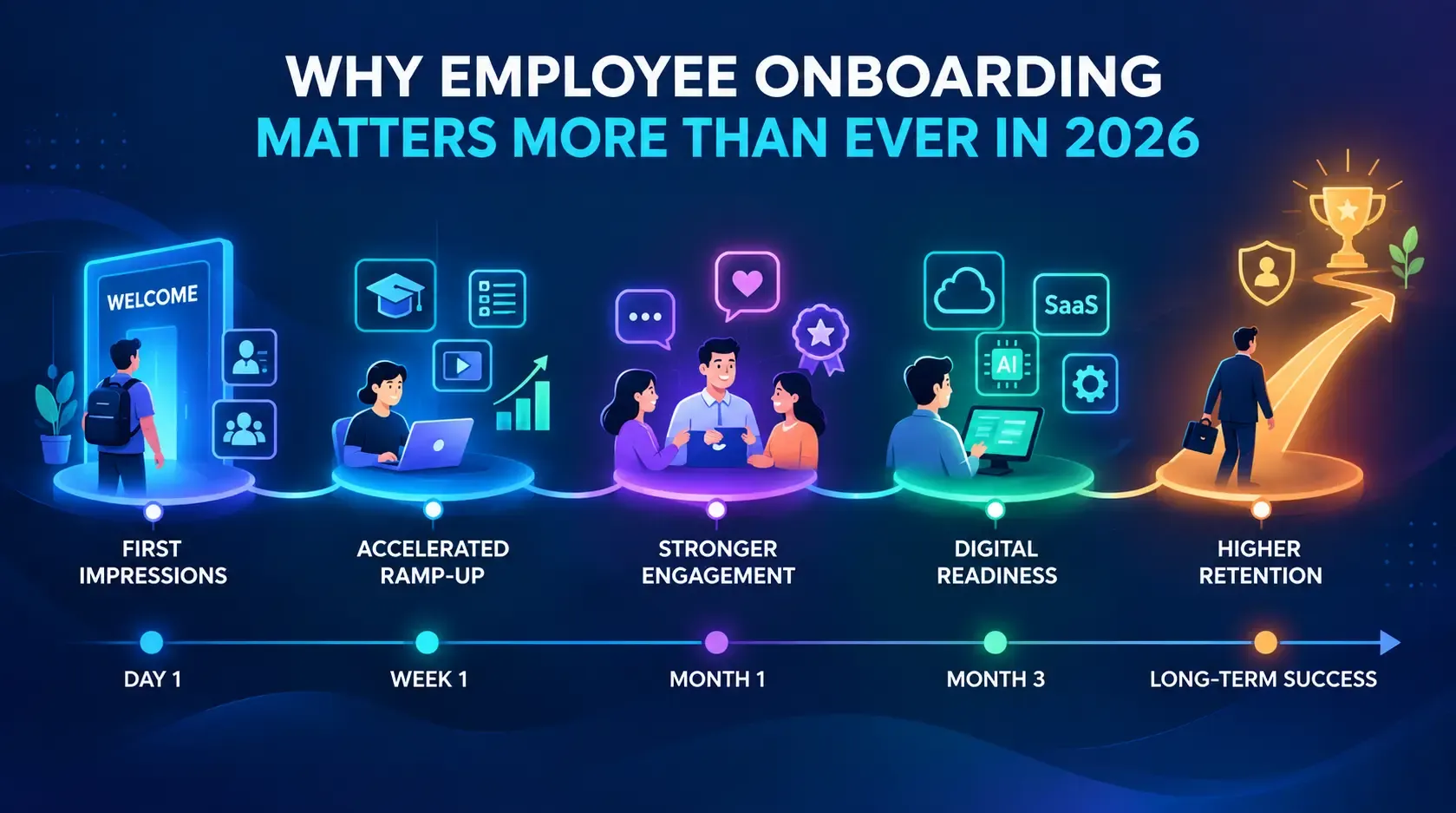
Organizations today operate in an environment characterized by hybrid work, AI-powered workflows, talent shortages, and rapidly changing technology stacks.
The challenge is no longer simply hiring talent. The challenge is helping employees become productive, engaged, and committed to the organization as quickly as possible.
An effective Employee Onboarding Process influences:
- Early productivity
- Employee confidence
- Role clarity
- Team integration
- Technology adoption
- Organizational commitment
- Long-term retention
Research consistently shows that employees who experience structured onboarding are more likely to remain with their employer and achieve performance milestones faster than employees who receive minimal onboarding support.
Key Employee Onboarding Statistics at a Glance
Here are some of the most important findings organizations should understand in 2026:
Area | Key Finding | Business Impact |
| Retention | Strong onboarding significantly improves first-year retention | Reduced replacement costs |
| Productivity | Structured onboarding accelerates time-to-productivity | Faster ROI from hiring |
| Engagement | Employees receiving clear onboarding report higher engagement levels | Better performance outcomes |
| Satisfaction | Positive onboarding experiences improve workplace satisfaction | Stronger employer brand |
| Technology Adoption | Guided learning improves software proficiency | Higher digital adoption rates |
| Remote Work | Digital-first onboarding reduces friction for distributed teams | Improved consistency |
| Manager Involvement | Active manager participation improves onboarding success | Better employee support |
| Learning Experience | Continuous learning outperforms one-time orientation programs | Long-term capability growth |
The Retention Crisis Is Driving New Employee Onboarding Investments
Retention is becoming a boardroom-level priority.
Replacing employees involves recruiting costs, lost productivity, training expenses, and institutional knowledge loss. As a result, organizations are increasingly viewing onboarding as a strategic retention initiative rather than an HR administrative process.
Recent workforce research suggests employees often decide whether they see a long-term future with an employer within the first several months of employment.
This means onboarding directly influences:
- Employee confidence
- Cultural alignment
- Performance expectations
- Relationship building
- Career development perception
Organizations that fail to create these connections early often experience higher turnover during the first year.
Employee Retention Statistics Show the Cost of Poor Onboarding
Many organizations still underestimate how onboarding affects workforce stability.
When employees experience:
- Unclear expectations
- Insufficient training
- Technology confusion
- Limited manager support
- Weak social integration
they are significantly more likely to disengage.
These Employee Retention Statistics reinforce a simple reality: retention starts long before annual reviews or career progression conversations.
It starts with the first experience employees have inside the organization.
Digital Transformation Is Reshaping Employee Onboarding
The rise of enterprise software, AI tools, and hybrid work environments has transformed onboarding.
Traditional approaches centered around classroom training, documentation, and presentations are increasingly being replaced by digital experiences that support employees in real workflows.
Modern onboarding now includes:
- Personalized learning paths
- Interactive training
- AI-powered assistance
- Contextual guidance
- Workflow-based learning
- Real-time support
This shift aligns with broader digital adoption initiatives across enterprises. Organizations increasingly recognize that employees learn more effectively when guidance is delivered within the tools they use every day rather than through separate training systems.
Technology Adoption Is Becoming an Onboarding KPI
Many organizations focus onboarding metrics exclusively on HR outcomes.
However, successful employers increasingly track:
- Software proficiency
- Workflow completion
- Feature usage
- Process accuracy
- Digital confidence
This reflects the growing importance of the technology adoption curve in workforce enablement.
Employees today must learn multiple systems simultaneously, including HR platforms, collaboration tools, CRM systems, project management software, and AI assistants.
Organizations that accelerate technology adoption during onboarding often see faster productivity gains and stronger employee confidence.
Employee Software Onboarding Is Now a Competitive Advantage
As workplace technology stacks expand, Employee Software Onboarding has become a major focus area.
Employees frequently interact with:
- ERP systems
- CRM platforms
- HR tools
- Collaboration platforms
- Analytics solutions
- AI copilots
Without structured onboarding, software complexity can create frustration and delay productivity.
Companies are increasingly using contextual learning approaches to help employees understand systems while completing actual work tasks rather than relying solely on traditional training methods.
High-Impact Onboarding Approaches Compared
| Onboarding Model | Employee Experience | Time to Productivity | Retention Impact | Scalability |
| Traditional Orientation | Low personalization | Moderate | Moderate | High |
| Classroom Training | Knowledge-heavy | Slow | Moderate | Medium |
| Documentation-Based Learning | Self-directed | Slow | Low | High |
| Digital Learning Programs | Personalized | Faster | High | High |
| Contextual In-App Guidance | Workflow-based | Fastest | Very High | Very High |
Organizations increasingly move toward workflow-based onboarding because employees learn best when training occurs in the context of real work rather than theoretical instruction.
Remote Onboarding Requires Different Success Metrics
The growth of distributed work has permanently changed onboarding expectations.
Effective Remote Onboarding now requires organizations to measure:
- Digital engagement
- Communication effectiveness
- Collaboration readiness
- Knowledge accessibility
- Team integration
Remote employees often face unique challenges, including isolation, unclear processes, and technology barriers.
Organizations that proactively address these challenges report stronger retention and faster employee ramp-up times.
Employee Experience Begins Before Day One
Leading employers increasingly recognize that onboarding starts before an employee's official first day.
A strong Employee Experience includes:
- Preboarding communication
- Equipment readiness
- Role clarity
- Team introductions
- Learning preparation
Early engagement reduces anxiety and helps new hires arrive with greater confidence and preparedness.
Employee Engagement Trends Are Reshaping Onboarding Design
Modern onboarding programs increasingly prioritize Employee Engagement rather than information delivery.
Instead of overwhelming employees with policies and presentations, organizations focus on:
- Interactive learning
- Manager conversations
- Collaborative activities
- Personalized experiences
- Early wins
Engaged employees are more likely to build relationships, adopt processes, and remain committed to the organization.
Employee Orientation Is Becoming More Personalized
Traditional Employee Orientation programs often deliver identical experiences to every employee.
In 2026, organizations increasingly customize onboarding based on:
- Department
- Role
- Seniority
- Location
- Learning preferences
Personalized onboarding improves relevance and helps employees focus on information that directly supports their responsibilities.
HR Onboarding Is Expanding Beyond Compliance
Historically, HR Onboarding focused primarily on administrative tasks such as paperwork, benefits enrollment, and policy reviews.
Modern HR teams are now expected to influence:
- Workforce readiness
- Employee productivity
- Retention outcomes
- Cultural integration
- Career development
This broader responsibility is reshaping how organizations measure onboarding success.
Digital Onboarding Is Becoming the Default Model
As enterprises continue investing in workplace technology, Digital Onboarding is becoming the standard approach.
Benefits include:
- Consistent experiences
- Faster deployment
- Improved scalability
- Better measurement
- Personalized learning journeys
Digital onboarding also enables organizations to support global teams more effectively while maintaining consistency across locations.
Employee Turnover Statistics Continue to Highlight Early Attrition Risks
Many Employee Turnover Statistics point to a common pattern: employees are most vulnerable to leaving during their first year.
Common reasons include:
- Poor onboarding
- Lack of support
- Limited growth opportunities
- Technology frustration
- Weak manager relationships
Organizations that address these challenges during onboarding often reduce voluntary turnover significantly.
Two Research Findings Every HR Leader Should Know
According to Gartner research, only 48% of digital initiatives meet or exceed their intended business outcomes, highlighting the importance of workforce adoption and enablement when introducing new technologies.
McKinsey research has also identified a significant readiness gap between employee willingness to embrace new technologies and organizational preparedness to support adoption effectively, emphasizing the need for structured learning and onboarding strategies.
Together, these findings reinforce a critical lesson: successful onboarding is increasingly tied to successful technology adoption.
SaaS Onboarding Best Practices Are Influencing Employee Enablement
Interestingly, many organizations are applying SaaS onboarding best practices to employee onboarding.
Examples include:
- Milestone-based journeys
- Guided workflows
- Progressive learning
- Personalized experiences
- Behavioral insights
Rather than overwhelming employees with information upfront, organizations introduce knowledge incrementally based on actual needs and workflows.
Product Tours Are Moving Beyond Customer Onboarding
Many organizations now use product tours internally to help employees learn enterprise applications.
Benefits include:
- Faster software proficiency
- Reduced support requests
- Better workflow understanding
- Increased confidence
Interactive guidance helps employees learn by doing, which often produces stronger outcomes than passive learning methods.
Employee Satisfaction Is Strongly Linked to Early Experiences
Research consistently shows that Employee Satisfaction is influenced heavily by first impressions.
Employees who receive:
- Clear expectations
- Adequate support
- Effective training
- Meaningful feedback
- Strong manager relationships
are more likely to report positive workplace experiences and remain committed to the organization.
Employee Onboarding Best Practices for 2026
Organizations seeing the strongest retention outcomes typically follow several Employee Onboarding Best Practices:
- Start onboarding before day one.
- Define clear success milestones.
- Personalize learning experiences.
- Integrate technology training into workflows.
- Encourage manager participation.
- Measure onboarding outcomes continuously.
- Provide ongoing support beyond orientation.
- Connect onboarding to long-term career growth.
These practices help transform onboarding from a short-term event into a strategic retention program.
The Future of Employee Onboarding Software
The next generation of Employee Software Onboarding is expected to focus on:
- AI-driven personalization
- Predictive analytics
- Contextual learning
- Workflow intelligence
- Real-time assistance
Solutions that combine learning, guidance, and adoption measurement will likely play an increasingly important role in workforce enablement.
Platforms supporting digital adoption initiatives—including solutions such as GuideNow in broader enterprise software environments—reflect the growing demand for contextual, workflow-based learning experiences rather than traditional training alone.
Conclusion
The latest Employee Onboarding Statistics reveal a clear trend: onboarding is no longer just an HR process. It is a strategic business function that directly influences retention, productivity, engagement, technology adoption, and employee satisfaction.
As organizations continue navigating AI transformation, digital workplaces, and evolving workforce expectations, onboarding will become even more important. Companies that invest in personalized learning, technology enablement, and employee-centered experiences will be better positioned to reduce turnover and build high-performing teams.
The organizations that win in 2026 will not simply hire great talent—they will help that talent succeed from the very first day.
Frequently Asked Questions
1. Why are Employee Onboarding Statistics important for HR leaders?
Employee Onboarding Statistics help HR leaders understand how onboarding affects retention, productivity, engagement, and workforce performance. These insights support data-driven improvements to onboarding programs.
2. How does onboarding impact employee retention?
Effective onboarding improves role clarity, confidence, workplace relationships, and organizational commitment, all of which contribute to stronger retention outcomes and lower turnover.
3. What is the difference between onboarding and orientation?
Orientation is typically a short-term introduction to company policies and procedures, while onboarding is a longer process focused on helping employees become productive and integrated into the organization.
4. What role does technology play in modern onboarding?
Technology enables personalized learning, workflow guidance, digital training, progress tracking, and real-time support, helping employees learn more efficiently and confidently.
5. What are the most important onboarding metrics to track in 2026?
Organizations should monitor retention, time-to-productivity, engagement levels, training completion, software proficiency, manager participation, and employee satisfaction to evaluate onboarding effectiveness.+