Employee productivity remains one of the most closely watched indicators of business performance. Yet despite significant investments in workplace technology, collaboration platforms, employee experience programs, and digital transformation initiatives, many organizations still struggle to identify where productivity gains are being lost.
Understanding the latest Employee Productivity Statistics helps business leaders move beyond assumptions and uncover measurable workplace efficiency gaps. Whether organizations are evaluating workforce performance, technology adoption, employee engagement, hybrid work policies, or operational processes, data provides a clearer picture of what's driving outcomes.
This article compiles 60 of the most relevant productivity facts and trends shaping modern workplaces. The goal is not simply to present numbers but to highlight what they reveal about workforce effectiveness, adoption challenges, and opportunities for improvement.
Why Employee Productivity Data Matters More Than Ever
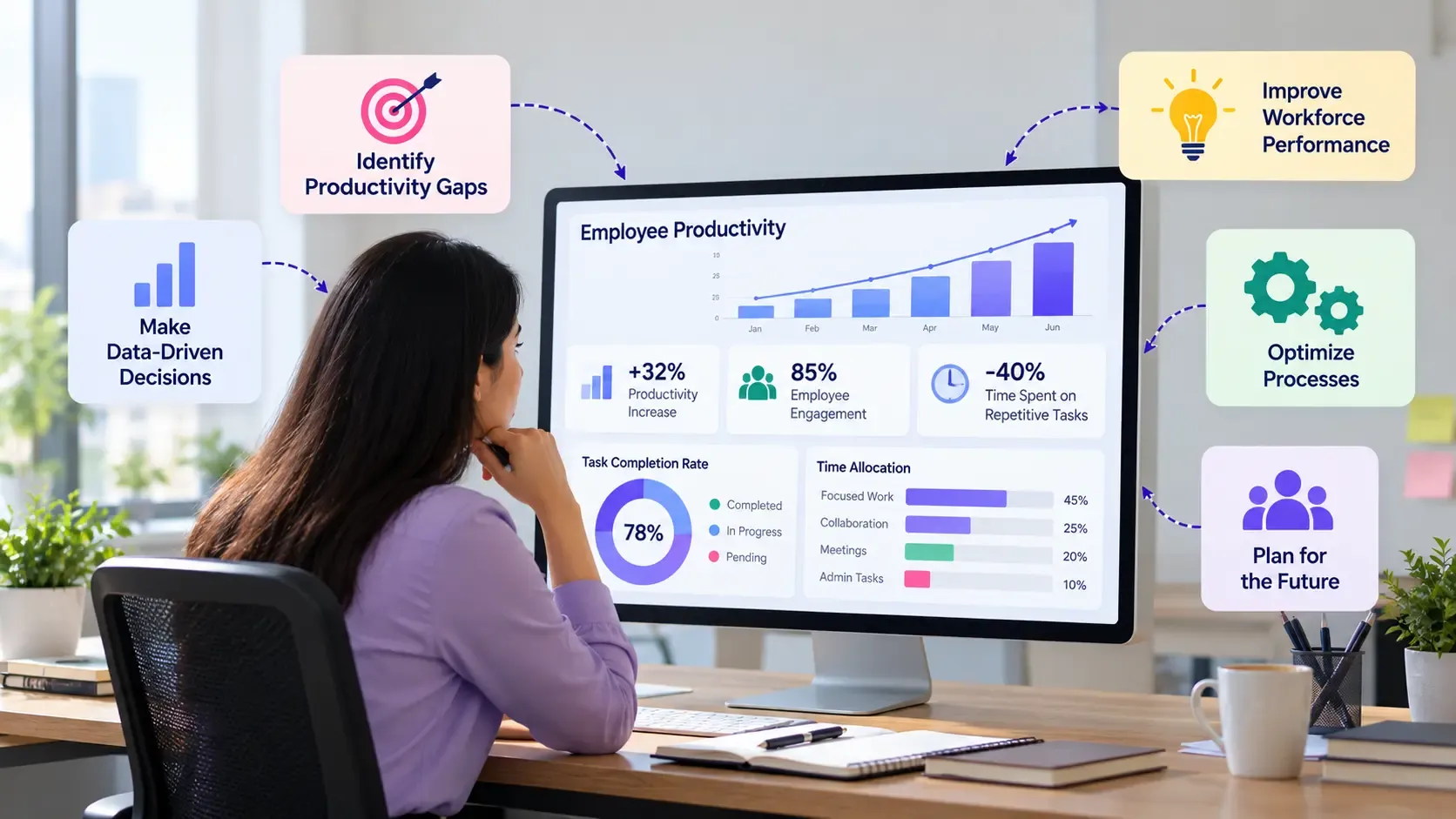
Productivity is no longer measured solely by output volume or hours worked. Modern organizations evaluate a combination of performance indicators, including collaboration quality, technology utilization, employee experience, process efficiency, and business outcomes.
As companies continue adapting to hybrid work environments, AI-powered tools, and evolving employee expectations, productivity insights help answer critical questions:
- Where is time being lost?
- Which workplace factors improve performance?
- How does employee engagement influence results?
- What role does technology adoption play in efficiency?
- Which trends are shaping the future workforce?
These questions make productivity benchmarking essential for leaders responsible for workforce optimization and digital transformation.
Employee Productivity at a Glance
The table below highlights some of the most significant productivity trends affecting organizations today.
| Productivity Area | Key Finding | Business Impact |
| Employee Engagement | Highly engaged employees outperform disengaged peers significantly | Higher profitability and retention |
| Workplace Interruptions | Frequent interruptions reduce focus and task completion rates | Lower efficiency and increased errors |
| Digital Tool Adoption | Underutilized software often leads to lower ROI | Reduced technology value realization |
| Hybrid Work | Flexibility can improve performance when managed effectively | Better employee satisfaction |
| Learning & Development | Ongoing training improves productivity outcomes | Faster skill development |
| Process Automation | Automation reduces repetitive tasks | Increased strategic work capacity |
| Employee Experience | Positive employee experiences correlate with higher productivity | Improved workforce performance |
60 Employee Productivity Statistics and Trends
Employee Engagement and Performance Statistics
1. Employees who are highly engaged consistently demonstrate stronger performance outcomes than disengaged employees.
2. Teams with higher engagement levels often report lower absenteeism and higher customer satisfaction.
3. Organizations that prioritize employee recognition frequently see measurable productivity improvements.
4. Employees who understand how their work contributes to company goals tend to be more productive.
5. Strong manager-employee relationships remain one of the most influential productivity drivers.
6. Clear communication significantly improves employee alignment and execution.
7. Employees receiving regular feedback typically show stronger performance growth.
8. Companies with robust learning cultures often outperform competitors in workforce productivity.
9. High-performing teams generally report stronger collaboration and accountability.
10. Organizations with effective onboarding programs often achieve faster employee ramp-up times.
These findings reinforce why employee engagement statistics continue to be closely linked to workforce performance outcomes.
Workplace Efficiency and Time Management Statistics
11. Employees spend a significant portion of their workday managing emails and internal communications.
12. Context switching between applications can reduce focus and increase cognitive load.
13. Unnecessary meetings remain one of the most cited productivity barriers.
14. Workers frequently report losing productive time due to interruptions.
15. Poor process design often creates hidden inefficiencies across departments.
16. Employees spend considerable time searching for information across disconnected systems.
17. Knowledge workers increasingly rely on digital tools to complete daily tasks.
18. Simplified workflows consistently improve execution speed.
19. Organizations that eliminate repetitive manual processes typically experience productivity gains.
20. Process standardization reduces operational bottlenecks and task duplication.
These findings highlight why many organizations track productivity in the workplace through workflow optimization metrics rather than output alone.
Remote and Hybrid Work Productivity Statistics
21. Many employees report improved focus when given flexible work options.
22. Hybrid work continues to be the preferred model across numerous industries.
23. Organizations with clearly defined hybrid policies tend to achieve stronger productivity outcomes.
24. Remote workers often save commuting time, creating additional availability for focused work.
25. Digital collaboration tools have become essential productivity enablers.
26. Virtual communication effectiveness directly impacts team performance.
27. Remote onboarding remains a challenge for many organizations.
28. Distributed teams require stronger documentation practices.
29. Organizations investing in employee experience often see improved hybrid workforce effectiveness.
30. Technology adoption plays a significant role in remote productivity success.
These trends continue to shape discussions around remote work productivity statistics and future workplace strategies.
Technology Adoption and Productivity Statistics
Technology alone does not guarantee productivity gains. Employee adoption remains a critical factor.
31. Organizations often use only a fraction of available software capabilities.
32. Poor software adoption can significantly reduce expected technology ROI.
33. Employees frequently require ongoing support after software implementation.
34. User guidance improves software proficiency and confidence.
Many organizations implement saas onboarding best practices such as interactive walkthroughs, contextual help, and role-based learning to accelerate proficiency
35. Contextual learning experiences reduce time-to-productivity.
36. Digital adoption initiatives help employees navigate complex workflows.
37. Employees are more likely to embrace tools that fit naturally into existing workflows.
This behavior often mirrors the technology adoption curve, where innovators and early adopters embrace new tools quickly while the majority require additional guidance and support.
38. Simplified user experiences reduce resistance to change.
39. Training effectiveness often determines implementation success.
40. Organizations increasingly evaluate technology investments based on user adoption metrics.
Organizations are increasingly investing in employee productivity software to address workflow inefficiencies, improve technology adoption, and support more effective ways of working.
According to McKinsey, digital transformation success depends heavily on user adoption and behavioral change rather than technology deployment alone. Organizations with effective change management practices are significantly more likely to achieve transformation goals.
To support organizational transitions, many enterprises also deploy change management software to improve communication, training delivery, and adoption tracking throughout transformation initiatives.
A practical example is how organizations use digital adoption solutions such as GuideNow to help employees navigate enterprise applications and reduce learning friction during software rollouts.
Employee Experience and Workplace Productivity Statistics
41. Positive employee experiences contribute to stronger organizational performance.
42. Employees who feel supported are more likely to remain productive during periods of change.
43. Workplace flexibility continues to influence employee satisfaction.
44. Career development opportunities impact workforce motivation.
45. Employees increasingly expect consumer-grade workplace technology experiences.
46. Burnout remains a significant productivity challenge.
47. Mental well-being programs are becoming part of productivity strategies.
48. Organizations that reduce workplace friction often improve employee performance.
49. Access to relevant information supports faster decision-making.
50. Employee-centric workplace initiatives contribute to long-term productivity improvements.
These findings align closely with broader workplace productivity statistics that emphasize employee experience as a key performance driver. Many organizations also track Employee Experience Statistics to understand how workplace satisfaction, technology usability, and employee support influence overall business performance.
Future of Work and Productivity Trends
51. AI-powered tools are becoming embedded within daily workflows.
52. Organizations are increasingly measuring productivity through outcomes rather than hours worked.
53. Skills-based workforce planning is gaining momentum.
54. Continuous learning is becoming a competitive advantage.
55. Data-driven workforce management is expanding across industries.
56. Process intelligence tools help organizations identify hidden inefficiencies.
57. Employee productivity measurement is becoming more sophisticated.
58. Automation is shifting employee focus toward higher-value work.
59. Organizations are investing more heavily in digital workplace experiences.
60. Workforce productivity strategies increasingly combine technology, process optimization, and employee experience improvements.
According to Gartner research, organizations that successfully improve digital employee experience often see measurable gains in workforce effectiveness, retention, and employee satisfaction.
Source: Gartner Digital Employee Experience Research
What These Employee Productivity Statistics Reveal About Workplace Efficiency Gaps
While productivity trends vary across industries, several common themes emerge from the data:
Technology Adoption Gaps
Many organizations invest heavily in software but fail to achieve expected outcomes due to low adoption and inadequate user enablement.
These software adoption challenges often stem from inadequate training, resistance to change, poor user experiences, and limited employee awareness of available capabilities
Process Complexity
Employees often lose valuable time navigating inefficient workflows, redundant tasks, and disconnected systems.
Engagement Challenges
Workforce engagement continues to influence productivity, retention, and performance outcomes.
Information Accessibility Issues
Finding information remains a major productivity drain in many enterprises.
Training and Enablement Deficiencies
Employees require continuous support to effectively use evolving technologies and processes.
Organizations that address these gaps are often better positioned to improve workforce performance, accelerate transformation initiatives, and maximize technology investments.
Conclusion
The latest Employee Productivity Statistics reveal that workplace efficiency is influenced by far more than employee effort alone. Technology adoption, employee engagement, workflow design, communication quality, training effectiveness, and workplace experience all contribute to organizational productivity outcomes.
The most productive organizations are not necessarily those that work harder—they are often the ones that remove friction, streamline processes, support employees effectively, and ensure technology investments are fully adopted.
As workplace expectations continue evolving, productivity leaders will increasingly focus on creating environments where employees can perform at their best with minimal barriers. Understanding these trends provides a valuable foundation for identifying efficiency gaps and building more productive, resilient organizations.
Frequently Asked Questions
1. What are employee productivity statistics?
Employee productivity statistics are data points that measure workforce performance, efficiency, output, engagement, and effectiveness. Organizations use these metrics to evaluate operational performance and identify improvement opportunities.
2. Why are workplace productivity statistics important?
Workplace productivity statistics help leaders understand how employees work, identify inefficiencies, measure business performance, and make informed workforce decisions based on data rather than assumptions.
3. How does employee engagement affect productivity?
Engaged employees are generally more committed, motivated, and aligned with organizational goals. Higher engagement levels often correlate with improved performance, retention, and collaboration outcomes.
4. What factors have the biggest impact on employee productivity?
Technology adoption, process efficiency, communication quality, leadership effectiveness, employee experience, workplace flexibility, and access to information are among the most influential productivity factors.
5. How can organizations improve workplace productivity?
Organizations can improve productivity by simplifying workflows, investing in employee training, reducing workplace friction, strengthening engagement initiatives, improving knowledge accessibility, and increasing software adoption across the workforce.