As organizations expand across regions, business units, and time zones, operational consistency becomes increasingly difficult to maintain. What begins as a successful process in one office often evolves into multiple variations across departments, countries, and teams. Over time, these inconsistencies create inefficiencies, compliance risks, training challenges, and fragmented customer experiences.
This is why many operations leaders are prioritizing initiatives to standardize workflows across global teams. The objective is not simply to document processes but to ensure employees execute them consistently regardless of location, language, or experience level.
However, standardization has historically been difficult to achieve. Traditional training programs, documentation repositories, and change management initiatives often fail to keep pace with evolving software environments and distributed workforces.
Today, organizations are increasingly turning to Digital Adoption Platforms (DAPs) to bridge this gap. By embedding guidance directly within applications, DAPs help operations teams enforce best practices, accelerate proficiency, and maintain process consistency at scale.
This article explores how operations leaders leverage DAPs to create standardized operating models, reduce process deviations, and drive measurable business outcomes across global organizations.
Why Workflow Standardization Has Become a Strategic Priority
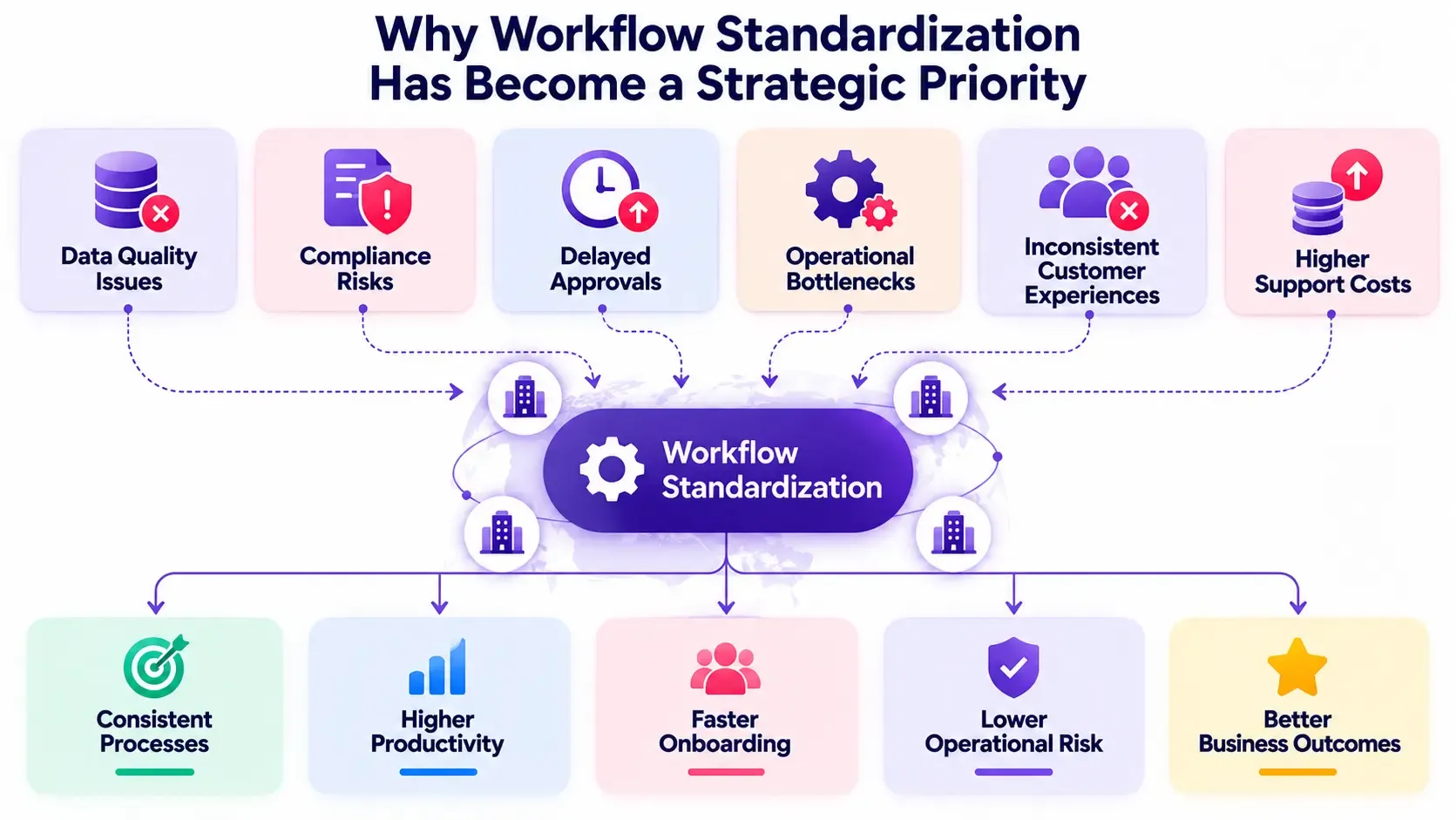
Global organizations rely on hundreds of interconnected processes spanning sales, finance, procurement, HR, customer service, and operations.
Without consistency, even minor process variations can create significant business challenges:
- Data quality issues
- Compliance violations
- Delayed approvals
- Operational bottlenecks
- Inconsistent customer experiences
- Increased support costs
As organizations continue investing in digital transformation, operational leaders are realizing that technology alone does not create consistency. Employees must also follow the intended processes accurately and repeatedly.
Standardization becomes especially important when organizations are managing distributed workforces, mergers and acquisitions, rapid growth, or enterprise-wide software implementations.
The Hidden Cost of Process Variability Across Global Teams
Many organizations underestimate how costly workflow inconsistencies can become.
When employees complete the same task differently across regions, organizations often experience:
- Duplicate work
- Reporting discrepancies
- Longer onboarding periods
- Audit failures
- Increased operational risk
Traditional Process Documentation vs DAP-Driven Standardization
| Traditional Approach | DAP-Driven Approach |
| Static documentation | Real-time in-app guidance |
| Employees search for answers | Guidance appears during tasks |
| Difficult to maintain globally | Centralized updates across regions |
| Training delivered separately from work | Learning integrated into workflows |
| High dependency on managers | Consistent guidance at scale |
| Knowledge retention challenges | Reinforcement during execution |
The difference is significant: instead of expecting employees to remember procedures, organizations provide guidance directly where work happens.
Why Traditional Standardization Efforts Often Fail
Many companies invest heavily in process documentation and training programs yet continue to struggle with execution consistency.
The issue is rarely process design.
The issue is process adoption.
Employees face challenges such as:
- Information overload
- Frequent software updates
- Multiple systems and applications
- Regional variations
- Time constraints
- Lack of contextual support
A McKinsey study found that large-scale transformation initiatives frequently fail to achieve expected outcomes because employee behavior does not change as quickly as organizational goals. Organizations that focus on capability building and adoption are significantly more likely to realize transformation value. McKinsey Digital Transformation Research
For many enterprises, building a strong digital adoption strategy has become essential to ensure employees embrace new technologies, follow standardized processes, and realize the full value of transformation investments.
This challenge becomes even more pronounced in multinational organizations where operational complexity increases exponentially.
How DAPs Help Standardize Workflows Across Global Teams
A digital adoption platform operates within enterprise applications, guiding employees through processes as they complete tasks.
Rather than requiring users to consult manuals, training videos, or support teams, DAPs provide contextual assistance directly inside the workflow. This type of in app guidance helps users complete tasks correctly without leaving the application to search for documentation, training materials, or support resources.
This enables organizations to:
- Deliver consistent process guidance
- Reduce human error
- Accelerate task completion
- Improve process adherence
- Support continuous learning
Most importantly, DAPs help organizations standardize workflows across global teams without requiring constant intervention from managers or trainers.
Delivering Consistent Process Execution Across Regions
One of the biggest challenges operations leaders face is ensuring that employees in different countries follow the same procedures.
Regional differences often emerge because:
- Teams develop local workarounds
- Legacy practices persist
- Training quality varies
- Documentation becomes outdated
DAPs solve this problem by embedding approved workflows directly into enterprise systems.
Instead of relying on memory, employees receive step-by-step guidance aligned with corporate standards.
This creates a scalable approach to business process standardization across locations while preserving operational consistency.
Accelerating Employee Onboarding Without Sacrificing Consistency
Training new employees is particularly challenging for global organizations.
Traditional onboarding often involves:
- Multiple training sessions
- Extensive documentation
- Shadowing experienced employees
- Regional knowledge transfer
While these methods have value, they often produce inconsistent outcomes.
By integrating guidance directly into applications, DAPs support employee onboarding through real-world learning experiences.
As organizations evaluate the best SaaS onboarding software, many prioritize platforms that provide contextual learning, role-based guidance, and measurable adoption outcomes across distributed teams.
Employees learn while performing actual tasks, reducing dependency on classroom-style training and accelerating productivity.
This approach aligns closely with modern workforce expectations, where learning is increasingly embedded into daily work.
Reducing Process Deviations Through Real-Time Guidance
Process deviations occur when employees unintentionally skip steps, enter incorrect data, or follow outdated procedures.
Over time, these deviations create operational inefficiencies and compliance risks.
DAPs address this challenge by providing:
- Interactive walkthroughs
- Context-sensitive instructions
- Dynamic prompts
- Task validation checkpoints
This level of guidance helps improve process compliance while reducing the need for manual oversight.
Employees receive support at the exact moment decisions are made, increasing accuracy and consistency.
Supporting Workflow Automation Initiatives
Many organizations invest heavily in workflow automation but struggle to achieve expected results.
Automation success depends on employees understanding how automated processes interact with their responsibilities.
When users bypass workflows or fail to follow defined procedures, automation benefits diminish significantly.
DAPs help reinforce process integrity by guiding employees through automated workflows and clarifying how systems should be used.
This creates stronger alignment between automation investments and operational execution.
Enabling Continuous Workflow Optimization Through Analytics
Operational leaders need visibility into how processes are actually executed.
Traditional reporting often focuses on outcomes rather than behaviors.
DAP analytics provide insights into:
- Process completion rates
- User friction points
- Error trends
- Feature adoption
- Knowledge gaps
These insights help organizations identify opportunities for workflow optimization and continuously improve operational efficiency.
Rather than relying on assumptions, leaders gain direct visibility into user behavior and process performance.
Driving Software Adoption Across Enterprise Systems
New technology investments frequently struggle because employees continue relying on legacy habits.
Even well-designed systems fail to deliver value when adoption remains low.
DAPs support software adoption by helping employees become productive more quickly and confidently.
This approach reduces resistance to change while increasing utilization of enterprise applications.
Organizations also benefit from improved user adoption, as employees experience fewer frustrations when navigating unfamiliar systems.
By reducing complexity, DAPs help organizations move users through the technology adoption curve more effectively.
Strengthening Global Change Management Programs
Every major transformation initiative introduces new processes, technologies, and expectations.
The challenge for operations leaders is ensuring employees adapt successfully.
According to Gartner, employees today face significantly more organizational change than in previous years, increasing the importance of structured enablement and support programs. Organizations that effectively reinforce change adoption are more likely to achieve desired business outcomes. Gartner Change Management Insights
This highlights why change management statistics increasingly emphasize ongoing reinforcement rather than one-time communication campaigns.
DAPs strengthen transformation programs by delivering guidance continuously rather than only during rollout phases.
Standardizing Processes Across Multiple Enterprise Applications
Modern organizations rarely operate within a single software platform.
Employees often navigate:
- ERP systems
- CRM platforms
- HR applications
- Procurement tools
- Service management solutions
This complexity creates challenges for workflow management and process consistency.
DAPs provide a unified guidance layer across applications, helping employees execute processes consistently regardless of the underlying system.
This becomes particularly valuable during mergers, acquisitions, and large-scale platform migrations.
Supporting Employee Productivity Without Increasing Training Costs
One of the most significant benefits of DAP adoption is the ability to improve performance while reducing training overhead.
Traditional training programs often require:
- Instructor-led sessions
- Repeated workshops
- Extensive documentation maintenance
DAPs complement existing employee training software investments by providing support directly within workflows.
Employees spend less time searching for answers and more time completing productive work.
As a result, organizations often see improvements in operational efficiency and workforce effectiveness.
DAPs and Business Process Management: A Stronger Operational Framework
Many organizations already use business process management (BPM) methodologies to design and optimize workflows.
However, BPM initiatives often focus on process design rather than execution.
DAPs bridge this gap by ensuring employees follow defined workflows consistently.
Together, BPM and digital adoption technologies create a powerful operational framework:
- BPM defines the process.
- DAPs reinforce the process.
- Analytics validate the process.
This combination enables organizations to scale process excellence across global operations.
SaaS Onboarding Best Practices for Global Operations Teams
As organizations adopt more cloud-based platforms, operational leaders must rethink how users learn new systems.
Effective saas onboarding best practices include:
- Delivering role-based guidance
- Reducing information overload
- Supporting learning in the flow of work
- Measuring onboarding effectiveness
- Continuously improving user experiences
DAPs align naturally with these principles because they provide contextual support exactly when users need it.
For organizations seeking to improve adoption outcomes, platforms such as GuideNow represent one example of how embedded guidance can support operational consistency without increasing complexity.
Conclusion
For operations leaders, standardization is no longer just a process challenge—it is a business performance imperative.
As organizations become more distributed, software ecosystems become more complex, and transformation initiatives accelerate, maintaining consistency across regions becomes increasingly difficult.
Organizations that successfully standardize workflows across global teams are moving beyond static documentation and traditional training models. They are embedding guidance directly into workflows, enabling employees to execute processes correctly regardless of location or experience level.
Digital Adoption Platforms provide a scalable approach to process consistency, adoption acceleration, operational efficiency, and continuous improvement.
In 2026 and beyond, the organizations that achieve the highest levels of operational excellence will not simply document best practices—they will make those best practices impossible to miss.
Frequently Asked Questions
1. How do Digital Adoption Platforms help standardize workflows across global teams?
DAPs provide real-time, in-app guidance that ensures employees follow approved processes consistently regardless of region, language, or experience level. This reduces process variation and improves execution quality.
2. Why is workflow standardization important for multinational organizations?
Workflow standardization improves operational efficiency, data quality, compliance, customer experience, and reporting consistency while reducing errors and support costs across distributed teams.
3. Can DAPs improve employee onboarding for global workforces?
Yes. DAPs accelerate onboarding by providing contextual learning experiences directly within applications, helping employees learn while performing actual tasks rather than relying solely on traditional training.
4. What role do DAPs play in digital transformation initiatives?
DAPs help employees adapt to new technologies, workflows, and processes by providing continuous guidance, reducing resistance to change, and improving technology utilization throughout transformation programs.
5. How do operations leaders measure workflow standardization success?
Common metrics include process completion rates, compliance levels, task accuracy, onboarding speed, error reduction, software utilization, support ticket volume, and productivity improvements across teams.