Enterprise software projects rarely fail because of technology. Most fail because employees do not fully adopt the new system after launch.
Organizations invest heavily in CRM platforms, ERP systems, HR systems, project management tools, analytics platforms, and AI-powered applications. Yet many deployments struggle to achieve the expected return because users continue relying on old processes, spreadsheets, manual workarounds, or legacy tools.
A successful Software Rollout Plan bridges the gap between technical deployment and business adoption. It ensures employees understand why the change matters, how the software supports their work, and what support they need throughout the transition.
Whether you are deploying a new ERP, CRM, HRIS, or collaboration platform, following a structured rollout framework helps reduce resistance, accelerate time-to-value, and increase long-term adoption.
This guide outlines a proven 10-step framework that enterprise teams can use to improve rollout outcomes, reduce implementation risks, and maximize technology investments.
Why Most Enterprise Software Rollouts Fail
Many organizations treat deployment as the finish line. In reality, deployment is only the beginning.
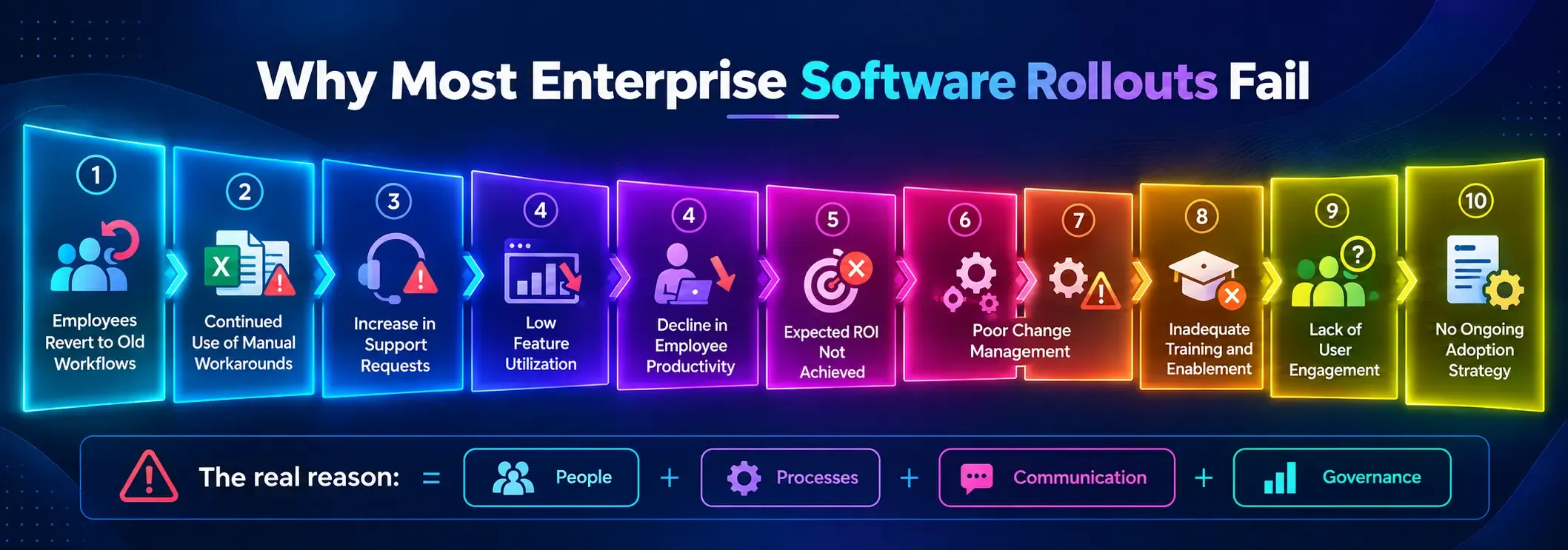
Technical implementation may be completed successfully, but adoption challenges often emerge after go-live:
- Employees revert to previous workflows
- Departments create unofficial workarounds
- Support requests increase dramatically
- Feature utilization remains low
- Productivity declines during transition periods
- Expected ROI never materializes
Research from Gartner found that only 48% of digital initiatives meet or exceed their intended business outcomes, highlighting the difficulty organizations face in achieving sustainable adoption after deployment.
The root cause is usually not technology. It is the absence of a structured adoption framework that aligns people, processes, communication, training, and governance.
Software Rollout Plan vs. Traditional Software Deployment
| Traditional Deployment Approach | Strategic Rollout Approach |
| Focuses on technical go-live | Focuses on business outcomes |
| IT-led implementation | Cross-functional ownership |
| One-time training sessions | Continuous enablement |
| Success measured by launch date | Success measured by adoption and utilization |
| Reactive support model | Proactive guidance model |
| Limited change planning | Structured organizational readiness |
Organizations that prioritize adoption planning alongside implementation are more likely to achieve measurable business value from technology investments. Many rollout leaders also evaluate where employees sit on the technology adoption curve, helping teams identify innovators, early adopters, and users who may require additional support during the transition.
Step 1: Define Clear Business Outcomes Before Launch
Before configuring workflows or migrating data, identify what success looks like.
Many projects begin with technical requirements but fail to establish measurable business objectives.
Examples include:
- Reducing onboarding time by 30%
- Increasing CRM data accuracy
- Improving employee productivity
- Eliminating manual reporting processes
- Standardizing workflows across departments
When stakeholders agree on desired outcomes early, rollout decisions become easier throughout the project lifecycle.
This foundation should become the guiding principle for the entire Software Rollout Plan.
Step 2: Assess Organizational Readiness
Technology readiness and employee readiness are different things.
Before launch, evaluate:
- Current process maturity
- Employee skill levels
- Change readiness
- Department-specific concerns
- Leadership alignment
Conduct stakeholder interviews, surveys, and workflow assessments to identify adoption barriers before deployment begins.
Organizations that identify resistance early can address concerns proactively rather than reacting after launch.
This assessment phase often becomes one of the most overlooked components of successful ai change management initiatives.
Step 3: Build a Cross-Functional Rollout Team
Software adoption is not solely an IT responsibility.
Successful rollouts require participation from:
- IT leaders
- Department managers
- Operations teams
- HR teams
- Training specialists
- Executive sponsors
Each group plays a different role in adoption success.
Cross-functional ownership improves communication, accelerates issue resolution, and increases employee trust throughout the transition.
Step 4: Create a Detailed Adoption Roadmap
A rollout roadmap provides structure and accountability.
The roadmap should include:
- Project milestones
- Training timelines
- Pilot phases
- Communication schedules
- Go-live activities
- Post-launch support plans
Many organizations develop a technical deployment schedule but fail to create a corresponding adoption roadmap.
A successful software implementation plan should integrate both technical and human adoption activities.
The objective is to prepare employees before software becomes mandatory.
Step 5: Launch a Pilot Program Before Full Deployment
Pilot programs reduce risk and generate valuable feedback.
Select a representative group of users who can:
- Test workflows
- Validate business processes
- Identify usability issues
- Surface training gaps
- Provide real-world insights
Pilot users often become internal advocates who help influence broader adoption later.
This phase transforms assumptions into evidence and allows teams to refine the rollout before enterprise-wide deployment.
Step 6: Develop Role-Based Training Programs
One-size-fits-all training rarely works.
Different teams use software differently.
Sales teams need different workflows than finance teams. Operations teams require different capabilities than HR teams.
Role-specific training should focus on:
- Daily workflows
- Critical tasks
- Department-specific use cases
- Business outcomes
McKinsey research consistently highlights that technology investments generate value only when employees are prepared to use them effectively in their daily work.
Training should emphasize practical execution rather than feature demonstrations. Applying proven saas onboarding best practices, such as progressive learning paths, contextual guidance, and milestone-based training, can significantly improve user confidence during the first weeks after launch.
This is where a strong user adoption strategies begins to take shape.
Step 7: Communicate the "Why" Behind the Change
Employees are more likely to embrace change when they understand its purpose.
Communication should answer:
- Why are we changing?
- What problems will this solve?
- How will daily work improve?
- What support will be available?
Avoid focusing exclusively on software features.
Instead, explain business outcomes and employee benefits.
Effective communication should occur:
- Before launch
- During rollout
- After deployment
Consistent messaging reduces uncertainty and minimizes resistance. Many organizations also leverage change management software to coordinate communications, monitor employee readiness, and ensure stakeholders remain aligned throughout the rollout process.
Step 8: Deliver In-Workflow Support After Go-Live
Traditional training alone is rarely enough.
Employees often forget information learned during classroom sessions or webinars.
The most successful organizations provide guidance within the workflow itself.
Examples include:
- Interactive walkthroughs
- Contextual help
- Tooltips
- Process guidance
- Knowledge resources
Many enterprises now leverage a digital adoption platform to provide support directly within applications and reduce dependence on traditional training materials.
Some organizations also deploy a software adoption platform to help employees navigate new workflows and accelerate proficiency after launch.
For teams evaluating long-term enablement approaches, solutions such as GuideNow are increasingly being explored as part of broader adoption ecosystems.
Step 9: Measure Adoption Using Meaningful Metrics
If adoption cannot be measured, it cannot be improved.
Track metrics such as:
- Active users
- Feature utilization
- Workflow completion rates
- Training completion
- Support ticket volume
- Employee satisfaction
- Time-to-proficiency
Avoid relying solely on login activity.
A user who logs in daily may still avoid critical workflows.
Organizations focused on enterprise software adoption monitor both usage behavior and business outcomes. The most effective software adoption metrics combine behavioral indicators, such as feature utilization and workflow completion, with business KPIs that demonstrate operational impact.
High-Intent Adoption Metrics Framework
| Metric Category | Example KPI | Business Impact |
| User Adoption | Active users | Adoption progress |
| Feature Adoption | Feature utilization rate | Software ROI |
| Productivity | Task completion time | Operational efficiency |
| Support | Ticket volume | User proficiency |
| Training | Completion rates | Readiness assessment |
| Business Outcomes | Process efficiency | Strategic value |
These metrics provide visibility into whether the rollout is achieving its intended objectives.
Step 10: Optimize and Scale Continuously
The rollout does not end after go-live.
Technology evolves.
Business processes change.
New employees join.
Additional features are introduced.
Successful organizations treat adoption as an ongoing process rather than a one-time event.
Continuous improvement activities include:
- Adoption reviews
- User feedback sessions
- Workflow optimization
- Additional training
- Feature awareness campaigns
- Performance analysis
A mature digital adoption strategy focuses on sustained utilization rather than short-term launch success.
This approach helps organizations maximize the long-term value of their technology investments.
Common Software Rollout Mistakes to Avoid
Even well-funded initiatives encounter adoption challenges. Understanding common software adoption challenges can help organizations proactively address barriers before they affect productivity, employee engagement, or overall rollout success.
The most common mistakes include:
Focusing Only on Deployment
Technical success does not guarantee user success.
Underestimating Change Resistance
Employees often require more support than leaders expect.
Delivering Generic Training
Role-specific enablement consistently outperforms broad training programs.
Ignoring Adoption Metrics
Without measurement, adoption challenges remain hidden.
Ending Support Too Early
Users need assistance long after launch day.
Organizations investing in software implementation services often discover that sustained adoption support has a greater impact on outcomes than implementation speed alone.
Likewise, successful enterprise software deployment programs prioritize employee enablement alongside technical execution.
How Modern Enterprises Accelerate Adoption
Leading organizations increasingly combine:
- Structured rollout governance
- Change management programs
- Workflow-based learning
- Analytics-driven optimization
- Contextual guidance
Many also deploy user adoption software to provide real-time assistance and reduce employee friction during transition periods.
Rather than treating training, communication, and support as separate initiatives, they integrate them into a unified adoption framework that supports the entire software implementation process.
The result is faster proficiency, higher engagement, lower support costs, and stronger ROI.
Conclusion
A successful Software Rollout Plan is not simply a deployment checklist.
It is a structured framework that aligns technology, people, processes, communication, training, and measurement around a common objective: achieving lasting adoption.
Organizations that focus exclusively on technical implementation often struggle to realize the value of their investments. In contrast, organizations that prioritize readiness, role-based enablement, stakeholder alignment, continuous support, and measurable outcomes create significantly better adoption results.
By following this 10-step framework, enterprises can reduce rollout risks, improve employee engagement, accelerate time-to-value, and transform software deployment into meaningful business impact.
Frequently Asked Questions
1. What is a software rollout plan?
A software rollout plan is a structured framework that outlines how an organization introduces new software, prepares employees, manages change, delivers training, measures adoption, and supports users after deployment to ensure successful business outcomes.
2. How long does an enterprise software rollout typically take?
The timeline varies based on project complexity, organization size, integrations, and user groups. Most enterprise deployments take several months from planning through post-launch optimization, while large-scale transformations may extend beyond a year.
3. What metrics should be used to measure software adoption success?
Key metrics include active users, feature utilization, workflow completion rates, training completion, support ticket volume, employee satisfaction, process efficiency improvements, and business outcome achievement.
4. Why do employees resist new software implementations?
Common reasons include lack of communication, insufficient training, unclear business benefits, workflow disruption, fear of change, and inadequate support after deployment.
5. How can organizations improve user adoption after software go-live?
Organizations can improve adoption through role-based training, contextual guidance, workflow support, adoption analytics, continuous communication, leadership sponsorship, and ongoing optimization based on employee feedback and usage data.