Organizations spend millions on new software every year, yet many struggle to achieve meaningful adoption. Employees attend training sessions, leadership announces the rollout, and implementation teams complete deployment. However, months later, usage remains low, workflows are inconsistent, and the expected business value never materializes.
This is why software adoption has become one of the most important success factors in digital transformation initiatives. Organizations no longer fail because they choose the wrong technology. They fail because people never fully embrace the technology they purchase.
According to McKinsey research, organizations increasingly recognize that technology value depends on workforce readiness and adoption, not just implementation. Successful organizations focus equally on technology deployment and employee enablement.
For leaders looking to improve adoption outcomes, the challenge is no longer "Which software should we buy?" but rather "How do we ensure people actually use it?"
This guide explores 10 proven User Adoption Strategies that help organizations increase usage, accelerate proficiency, improve productivity, and maximize software returns in 2026.
Why Software Adoption Matters More Than Software Implementation
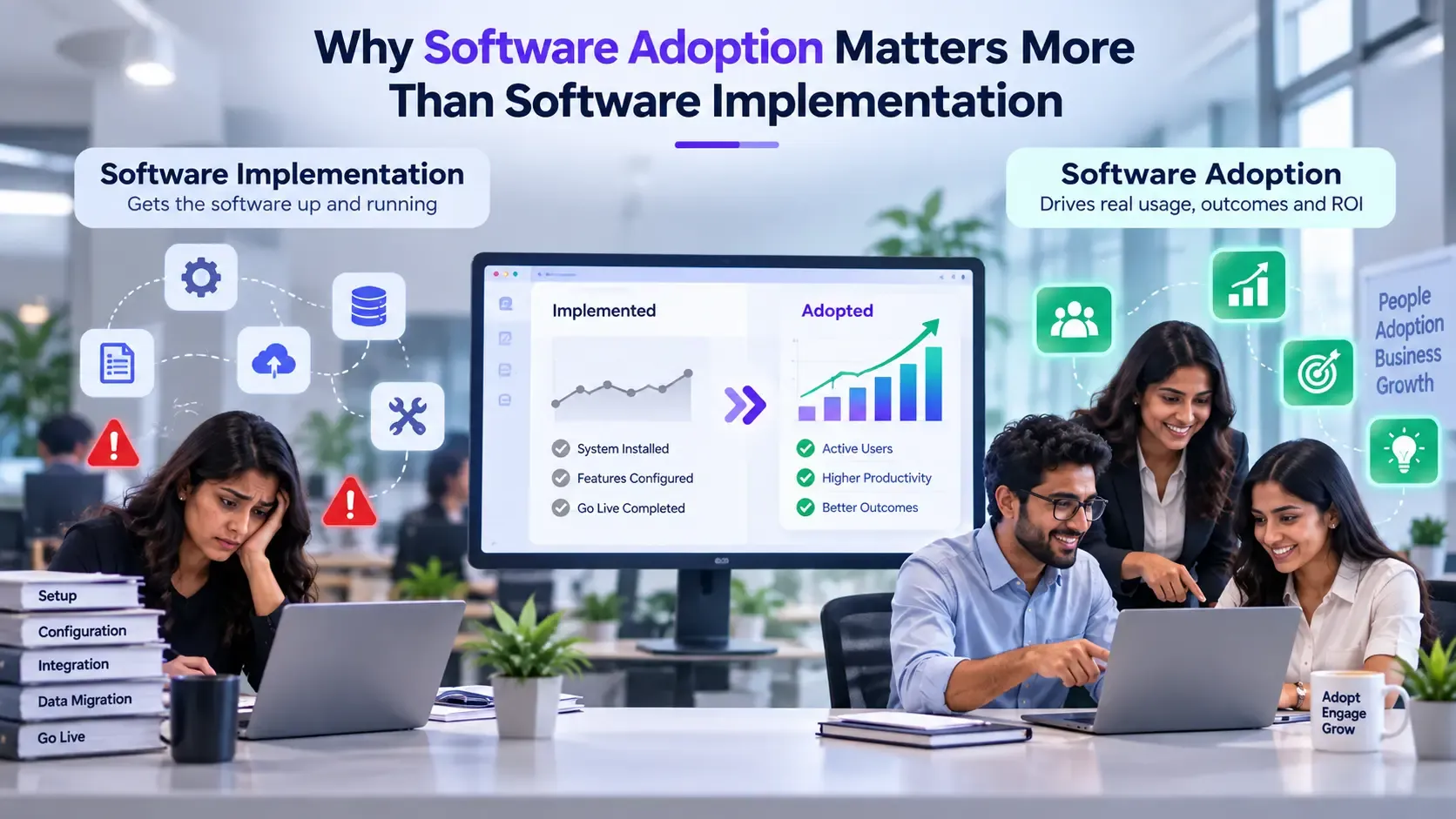
Many organizations celebrate go-live dates as project milestones. In reality, deployment is only the beginning.
A system creates value only when employees consistently use it to complete business-critical tasks. When adoption is low, organizations experience:
- Reduced utilization of purchased licenses
- Higher support costs
- Workflow inconsistencies
- Lower employee confidence
- Delayed business outcomes
- Poor technology investment returns
The difference between implementation success and business success is adoption.
Software Implementation vs Adoption
| Implementation Success | Adoption Success |
| Software deployed on time | Employees actively use the system |
| Technical requirements completed | Business processes improve |
| Integrations configured | Productivity increases |
| Training delivered | Knowledge is retained and applied |
| Project closed | Measurable business value achieved |
Organizations that prioritize adoption often realize faster value from technology investments while reducing resistance to change.
1. Start With Business Outcomes Instead of Features
One of the most common adoption mistakes is introducing software through feature lists.
Employees rarely care about dashboards, automation capabilities, or integrations. They care about solving problems faster.
Instead of explaining features, connect the software to business outcomes:
- Reduced manual work
- Faster approvals
- Improved reporting accuracy
- Better collaboration
- Shorter processing times
When users understand how technology improves their daily work, adoption becomes significantly easier.
A successful software adoption strategy begins with answering a simple question:
"How does this tool make my job easier?"
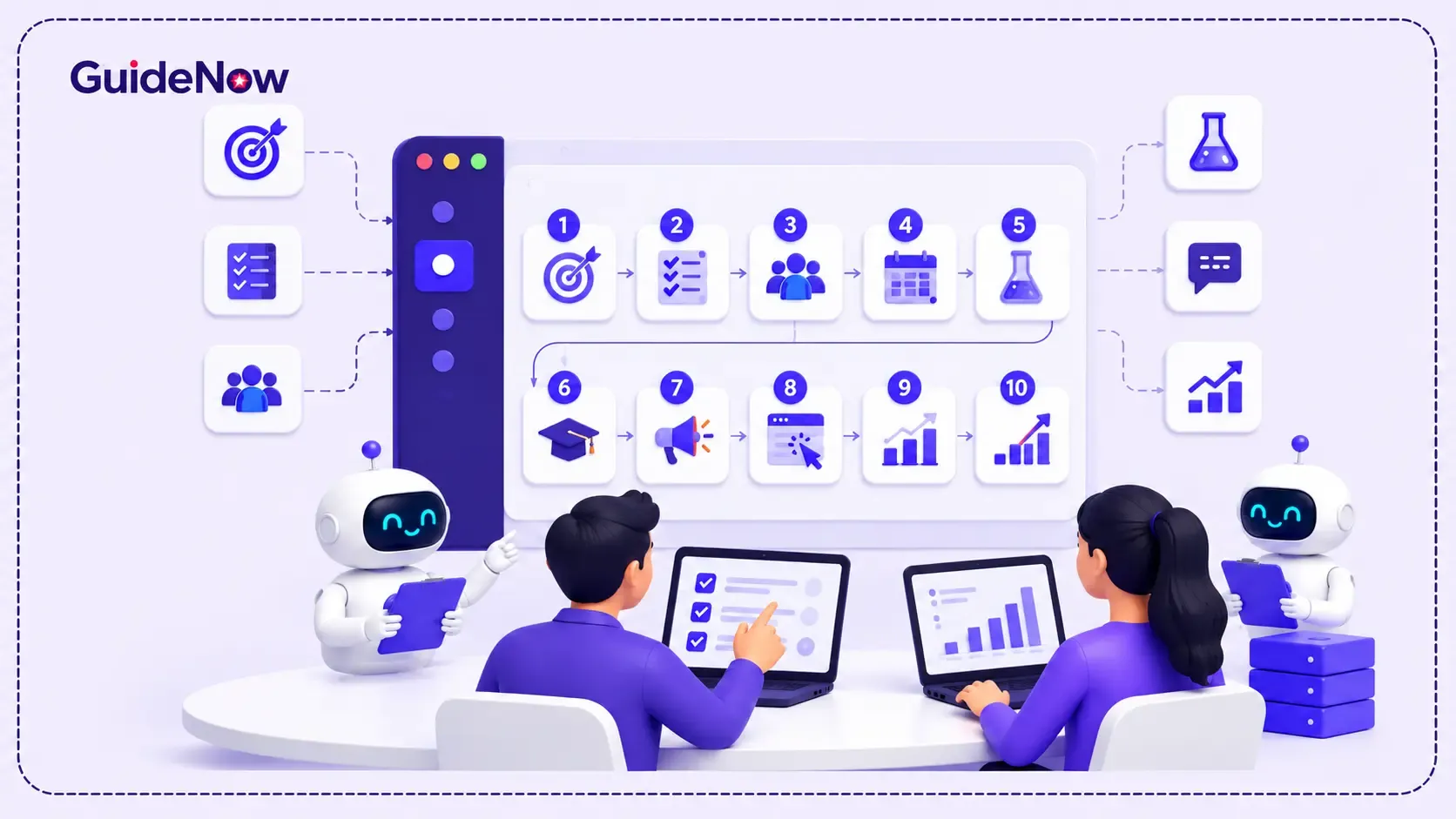
2. Build a Structured User Adoption Framework
Organizations with strong adoption outcomes rarely rely on one-time training programs.
They create a repeatable user adoption framework that guides employees throughout the entire adoption lifecycle.
A mature framework typically includes:
Awareness
Communicating why change is happening.
Readiness
Preparing employees before rollout.
Learning
Delivering practical training experiences.
Reinforcement
Providing ongoing support.
Optimization
Monitoring usage and improving adoption continuously.
The most successful organizations treat adoption as an ongoing process rather than a one-time event.
3. Personalize Onboarding Based on User Roles
Not every employee uses software the same way.
Finance teams, HR professionals, operations managers, and executives interact with different workflows and features.
Generic onboarding often overwhelms users with irrelevant information.
Instead, create role-specific onboarding paths that focus on:
- Daily responsibilities
- Key workflows
- Common tasks
- Department-specific use cases
Personalized user onboarding experiences reduce learning curves and accelerate proficiency.
Research consistently shows that contextual guidance improves adoption because users receive information when they actually need it rather than all at once.
4. Focus on Time-to-Value, Not Training Completion
Many organizations measure success using training attendance rates.
Unfortunately, attendance does not equal adoption.
The better metric is time-to-value.
Ask:
- How quickly can users complete their first task?
- How fast can they become productive?
- How soon can they realize benefits?
Reducing time-to-value helps improve confidence and increases long-term retention.
Organizations that optimize onboarding around outcomes rather than course completion generally experience stronger user engagement and sustained usage.
5. Create Internal Champions and Power Users
Employees often trust colleagues more than official communications.
Internal champions help bridge the gap between leadership expectations and employee adoption.
Champion programs should:
- Identify enthusiastic early adopters
- Provide advanced training
- Enable peer-to-peer learning
- Gather employee feedback
- Encourage best-practice sharing
Champions create credibility and help scale adoption organically throughout the organization.
This approach is particularly effective during enterprise software adoption initiatives involving multiple departments.
6. Align Adoption Strategies With the Technology Adoption Curve
Every workforce contains different types of adopters.
The technology adoption curve explains why some users embrace change immediately while others resist it.
Common adoption groups include:
| User Type | Adoption Characteristics | Recommended Approach |
| Innovators | Experiment with new tools quickly | Early access programs |
| Early Adopters | Influence peers positively | Champion networks |
| Early Majority | Need evidence of success | Case studies and practical examples |
| Late Majority | Prefer proven processes | Additional support and reassurance |
| Laggards | Resistant to change | Personalized coaching and guidance |
Understanding these groups helps organizations develop targeted adoption programs rather than treating every employee the same.
7. Deliver Support Inside the Workflow
Traditional support models require employees to leave their work and search for answers.
This creates friction.
Modern organizations increasingly provide assistance directly inside applications through:
- Interactive walkthroughs
- Contextual guidance
- Smart tooltips
- AI-powered assistants
- In-app knowledge resources
Research shows that users are more likely to adopt features when guidance appears at the moment of need rather than during isolated training sessions.
This approach is a major driver of digital adoption strategy because learning happens within real workflows.
A platform such as GuideNow can support this model by delivering contextual guidance directly within enterprise applications.
8. Use Data to Identify Adoption Friction
Organizations cannot improve what they do not measure.
Successful adoption programs track leading indicators such as:
- Feature utilization
- Workflow completion rates
- User drop-off points
- Support ticket volume
- Active usage trends
- Time-to-completion metrics
Rather than measuring logins alone, focus on behaviors that indicate successful adoption.
Key Adoption Metrics That Matter
| Metric | Why It Matters |
| Active users | Indicates engagement consistency |
| Workflow completion rate | Measures task success |
| Feature utilization | Shows product value realization |
| Support requests | Reveals friction areas |
| Time-to-value | Measures onboarding effectiveness |
| Productivity gains | Connects adoption to business outcomes |
Analytics help organizations proactively address adoption barriers before they impact performance.
9. Combine AI Change Management With Human Support
The rise of AI-powered tools has created new adoption challenges.
Many employees worry about:
- Job security
- Skill gaps
- Process changes
- Increased complexity
This makes Ai change management increasingly important.
Successful organizations combine:
- Leadership communication
- Employee readiness assessments
- Skills development
- Workflow redesign
- Continuous support
McKinsey research highlights a significant readiness gap between workforce confidence and organizational preparedness, emphasizing the importance of structured change management programs.
Technology adoption succeeds when people feel supported throughout the transition process.
10. Continuously Reinforce Adoption After Go-Live
One of the biggest mistakes organizations make is assuming adoption ends after launch.
In reality, adoption is a continuous process.
Users need ongoing reinforcement through:
- New feature announcements
- Refresher training
- Usage insights
- Coaching sessions
- Contextual guidance
- Knowledge-sharing initiatives
Organizations that invest in continuous enablement consistently outperform those relying solely on initial training programs.
This is especially important for organizations pursuing digital transformation adoption, where software ecosystems evolve continuously.
The Link Between Adoption and Software ROI
Many organizations focus on reducing software costs.
The greater opportunity is maximizing value from existing investments.
Low adoption often leads to:
- Unused licenses
- Duplicate processes
- Shadow systems
- Increased support costs
High adoption creates:
- Faster workflows
- Better collaboration
- Improved compliance
- Greater efficiency
- Stronger employee satisfaction
Ultimately, software ROI depends less on technology capabilities and more on employee usage.
Organizations that successfully improve software adoption often realize higher productivity gains without increasing technology spending.
Similarly, businesses that actively work to increase software adoption rates are more likely to achieve measurable business outcomes from technology investments.
How Modern Digital Adoption Platforms Support Adoption Success
As enterprise technology environments become increasingly complex, organizations need scalable ways to support users.
A Digital Adoption Platform helps organizations:
- Simplify onboarding
- Reduce support dependency
- Accelerate learning
- Improve workflow completion
- Increase feature discovery
- Monitor adoption performance
Rather than replacing training, these platforms extend learning into daily workflows.
This approach has become increasingly important as organizations adopt more applications and employees navigate increasingly complex digital workplaces.
Conclusion
Technology investments succeed when people use technology effectively.
The organizations achieving the strongest adoption outcomes in 2026 are not necessarily deploying more software. They are enabling employees more effectively.
The most effective User Adoption Strategies focus on business outcomes, personalized onboarding, contextual support, change management, analytics, and continuous reinforcement.
By aligning adoption efforts with employee needs and organizational goals, businesses can increase software utilization, improve workforce productivity, accelerate value realization, and maximize long-term returns from technology investments.
In an increasingly digital workplace, adoption is no longer a training challenge. It is a business growth strategy.
Frequently Asked Questions
1. What are the most effective user adoption strategies for enterprise software?
The most effective strategies include role-based onboarding, contextual guidance, adoption analytics, internal champion programs, change management initiatives, and continuous post-launch support.
2. How can organizations increase software adoption rates quickly?
Organizations can accelerate adoption by reducing onboarding friction, providing in-app guidance, focusing on time-to-value, and addressing user challenges at the moment they occur.
3. Why do software adoption initiatives fail after implementation?
Most initiatives fail because organizations focus on deployment rather than user behavior. Lack of ongoing support, poor communication, insufficient training reinforcement, and unclear business value often contribute to low adoption.
4. How do Digital Adoption Platforms improve end-user adoption?
Digital Adoption Platforms provide real-time guidance, walkthroughs, tooltips, onboarding flows, and analytics that help users complete tasks successfully without leaving their workflow.
5. Which metrics should organizations track to measure software adoption success?
Organizations should track active users, feature adoption rates, workflow completion rates, time-to-value, user retention, support tickets, and productivity improvements. These metrics help measure engagement, identify adoption barriers, and evaluate the business impact of software investments.