Product-led growth (PLG) depends on a simple commercial principle: the product must demonstrate value before a sales conversation becomes necessary. That makes onboarding a revenue lever, not just a welcome experience. The right SaaS onboarding software helps new users reach meaningful value faster, understand relevant capabilities, and continue discovering reasons to use the product.
In 2026, buyers are evaluating onboarding platforms differently. A basic walkthrough is no longer enough. Product teams need behavior-based experiences, segmentation, analytics, experimentation, feature discovery, and the ability to update onboarding without waiting for engineering. The best platform is therefore the one that connects onboarding activity to measurable product outcomes.
This guide compares the leading approaches to SaaS onboarding software and explains what to evaluate before buying.
What Is SaaS Onboarding Software?

SaaS onboarding software is a platform used to guide new and existing users through a web application so they can understand the product, complete important setup steps, and reach value with less friction.
Depending on the platform, capabilities can include interactive walkthroughs, checklists, contextual tooltips, surveys, announcements, behavioral targeting, product analytics, and triggered experiences.
The important distinction is between showing users where features are and helping them complete actions that matter. A long tour can explain an interface without helping a user accomplish a meaningful outcome. Effective onboarding connects guidance to a user's role, goal, behavior, and stage in the customer journey.
This category is also commonly evaluated as user onboarding software,product onboarding software, or SaaS user onboarding software, depending on whether the buyer is focused on customer onboarding, product experience, or broader software adoption.
For PLG teams, onboarding should answer three questions:
- What does this user need to accomplish first?
- What is blocking progress?
- What should the user discover next once the initial value is clear?
Why Onboarding Matters in a PLG Model
PLG puts more responsibility on the product to convert interest into measurable value. Users may sign up without speaking to sales, explore independently, test features, invite teammates, and decide whether the product deserves continued use.
That creates a critical gap between acquisition and revenue. A company can generate thousands of signups while still losing potential customers because users never complete setup, cannot find a relevant capability, or fail to understand how the product fits their workflow.
Gartner's 2025 CIO and Technology Executive Survey found that only 48% of digital initiatives meet or exceed their business outcome targets. While the research covers digital initiatives broadly rather than SaaS onboarding specifically, it highlights an important buying principle: technology investments should be evaluated against measurable outcomes, not implementation alone.
For SaaS companies, onboarding should therefore be measured against outcomes such as time-to-value, trial progression, product usage, retention, expansion, and support demand.
What to Look for in SaaS Onboarding Software
The strongest buying criteria are not the number of UI patterns a vendor offers. They are the capabilities that let a product team diagnose friction, guide users, and prove whether onboarding changes actually improve business results.
1. Behavior-Based Targeting
The platform should let teams trigger experiences based on actions, attributes, account status, plan, role, or product behavior.
A new administrator should not receive the same experience as an experienced user returning to a newly released feature. Behavioral targeting makes onboarding more relevant while reducing unnecessary guidance.
2. Contextual In-App Guidance
Guidance should appear where the user is working. Tooltips, hotspots, contextual prompts, and interactive walkthroughs are more useful when they respond to the user's current task instead of forcing everyone through the same sequence.
3. No-Code or Low-Code Creation
Product and customer success teams should be able to create, test, and update experiences without turning every onboarding change into an engineering project.
This is especially important for PLG companies that release frequently and need to respond quickly when onboarding data reveals friction.
4. Analytics Connected to Behavior
Completion rates alone are insufficient.
Buyers should look for visibility into drop-off, engagement, time-to-value, product usage, cohorts, and downstream behavior. The platform should help answer whether users who received an onboarding experience actually progressed further in the product.
5. Feature Discovery and Secondary Onboarding
Onboarding should not end after the first session.
Users need contextual prompts when they encounter advanced workflows, new capabilities, or features that can increase the value they receive from the product. This is where feature adoption becomes an important evaluation criterion.
6. Experimentation
The platform should support testing different messages, flows, triggers, and onboarding paths.
Without experimentation, teams may optimize based on opinions rather than evidence. PLG teams should be able to test an onboarding hypothesis, measure the result, and iterate.
7. Integrations and Data Flexibility
A serious evaluation should include analytics, CRM, customer-data, product-event, and communication integrations.
The platform should fit into the existing data model rather than create another isolated reporting layer.
Best SaaS Onboarding Platforms to Consider in 2026
There is no universal winner. The right choice depends on whether the primary requirement is product-led onboarding, product analytics, enterprise adoption, or broader digital enablement.
Platform | Best suited for | Key buying consideration |
| GuideNow | Broader software adoption and contextual guidance | Useful when onboarding extends beyond a single product journey |
| Pendo | Product teams combining analytics and in-app guidance | Product analytics and experience management |
| Appcues | SaaS teams focused on in-product onboarding | No-code onboarding experiences and guided product experiences |
| Chameleon | Teams prioritizing customized in-product experiences | Experience design and customization |
| UserGuiding | Teams seeking accessible onboarding tooling | Straightforward no-code onboarding capabilities |
| Userpilot | Product-led SaaS teams | In-app experiences, segmentation, analytics, and experimentation |
This table should be treated as a starting point rather than a definitive ranking. Pricing, packaging, integrations, security requirements, and capabilities can change, so buyers should validate current functionality directly with each vendor.
SaaS Onboarding Best Practices for PLG Teams
Saas onboarding best practices most effective onboarding programs are designed around the path to value rather than the product's navigation structure.
Start With the User's Desired Outcome
Instead of asking which screens a new user should see, define what the user should be able to accomplish.
A project-management application might prioritize creating a project and assigning work. An analytics product might prioritize connecting a data source and creating the first report.
The onboarding experience should guide users toward that outcome rather than simply introduce interface elements.
Reduce Unnecessary Steps
Every additional field, configuration choice, or unclear instruction can delay value.
Remove steps that are not essential to the first meaningful outcome and defer advanced configuration until it becomes relevant.
Personalize the Path
Different personas often need different starting points.
Segment onboarding around role, use case, plan, industry, or behavior when those signals materially change what the user needs.
Teach Through Action
Static explanations are easy to forget. Guided actions let users learn while completing a real task.
The goal is not to make users finish an onboarding sequence. The goal is to help them accomplish something useful.
Continue Onboarding After the First Value Moment
The second stage of onboarding is often where expansion opportunities appear.
Once users understand the core workflow, introduce related capabilities based on actual behavior instead of showing every feature upfront.
Measure the Commercial Outcome
Track whether onboarding improves the metrics that matter to the business.
Depending on the product, these could include trial-to-paid conversion, retention, expansion, product usage, support volume, or time-to-value.
Common Buying Mistakes to Avoid
Choosing Based Only on Product Tours
A product tour is one component of an onboarding strategy.
A platform may have attractive tours but weak segmentation, analytics, experimentation, or lifecycle capabilities. Buyers should evaluate the complete operating model rather than a single UI pattern.
Optimizing Completion Instead of Value
A 90% completion rate does not necessarily mean users understand the product.
If users complete every onboarding step but do not reach meaningful product outcomes, the experience is optimized for the wrong metric.
Using One Onboarding Path for Everyone
A single flow is easier to create but can introduce unnecessary friction.
PLG products typically serve different personas, use cases, company sizes, and levels of product maturity. Personalization becomes increasingly important as the customer base grows.
Ignoring Post-Onboarding Adoption
Users can complete initial setup and still fail to adopt the capabilities that create long-term value.
Your evaluation should therefore include secondary onboarding, feature discovery, behavioral targeting, and analytics.
Buying Without Testing Implementation Effort
A platform can look simple in a demo and become difficult to manage at scale.
Before purchasing, test how quickly your team can build a real flow, target it to a specific segment, measure the result, and update it.
How to Choose the Right Platform
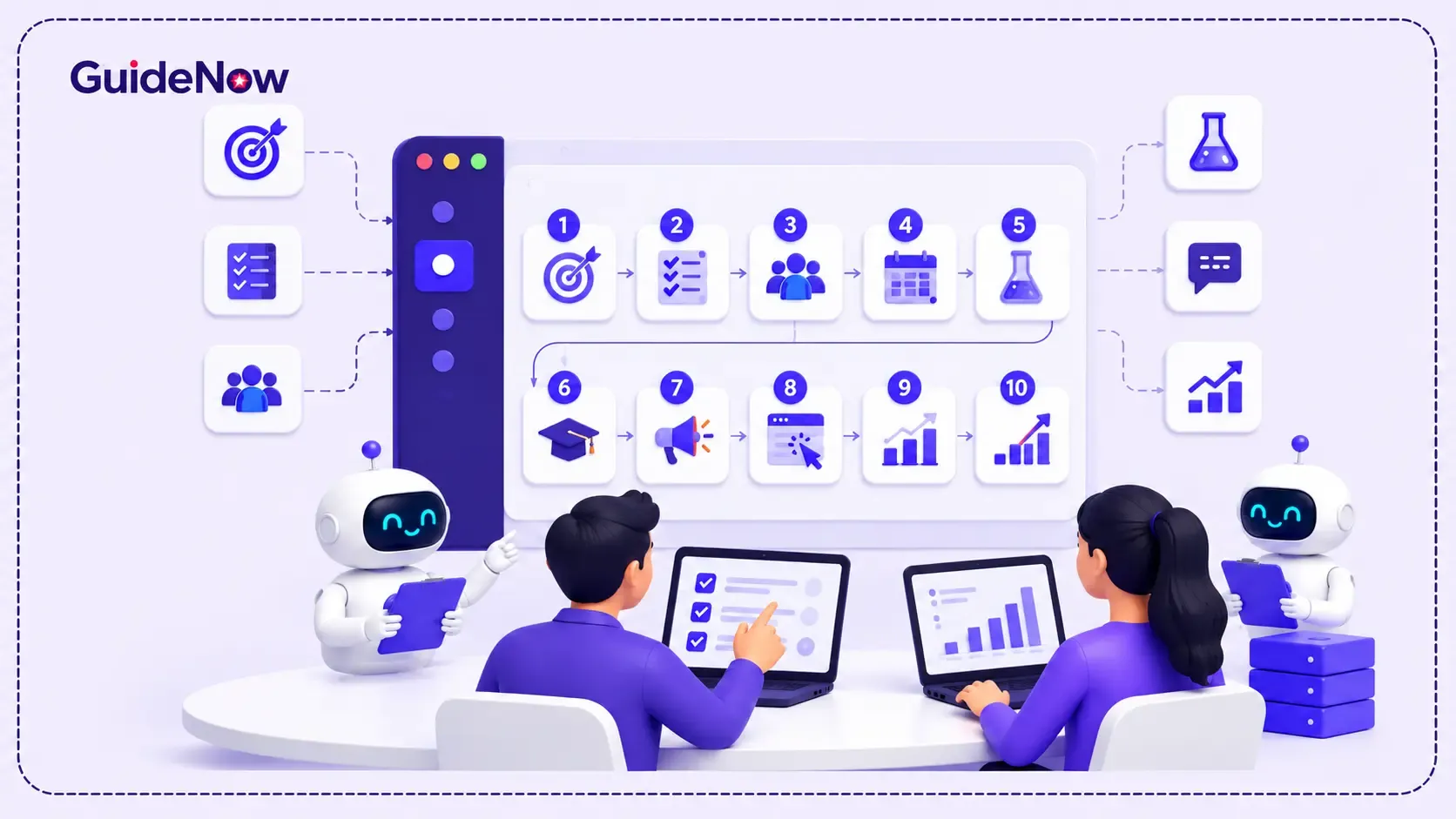
A practical buying process can be reduced to five steps.
1. Define the business outcome
Decide whether the immediate priority is reducing time-to-value, improving trial conversion, increasing product usage, reducing support dependency, or improving retention.
2. Map the critical user journeys
Identify the actions users must complete to experience the product's core value.
3. Create a vendor scorecard
Weight capabilities such as targeting, in-app guidance, analytics, experimentation, integrations, security, governance, implementation effort, and total cost of ownership.
4. Run a realistic proof of concept
Do not evaluate only a polished demo. Build one onboarding experience using your own product, users, events, and success criteria.
5. Measure the result
Compare the experience against a baseline or control group and look beyond guide completion to downstream product behavior.
This approach also helps expose software adoption challenges before they become expensive implementation problems.
The business case becomes much stronger when a platform can show not just that users interacted with onboarding, but that onboarding changed what users did next.
The Role of Onboarding in Long-Term Product Growth
Onboarding is increasingly becoming a continuous product experience. New capabilities, pricing plans, workflows, integrations, and user roles create new learning requirements throughout the customer lifecycle.
This is particularly important as SaaS products become more sophisticated. A user may understand the core workflow but never discover an advanced reporting capability, collaboration feature, automation option, or integration that could materially increase product value.
McKinsey has described SaaS as a major and expanding part of the software market, noting that SaaS was already a little over a third of software and was projected to approach 80% by the end of the decade in an earlier industry discussion.
As the SaaS footprint expands, the ability to turn software capabilities into habitual usage becomes increasingly important.
For PLG companies, this means onboarding should evolve from a one-time orientation layer into an ongoing system for reducing friction and improving product discovery.
Conclusion
The best SaaS onboarding software for product-led growth is not necessarily the platform with the longest feature list. It is the platform that helps a team connect user guidance to measurable product outcomes.
Prioritize behavior-based targeting, contextual guidance, no-code management, meaningful analytics, experimentation, integrations, and continuous feature discovery. Then evaluate vendors against your actual user journeys instead of comparing screenshots or generic feature checklists.
Most importantly, treat onboarding as part of the product growth engine. When users can reach value quickly, understand what to do next, and discover relevant capabilities at the right moment, onboarding becomes more than a first-session experience—it becomes a mechanism for improving the overall product journey.
For teams evaluating platforms in 2026, the strongest buying decision will be the one that balances ease of implementation with measurable impact on time-to-value, product usage, retention, and sustainable growth.
Frequently Asked Questions(FAQ’s)
1. How do I measure the ROI of SaaS onboarding software?
Focus on measurable business outcomes such as reduced time-to-value, higher trial conversion, increased feature usage, lower support costs, and retention.
2. What features should I prioritize when buying SaaS onboarding software?
Prioritize behavioral targeting, contextual in-app guidance, no-code creation, analytics, experimentation, segmentation, integrations, and support for ongoing feature discovery. Enterprise buyers should also evaluate security, governance, scalability, and administration.
3. Is SaaS onboarding software worth it for a PLG company?
It can be, particularly when a significant share of users must discover value without one-to-one sales or customer-success support. The business case is strongest when onboarding friction can be tied to measurable losses in conversion, retention, product usage, or support efficiency.
4. What is the difference between onboarding software and a digital adoption platform?
Onboarding software typically focuses on helping users learn and adopt a specific product. A digital adoption platform can cover broader software enablement, including contextual guidance across applications, employee enablement, workflow support, and enterprise adoption initiatives. The right category depends on the scope of the problem you need to solve.
5. How should I compare SaaS onboarding tools before buying?
Start with your highest-value user journeys and define measurable success criteria. Then compare targeting, guidance formats, analytics, experimentation, integrations, implementation effort, security, scalability, and total cost. A proof of concept using your own product is usually more useful than a generic vendor demo.