Investing in a powerful SaaS product is only the first step toward business success. The real challenge begins after implementation—helping users understand features, complete key workflows, and realize value as quickly as possible.
When users struggle to navigate an application, adoption slows, support tickets increase, and software investments fail to deliver their expected return. That's why more SaaS companies are replacing traditional documentation and one-time training sessions with AI-powered user employee software onboarding.
Modern user onboarding platforms deliver contextual guidance directly inside applications through interactive walkthroughs, tooltips, onboarding checklists, and in-app assistance. Many also leverage artificial intelligence to simplify onboarding creation, personalize guidance, identify adoption gaps, and provide actionable insights that improve user engagement.
Whether you're a product manager launching new features, a customer success leader reducing onboarding friction, or an enterprise buyer evaluating digital adoption solutions, choosing the right platform can significantly improve user activation, product adoption, and customer retention.
To help you make an informed decision, we've evaluated the best AI-powered user onboarding software for SaaS teams based on onboarding capabilities, AI functionality, ease of implementation, analytics, scalability, and overall value.
Best AI-Powered User Onboarding Software: Quick Comparison
| Software | Best For | AI Capabilities | No-Code Builder | Analytics | Enterprise Ready | Pricing |
| GuideNow | SaaS & enterprise software adoption | AI-powered in-app guidance | ✔ | ✔ | ✔ | Custom |
| WalkMe | Enterprise digital adoption | AI-powered automation & guidance | ✔ | ✔ | ✔ | Custom |
| Whatfix | Enterprise onboarding | AI-assisted guidance | ✔ | ✔ | ✔ | Custom |
| Userpilot | Product-led SaaS | AI-assisted content creation | ✔ | ✔ | ✔ | Custom |
| Pendo | Product analytics & onboarding | AI-powered insights | ✔ | ✔ | ✔ | Custom |
| Chameleon | SaaS product onboarding | Limited AI capabilities | ✔ | ✔ | ✔ | Custom |
| UserGuiding | SMB & mid-market SaaS | AI-assisted onboarding content | ✔ | ✔ | ✔ | Custom |
How We Evaluated These User Onboarding Platforms
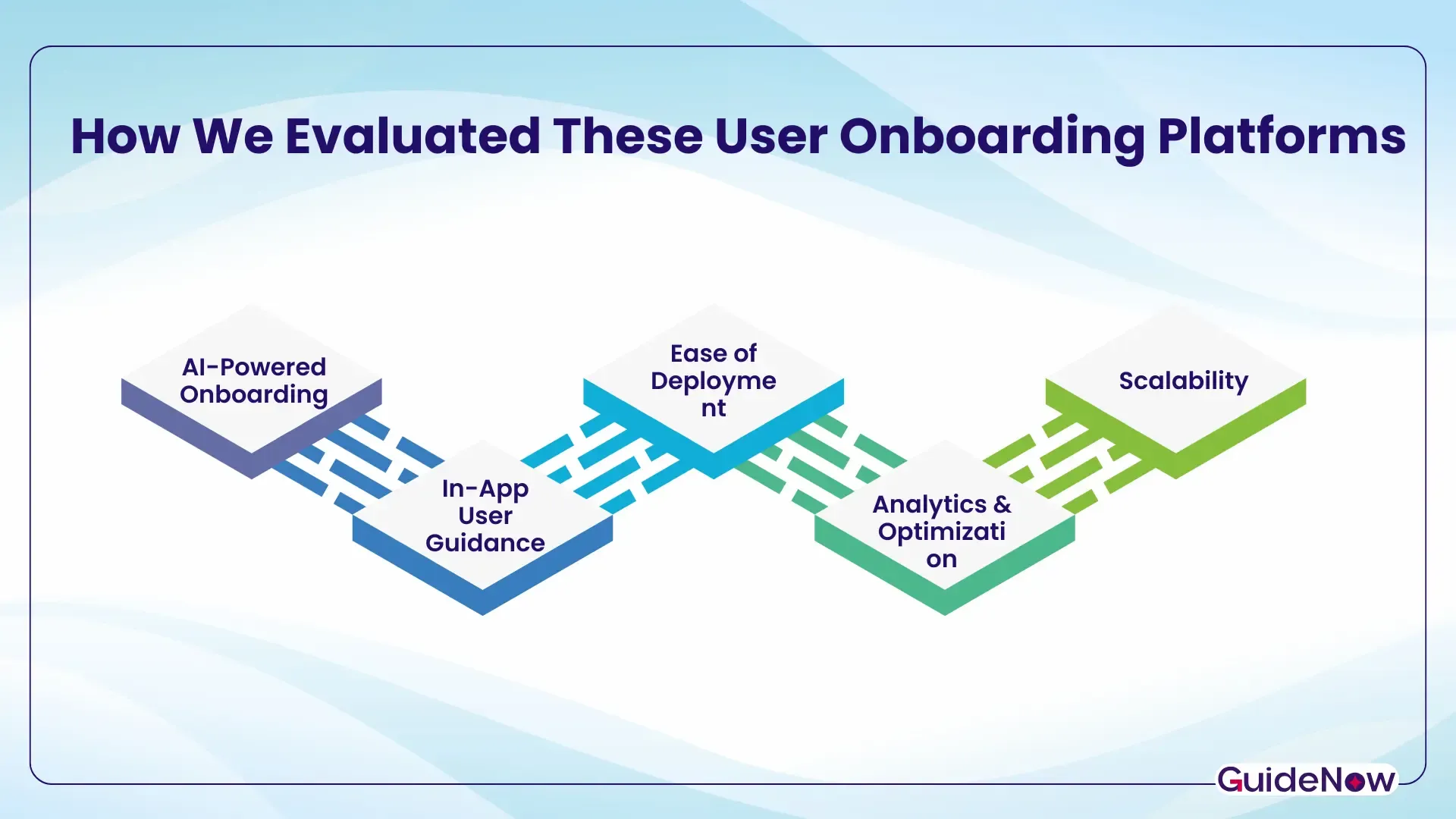
Every onboarding platform promises to improve product adoption, but not all solutions address the same business challenges. Our evaluation focused on the capabilities that matter most to SaaS organizations looking to accelerate customer onboarding and maximize software adoption.
AI-Powered Onboarding
We evaluated how each platform incorporates AI into onboarding workflows, including guidance creation, automation, content generation, analytics, or intelligent recommendations. Only publicly documented AI capabilities were considered.
In-App User Guidance
The ability to guide users within the application is fundamental. We assessed support for interactive walkthroughs, tooltips, hotspots, onboarding checklists, product tours, announcements, and contextual guidance.
Ease of Deployment
Modern product and customer success teams need solutions that minimize engineering effort. Platforms with intuitive no-code or low-code builders scored higher for implementation speed and ongoing maintenance.
Analytics & Optimization
Understanding how users interact with your application is essential for continuous improvement. We evaluated onboarding analytics, feature adoption insights, user segmentation, and reporting capabilities.
Scalability
Finally, we considered enterprise readiness, governance, localization, integrations, administrative controls, and the ability to support growing SaaS businesses.
1. GuideNow
Best for: SaaS companies and enterprises looking to accelerate software adoption through AI-powered contextual guidance.
Overview
GuideNow is an AI-powered user onboarding platform designed to help organizations accelerate software adoption by delivering contextual guidance directly inside business applications. Instead of relying on traditional documentation, lengthy training sessions, or reactive support, GuideNow enables users to complete tasks with confidence through interactive in-app experiences.
The platform focuses on reducing onboarding friction, improving software utilization, and helping organizations realize business value from their technology investments more quickly. Whether introducing a new SaaS application or rolling out updates across multiple enterprise systems, GuideNow provides guided experiences that help users navigate complex workflows without disrupting productivity.
Key Features
- AI-powered in-app guidance
- Interactive walkthroughs
- Step-by-step task guidance
- Smart tooltips and hotspots
- Onboarding checklists
- Announcement banners
- Cross-application guided workflows
- Real-time adoption analytics
- User segmentation
- No-code content creation
- Administrative controls
AI Capabilities
GuideNow combines AI-powered guidance with contextual in-app assistance to simplify onboarding experiences. The platform also provides adoption insights that help organizations identify friction points, understand software usage, and optimize user engagement over time.
Why Choose GuideNow?
Unlike many onboarding tools that focus only on product tours, GuideNow is built to improve software adoption across the entire user journey. Organizations can guide users through business-critical workflows, reduce repetitive support requests, simplify change management, and monitor adoption through real-time analytics.
Its cross-application guidance capabilities make it particularly valuable for organizations operating multiple SaaS platforms where users frequently switch between systems. By embedding assistance directly into the flow of work, GuideNow helps teams reduce training overhead while enabling users to become productive faster.
Pros
- AI-powered contextual guidance
- Cross-application onboarding
- Strong adoption analytics
- Reduces support and training effort
- No-code onboarding builder
- Enterprise-ready governance
Considerations
- Custom pricing requires contacting the sales team.
- Integration requirements should be evaluated based on your existing technology ecosystem.
Pricing
Custom pricing available on request.
2. WalkMe
Best for: Large enterprises driving digital transformation and software adoption.
Overview
WalkMe is one of the most established enterprise digital adoption platforms, helping organizations improve user onboarding across complex business applications. It enables enterprises to create guided workflows, automate repetitive tasks, and deliver contextual assistance that reduces user friction during software adoption.
The platform is particularly well suited for organizations managing multiple enterprise applications where consistent onboarding and governance are essential.
Key Features
- Interactive walkthroughs
- SmartTips
- Task automation
- Workflow automation
- Self-service support
- Enterprise analytics
- User segmentation
AI Capabilities
WalkMe incorporates AI-powered capabilities to assist with workflow automation, digital adoption, and user guidance while providing insights that help organizations optimize software usage.
Pros
- Enterprise-grade scalability
- Strong governance
- Extensive integrations
- Advanced analytics
- Suitable for large software ecosystems
Considerations
- Higher implementation complexity compared to lightweight onboarding tools.
- Best suited for mid-market and enterprise organizations rather than early-stage startups.
Pricing
Custom enterprise pricing.
3. Whatfix
Best for: Enterprises seeking scalable onboarding and digital adoption.
Overview
Whatfix helps organizations create interactive onboarding experiences, contextual guidance, and self-service support directly inside web applications. It enables businesses to improve software adoption while reducing dependency on traditional training and documentation.
Its combination of guided workflows, analytics, and enterprise governance has made it a popular choice for organizations undergoing large-scale software rollouts.
Key Features
- Interactive product tours
- Contextual walkthroughs
- Self-help widgets
- Task lists
- Knowledge integration
- Adoption analytics
- User segmentation
AI Capabilities
Whatfix offers AI-assisted capabilities that support onboarding content creation and enhance digital adoption experiences.
Pros
- Mature enterprise platform
- Rich onboarding capabilities
- Comprehensive analytics
- Flexible deployment options
Considerations
- Premium pricing may not suit smaller SaaS businesses.
- Advanced implementations often require additional planning.
Pricing
Custom pricing.
4. Userpilot
Best for: Product-led SaaS companies focused on feature adoption and user engagement.
Overview
Userpilot enables product teams to build personalized onboarding experiences without heavy engineering involvement. Its no-code platform makes it easy to launch interactive product tours, onboarding checklists, surveys, and contextual guidance that help users discover and adopt key features.
Userpilot is particularly popular among product managers looking to optimize user activation and reduce time-to-value.
Key Features
- Interactive product tours
- Onboarding checklists
- Feature tagging
- In-app surveys
- User segmentation
- Product analytics
- Goal tracking
AI Capabilities
Userpilot provides AI-assisted content generation to help teams create onboarding experiences and product messaging more efficiently.
Pros
- Easy to implement
- Strong segmentation capabilities
- Excellent for product-led growth
- Flexible onboarding customization
Considerations
- Some advanced capabilities are limited to higher-tier plans.
Pricing
Subscription-based pricing.
5. Pendo
Best for: Product teams that want to combine user onboarding with product analytics and feature adoption insights.
Overview
Pendo is a product experience platform that combines in-app guidance with robust product analytics, enabling SaaS businesses to understand user behavior while improving onboarding. Unlike onboarding-focused platforms alone, Pendo helps teams identify how users interact with features and where they encounter friction.
Its analytics-first approach makes it a strong choice for organizations that want onboarding decisions backed by user data rather than assumptions.
Key Features
- In-app guides and walkthroughs
- Product analytics
- Feature tagging
- User segmentation
- Feedback collection
- Journey analytics
- NPS surveys
- Resource center
AI Capabilities
Pendo incorporates AI-powered insights to help teams identify usage patterns, uncover adoption opportunities, and make informed product decisions.
Pros
- Industry-leading product analytics
- Strong onboarding capabilities
- Excellent feature adoption tracking
- Supports data-driven product optimization
- Enterprise-ready scalability
Considerations
- Better suited for organizations that need advanced analytics alongside onboarding.
- Premium features are available in higher-tier plans.
Best For
- Product managers
- Product-led SaaS companies
- Enterprise software vendors
- Teams focused on feature adoption
Pricing
Custom pricing.
6. Chameleon
Best for: SaaS product teams looking for highly customizable in-app onboarding experiences.
Overview
Chameleon is an in-app guidance platform that enables product teams to build personalized onboarding experiences without extensive engineering effort. It focuses on helping users discover product functionality through contextual guidance, interactive tours, announcements, and onboarding checklists.
Its flexibility makes it particularly attractive for organizations that prioritize branded onboarding experiences and continuous feature adoption.
Key Features
- Product tours
- Tooltips
- Launchers
- Checklists
- Announcement banners
- User segmentation
- A/B testing
- Product surveys
AI Capabilities
Chameleon has introduced limited AI-assisted capabilities to improve onboarding workflows, although its primary strength remains customization and user engagement.
Pros
- Highly customizable onboarding
- Strong UI flexibility
- Easy feature announcements
- Good experimentation capabilities
- Suitable for product-led growth
Considerations
- Analytics are not as comprehensive as platforms like Pendo.
- Enterprise governance capabilities may be more limited than enterprise-focused competitors.
Best For
- Product teams
- Growth teams
- Mid-market SaaS companies
- Organizations prioritizing onboarding customization
Pricing
Custom pricing.
7. UserGuiding
Best for: Small and mid-sized SaaS businesses seeking an affordable, no-code onboarding platform.
Overview
UserGuiding is designed to help SaaS businesses create onboarding experiences quickly without requiring developer resources. Its no-code editor enables teams to build interactive product tours, onboarding checklists, tooltips, and self-service resource centers that improve user activation and reduce support dependency.
The platform is particularly appealing to growing SaaS companies that want to launch onboarding initiatives quickly while maintaining flexibility as their products evolve.
Key Features
- Interactive product tours
- Onboarding checklists
- Tooltips
- Hotspots
- Resource center
- Knowledge base
- User segmentation
- Surveys
- Analytics
AI Capabilities
UserGuiding includes AI-assisted content creation features that help teams produce onboarding content more efficiently.
Pros
- Easy no-code implementation
- Affordable for growing SaaS companies
- Fast onboarding deployment
- Good balance of features and usability
- Minimal engineering dependency
Considerations
- Large enterprises with highly complex governance requirements may require more advanced capabilities.
- Advanced analytics are less comprehensive than analytics-focused platforms.
Best For
- SaaS startups
- Scale-ups
- Customer success teams
- Product managers
Pricing
Subscription-based pricing.
Why SaaS Teams Are Investing in AI-Powered User Onboarding Software
As SaaS products continue to evolve, onboarding has become more than a one-time customer training activity. Organizations now expect onboarding platforms to drive product adoption, reduce operational costs, and improve customer retention throughout the user lifecycle.
Here are some of the key benefits modern onboarding software delivers:
Accelerates Time-to-Value
Interactive guidance helps users complete important workflows immediately, reducing the learning curve and enabling faster adoption of new features.
Reduces Support Costs
Contextual in-app assistance answers common questions before users submit support requests, allowing customer success and support teams to focus on higher-value interactions.
Improves Product Adoption
Guided experiences encourage users to discover and use key features, leading to higher engagement and stronger long-term retention.
Simplifies Change Management
When new features or workflows are introduced, in-app guidance helps users adapt without requiring extensive retraining or documentation updates.
Enables Data-Driven Optimization
Adoption analytics help product teams understand where users experience friction, making it easier to optimize onboarding journeys and improve product experiences over time.
Scales Customer Onboarding
Unlike manual onboarding programs, AI-powered guidance can support thousands of users simultaneously while delivering a consistent onboarding experience.
How to Choose the Right AI-Powered User Onboarding Software
Not every onboarding platform is built for the same use case. Some solutions prioritize enterprise governance and best digital adoption platforms, while others focus on product-led growth, customer activation, or feature adoption. Before investing in a platform, evaluate how well it aligns with your business goals, technical requirements, and user experience strategy.
Define Your Primary Onboarding Goal
Start by identifying the challenge you're trying to solve.
- Reducing customer onboarding time
- Increasing product adoption
- Improving feature discovery
- Lowering support ticket volume
- Simplifying software rollouts
- Accelerating employee or customer training
Having a clear objective will help narrow your options.
Evaluate AI Capabilities
AI is becoming a key differentiator, but capabilities vary widely between vendors. Look for platforms that use AI to:
- Create onboarding content more efficiently
- Deliver contextual guidance
- Identify adoption bottlenecks
- Surface actionable usage insights
- Automate onboarding workflows where appropriate
Choose a solution that provides practical AI functionality rather than simply marketing itself as AI-powered.
Prioritize No-Code Content Creation
Your product and customer success teams should be able to update onboarding flows without relying heavily on developers. No-code builders reduce implementation time and make it easier to keep onboarding experiences aligned with product updates.
Look Beyond Product Tours
Effective onboarding goes beyond a single welcome tour. The best user onboarding platforms support:
- Interactive walkthroughs
- Contextual tooltips
- Checklists
- Resource centers
- Announcements
- Feature adoption campaigns
- User segmentation
- Continuous onboarding throughout the customer lifecycle
Measure Adoption with Analytics
Without analytics, it's difficult to understand whether onboarding is delivering results. Look for reporting that helps answer questions such as:
- Where do users abandon onboarding?
- Which features have low adoption?
- Which workflows create friction?
- How quickly are users reaching activation milestones?
These insights enable continuous optimization rather than one-time implementation.
Consider Scalability
As your SaaS business grows, your onboarding platform should grow with it. Consider factors such as:
- Enterprise governance
- Role-based permissions
- Localization
- Multi-product support
- Cross-application guidance
- Integration with your existing technology stack
Selecting a scalable platform today can help avoid costly migrations later.
AI User Onboarding Trends to Watch in 2026
AI is transforming how organizations design, deliver, and optimize onboarding experiences. Several trends are shaping the future of user onboarding software.
More Personalized In-App Experiences
Rather than showing every user the same onboarding flow, platforms are increasingly tailoring guidance based on user roles, behavior, feature usage, and onboarding progress.
AI-Assisted Content Creation
Creating walkthroughs, tooltips, onboarding checklists, and knowledge resources is becoming faster with AI-assisted content generation, allowing teams to launch onboarding experiences more efficiently.
Predictive Adoption Insights
Analytics are evolving from descriptive reporting to predictive insights, helping organizations identify users who may struggle with adoption before support issues arise.
Cross-Application Guidance
Businesses rely on multiple SaaS applications to complete end-to-end workflows. Modern onboarding platforms are expanding beyond single-product guidance to support users across connected applications, creating a more seamless experience.
Continuous Onboarding
Onboarding is no longer viewed as a one-time activity. Organizations are using in-app guidance throughout the customer lifecycle to introduce new features, reinforce best practices, and support ongoing product adoption.
Greater Focus on Business Outcomes
Enterprise Software adoption initiatives are increasingly measured by business impact rather than onboarding completion alone. Organizations are evaluating success using metrics such as time-to-value, feature adoption, user productivity, support reduction, and return on software investments.
Final Verdict: Which AI-Powered User Onboarding Software Is Best?
The right user onboarding platform depends on your organization's size, product complexity, and adoption goals.
If you're evaluating enterprise-wide digital adoption platform initiatives, WalkMe and Whatfix provide comprehensive governance, workflow automation, and large-scale deployment capabilities.
For product-led SaaS businesses focused on user activation and feature adoption, Userpilot, Pendo, Chameleon, and UserGuiding offer flexible onboarding experiences with varying levels of analytics and customization.
If your priority is accelerating software adoption through contextual in-app guidance while reducing onboarding friction, simplifying change management, and gaining visibility into user adoption across applications, GuideNow stands out as a strong choice. Its combination of AI-powered guidance, cross-application workflows, and adoption analytics helps organizations deliver faster time-to-value while improving software utilization and reducing dependency on traditional training methods.
Before making a final decision, evaluate each platform based on your onboarding objectives, implementation requirements, integration needs, scalability, and total cost of ownership. Requesting product demonstrations and running pilot programs can help ensure the platform aligns with your team's workflows and long-term adoption strategy.
Frequently Asked Questions(FAQ's)
1. How is user onboarding software different from digital adoption platforms?
User onboarding software primarily focuses on helping new users learn and adopt a product, while digital adoption platforms often support broader use cases such as enterprise software adoption, employee enablement, process guidance, and change management across multiple business applications.
2. Can user onboarding software reduce customer support tickets?
Yes. By providing contextual guidance, interactive walkthroughs, and self-service assistance inside the application, onboarding platforms help users resolve common questions independently, reducing reliance on support teams.
3. Which teams benefit most from user onboarding software?
Product management, customer success, implementation, support, sales enablement, and digital transformation teams commonly use onboarding platforms to improve user adoption and customer experience.
4. Do I need developers to create onboarding experiences?
Many modern platforms include no-code or low-code builders that allow non-technical teams to create and update onboarding flows without extensive engineering support.
5. What features should I look for in a user onboarding platform?
Look for interactive walkthroughs, tooltips, onboarding checklists, user segmentation, analytics, resource centers, announcements, integrations, AI capabilities, and enterprise security features that align with your business requirements.