SaaS onboarding best practices are strategies that help new users move from signup to meaningful product value with as little friction as possible. The most effective approaches include defining a clear activation event, reducing time to value, aligning onboarding with user intent, simplifying setup, using relevant templates, personalizing the journey, and measuring activation beyond onboarding completion.
A successful SaaS onboarding process is not simply a product tour or checklist. Its purpose is to help users accomplish the first task that proves the product can solve their problem. When that first success happens quickly, users have a stronger reason to continue exploring and using the product.
For SaaS product, growth, and customer success teams, the key question is therefore not “How do we show users more features?” but “How do we get the right users to their first meaningful outcome faster?”
What Is SaaS Onboarding?
SaaS onboarding is the structured experience that helps a new user understand a software product, complete essential setup, and reach an initial outcome.
It can include:
- Account and workspace setup
- Use-case selection
- Product tours
- Templates
- Checklists
- Contextual assistance
- Integrations
- First-workflow completion
- Email or lifecycle communication
- Help and support resources
However, effective onboarding does not require every element above.
The right onboarding experience depends on what the customer needs to accomplish. A simple productivity application may deliver value within minutes, while an enterprise analytics or workflow platform may require configuration before the first meaningful result.
The common objective is the same: reduce the distance between signup and demonstrated value.
Why Does SaaS Onboarding Matter for User Activation?
User activation is the point at which a new user completes an action that demonstrates meaningful product value.
That action differs by product.
For a CRM, activation could mean creating the first opportunity. For a project management platform, it might be creating and assigning a project. For an analytics product, it could mean connecting data and generating the first report.
This makes activation more useful than simply measuring whether someone completed an onboarding checklist.
Amplitude's 2025 Product Benchmark Report analyzed more than 2,600 companies and 10,600 digital products and found a strong relationship between early activation and later retention. Its analysis found that 69% of products that performed strongly on seven-day activation were also strong performers on three-month retention.
The implication for SaaS teams is clear: the digital onboarding experience should be designed around the behavior that signals value, not around the number of screens a user visits.
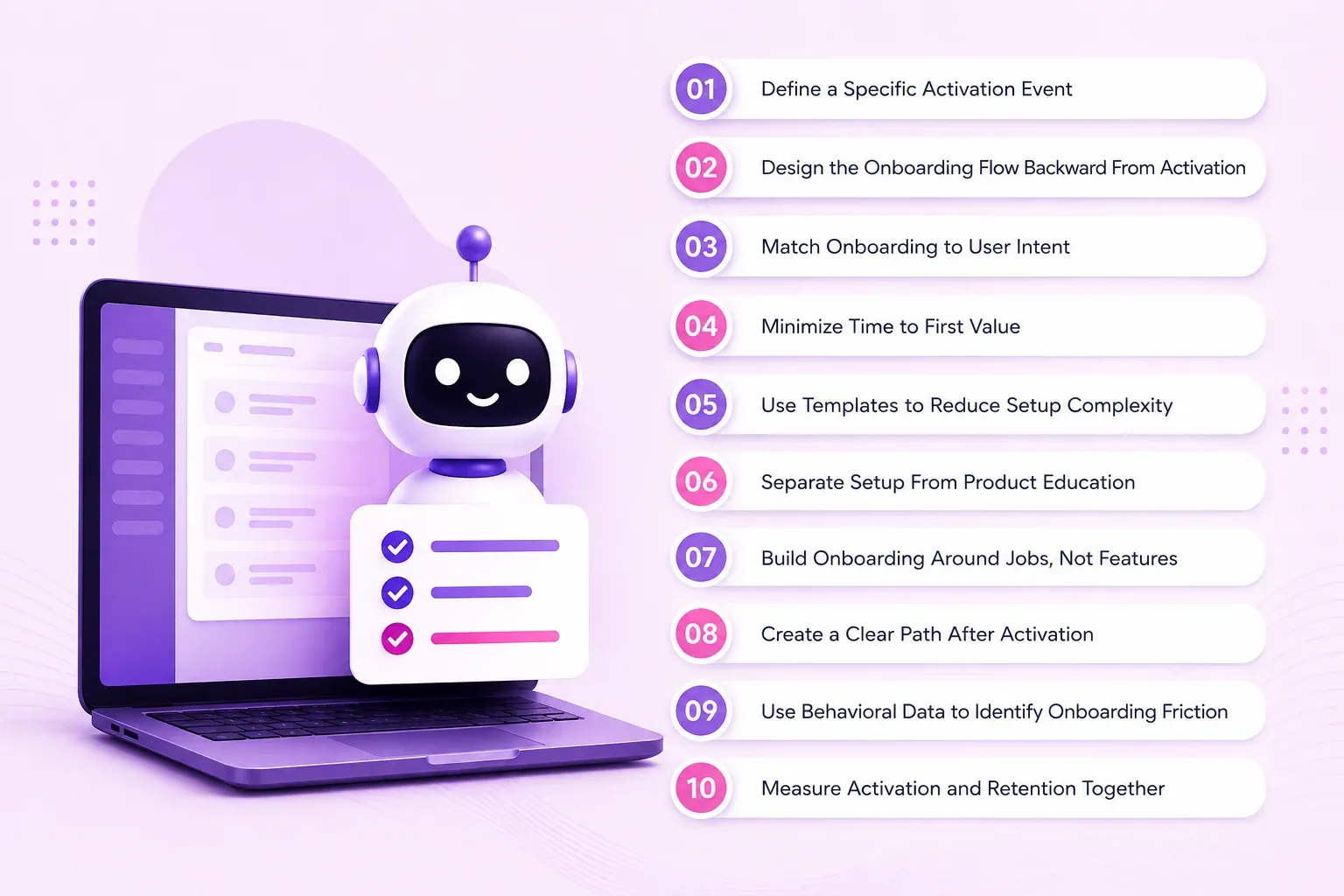
10 SaaS Onboarding Best Practices for Higher Activation
1. Define a Specific Activation Event
The first step is deciding what activation means for your product.
Avoid weak milestones such as:
- Creating an account
- Logging in
- Opening the dashboard
- Completing a profile
- Watching a tutorial
These actions show activity, but they may not demonstrate value.
Instead, identify the first behavior strongly connected to the customer's desired outcome.
For example:
| SaaS category | Possible activation event |
| CRM | Create first opportunity |
| Project management | Create and assign first project |
| Analytics | Connect data and generate report |
| Collaboration | Invite a teammate and complete a shared action |
| Marketing automation | Launch first campaign |
Your activation event should be observable in product analytics and closely related to continued product usage.
This gives product teams a measurable target for the entire onboarding journey.
2. Design the Onboarding Flow Backward From Activation
Once the activation event is defined, work backward to identify what users genuinely need to complete before reaching it.
Suppose the activation event is creating the first automated workflow.
The necessary path might be:
Choose template → Connect data → Select trigger → Configure action → Publish workflow
Now examine every additional step.
Does the user really need to:
- Complete their profile?
- Configure advanced permissions?
- Invite their entire team?
- Read documentation?
- Set every notification preference?
If not, move those actions later.
This is one of the most important user onboarding best practices because it prevents companies from turning onboarding into a mandatory product-training program.
The goal is not to expose everything before activation. It is to provide just enough information and setup for the user to succeed.
3. Match Onboarding to User Intent
A user who signs up to accomplish one task should not receive the same starting experience as someone with a completely different goal.
Use information such as:
- Role
- Use case
- Industry
- Company size
- Plan
- Acquisition source
- Signup responses
- Early product behavior
to identify likely intent.
For example, a CRM could ask:
“What are you trying to accomplish first?”
- Manage sales opportunities
- Track customer relationships
- Build sales reports
- Manage a sales team
The answer can determine the first recommended workflow.
This does not mean creating dozens of separate onboarding experiences. A few meaningful paths based on high-value use cases can make the experience considerably more relevant.
4. Minimize Time to First Value
A user should experience the product's value as early as the product reasonably allows.
That does not necessarily mean making onboarding shorter in absolute terms. It means removing work that does not contribute to the first meaningful outcome.
Prioritize:
- Required setup over optional configuration
- Defaults over unnecessary choices
- Templates over blank screens
- Demonstrable outcomes over feature explanations
- Relevant actions over broad product education
Amplitude's research emphasizes the importance of early value, with its 2025 benchmark analysis finding that products with stronger early activation were substantially more likely to perform well on longer-term retention.
For SaaS teams, time to value should therefore be treated as a product metric rather than simply a customer success concern.
5. Use Templates to Reduce Setup Complexity
Templates are particularly useful when the product requires users to build something before they can experience value.
Starting from an empty workspace forces users to make decisions they may not yet understand.
A template can provide a working starting point:
- A sales pipeline
- A project plan
- A reporting dashboard
- An automation workflow
- A marketing campaign
- A customer support configuration
The best template is not necessarily the most comprehensive one. It is the one that gets a specific user to a useful result with the fewest decisions.
For example, instead of showing 30 templates, a project-management platform could surface three based on the user's selected use case.
This reduces decision fatigue while giving users a concrete example of what successful product usage looks like.
6. Separate Setup From Product Education
Setup and education have different purposes.
Setup: Get the product ready to use.
Education: Explain how the product works.
Activation: Help the user achieve a valuable outcome.
Combining all three creates unnecessary cognitive load.
A better sequence is:
Complete essential setup → Perform the core action → Introduce the next relevant capability
For example, a new analytics user does not necessarily need a detailed explanation of every reporting feature before creating the first dashboard.
Once the user has produced a useful report, advanced capabilities become easier to understand because they have a practical context.
Digital adoption platforms can support this approach by delivering contextual guidance when users need help with a specific workflow or feature.
This approach makes SaaS user onboarding more focused and prevents the common mistake of teaching users features before they understand why those features matter.
7. Build Onboarding Around Jobs, Not Features
Feature-led onboarding asks:
“Which features should we show?”
Outcome-led onboarding asks:
“What does the customer need to accomplish?”
That distinction changes the entire experience.
Imagine a SaaS platform has:
- Dashboards
- Reports
- Filters
- Alerts
- Integrations
- Export tools
A feature-led tour might introduce all six.
An outcome-led flow might instead say:
“Create a weekly performance report for your team.”
The user then learns the dashboard, filters, and export functionality while completing an actual job. In-app guidance can support this approach by helping users complete the relevant workflow directly within the product, rather than asking them to learn every feature before taking action.
This is more useful because users learn through application rather than memorization.
It also prevents onboarding from becoming a condensed version of the product documentation.
8. Create a Clear Path After Activation
Activation is not the end of onboarding.
After users complete their first successful action, they need a logical next step.
For example:
First report → Schedule report → Share with team
or:
First project → Invite team → Create recurring workflow
or:
First campaign → Review performance → Optimize next campaign
This creates a progression from first value to repeat value.
Amplitude's benchmark research supports the importance of early activation and retention, showing a strong relationship between seven-day activation and three-month retention.
Therefore, teams should avoid designing onboarding around a single "aha moment." The stronger approach is to create a sequence of meaningful product outcomes.
9. Use Behavioral Data to Identify Onboarding Friction
Analytics should answer more than “How many users completed onboarding?”
Track where users:
- Start setup
- Abandon setup
- Repeat an action
- Encounter an error
- Visit help content
- Complete the core workflow
- Return after activation
Then examine the largest drop-offs.
For example:
Signup → 90%
Setup started → 75%
Integration completed → 42%
Core workflow started → 35%
If the biggest drop occurs during integration, improving the welcome screen will probably have little impact.
The data tells you where the real problem is.
This is also where onboarding experimentation becomes more useful. Instead of redesigning the entire experience, teams can focus on the specific step causing the highest-value users to stall.
10. Measure Activation and Retention Together
Onboarding success should not be reduced to one metric.
A practical measurement framework includes:
| Metric | What it tells you |
| Activation rate | How many users reach meaningful value |
| Time to activation | How quickly users reach that value |
| Step conversion | Where users drop out |
| Onboarding completion | Whether users finish the defined flow |
| Activation depth | How strongly activated users engage |
| Day-7 retention | Whether early value leads to return usage |
| Feature adoption | Whether users expand beyond the initial workflow |
A high onboarding completion rate with weak activation is a warning sign.
Likewise, high activation with poor retention may indicate that the first experience is successful but the product does not create enough recurring value.
The objective is therefore not to maximize one onboarding metric. It is to build a measurable relationship between signup, activation, repeat usage, and retention.
What Should a SaaS Onboarding Process Look Like?
A practical SaaS onboarding process can be organized into six stages:
Stage 1: Understand intent
Identify why the user signed up and what they want to accomplish.
Stage 2: Remove essential setup barriers
Ask only for the information required to reach the first outcome.
Stage 3: Guide the first meaningful action
Help the user complete the activation event.
Stage 4: Confirm success
Make the achieved outcome visible so users understand the value they just created.
Stage 5: Introduce the next relevant action
Move users from their first success toward repeat usage.
Stage 6: Measure and improve
Analyze behavioral data and continuously optimize the highest-impact friction points.
This framework keeps the onboarding experience connected to user outcomes instead of turning it into a list of product features.
SaaS Onboarding vs Customer Onboarding: What's the Difference?
The terms are related but are not always interchangeable.
SaaS onboarding generally refers to the product experience that helps users start using the software.
Customer onboarding is broader. It can include implementation, configuration, training, stakeholder alignment, integrations, success planning, and human support.
For a self-service SaaS product, these processes may happen almost entirely inside the application.
For an enterprise SaaS product, customer onboarding may involve product, sales, implementation, customer success, IT, and end users. Understanding how different stakeholders move through enterprise technology adoption can also help teams design onboarding experiences that support adoption beyond the initial product experience.
The distinction matters because product onboarding should not attempt to solve every implementation or customer-success requirement.
The product experience should focus on what users need to accomplish inside the software.
Common SaaS Onboarding Mistakes to Avoid
Even well-designed onboarding programs can underperform when they optimize the wrong thing.
Showing every feature immediately
Users rarely need the entire product on their first day.
Making setup mandatory before value
Move nonessential configuration after the first meaningful outcome.
Treating every user identically
Different roles and use cases often require different starting points.
Measuring completion instead of activation
A completed checklist does not prove that the customer received value.
Ignoring post-activation behavior
A successful first session does not automatically create retention.
Adding guidance instead of fixing UX problems
If users repeatedly fail because a workflow is confusing, simplify the workflow before adding more instructions.
Conclusion
The best SaaS Onboarding Best Practices are ultimately about one thing: helping users reach meaningful value with less uncertainty and unnecessary effort.
The strongest onboarding experiences define a clear activation event, align the journey with user intent, minimize setup requirements, use templates where appropriate, teach through real tasks, and create a logical path from first success to repeat usage.
Just as importantly, successful SaaS teams measure what happens after the welcome screen. Activation rate, time to activation, funnel conversion, and early retention provide a much clearer picture of onboarding performance than checklist completion alone.
In 2026, SaaS onboarding should therefore be treated as an activation system rather than a product tour.
When every onboarding step has a clear purpose—helping the right user reach the right outcome faster—the experience becomes easier to understand, easier to optimize, and more valuable to both the customer and the business.
Frequently Asked Questions
1. What are the best SaaS onboarding practices?
The most effective practices include defining a clear activation event, reducing time to value, matching onboarding to user intent, simplifying setup, using relevant templates, focusing on user outcomes, analyzing behavioral friction, and measuring activation alongside retention.
2. How can SaaS companies improve user activation?
Start by identifying the product action that represents meaningful value. Then remove unnecessary steps between signup and that action, provide relevant guidance or templates, and use behavioral analytics to identify where users abandon the journey.
3. What is a good SaaS onboarding process?
A good process moves users through a simple sequence: identify their goal, complete essential setup, perform the core action, confirm the first success, introduce the next relevant action, and continuously optimize the journey using behavioral data.
4. What metrics should SaaS companies track during onboarding?
Key metrics include activation rate, time to activation, onboarding step conversion, completion rate, activation depth, Day-7 retention, and feature adoption. The exact metrics should reflect the product's activation event and customer journey.
5. What is the difference between SaaS onboarding and customer onboarding?
SaaS onboarding primarily focuses on helping users start using the software and achieve an initial outcome. Customer onboarding is broader and can include implementation, integrations, training, stakeholder alignment, configuration, and customer-success activities.