Enterprise AI adoption is not complete when employees receive access to an AI tool. It becomes successful when teams use AI consistently in their daily workflows, understand its limitations, and achieve measurable business outcomes. An effective AI adoption framework helps organizations move from isolated experiments to repeatable, governed, and scalable AI usage.
For enterprise leaders, the challenge is not simply choosing the right technology. It is identifying valuable use cases, preparing employees, addressing security concerns, redesigning workflows, and measuring whether AI delivers lasting value. Without a structured approach, promising pilots can remain disconnected from everyday operations.
McKinsey's 2025 State of AI research reported that 88% of survey respondents said their organizations regularly used AI in at least one business function. Yet most organizations had not scaled AI across the enterprise. This gap highlights why adoption requires a deliberate plan beyond experimentation.
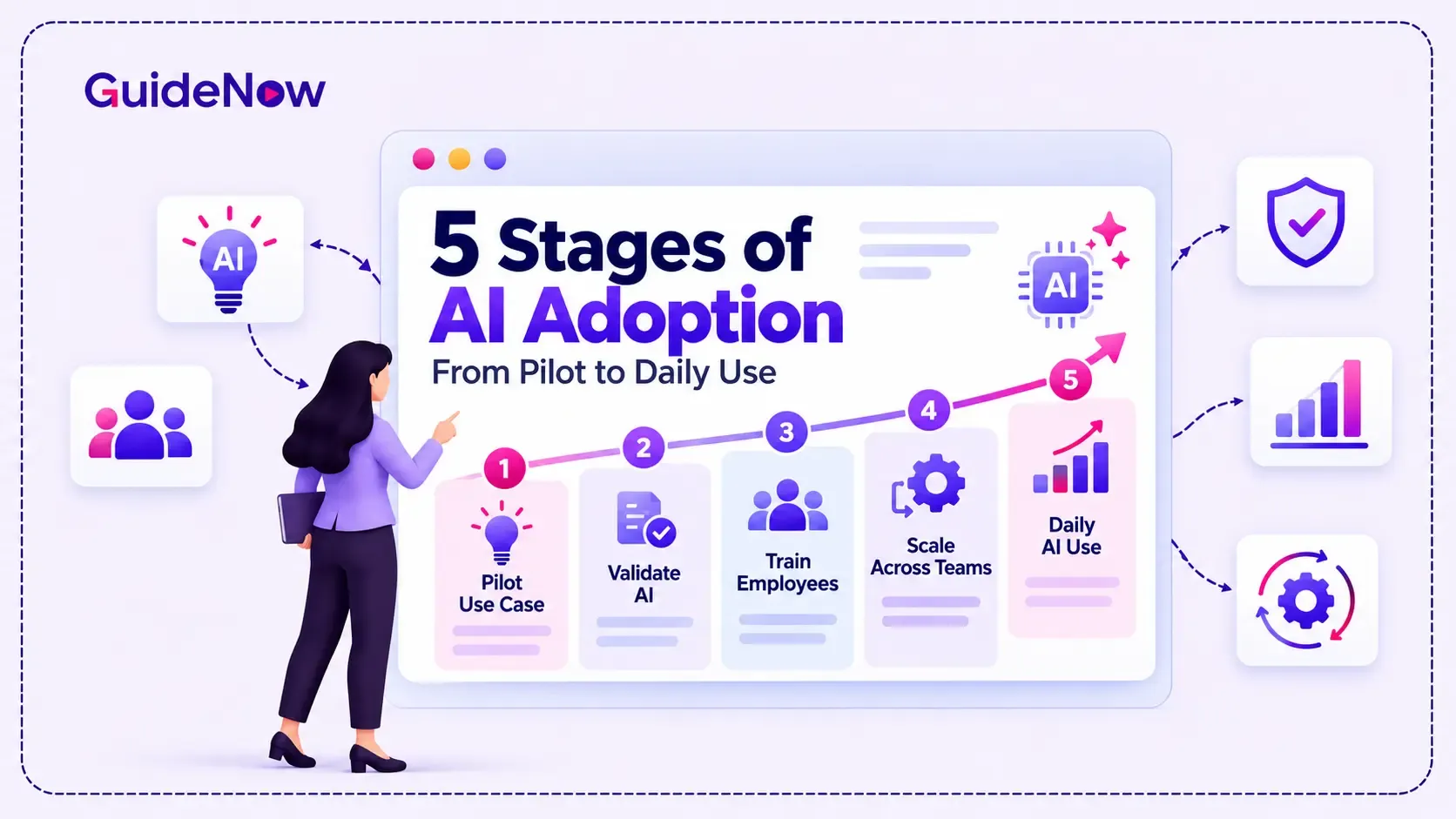
This guide explains five practical stages enterprises can follow to introduce AI, prepare employees, integrate tools into everyday work, and establish long-term adoption.
What Is an AI Adoption Framework?
An AI adoption framework is a structured approach that helps an organization introduce AI, validate its business value, prepare employees to use it, integrate it into workflows, and expand successful use cases across the enterprise.
Unlike an implementation plan that focuses primarily on technology deployment, an adoption framework addresses employee readiness, workflow changes, governance, training, and ongoing measurement.
A practical framework connects five elements:
- Business alignment: Identify problems where AI can deliver measurable value.
- Governance: Establish policies for security, privacy, accuracy, and responsible use.
- Employee readiness: Help employees understand when and how to use AI.
- Workflow integration: Make AI useful within existing business processes.
- Performance measurement: Track adoption, quality, productivity, and business outcomes.
The objective is to make AI a reliable part of everyday work rather than another application employees occasionally experiment with.
Why Enterprises Need a Structured AI Adoption Strategy
AI pilots can demonstrate technical potential without proving that an organization can use the technology consistently at scale. Employees may struggle to understand appropriate use cases, managers may lack clear success criteria, and disconnected tools may introduce additional work instead of reducing it.
McKinsey's 2025 research on scaling AI reported that only 7% of respondents said their organizations had fully scaled AI across the enterprise. The finding illustrates the difference between using AI in individual functions and embedding it throughout an organization.
Common barriers include:
- Unclear business objectives and ownership.
- Employee concerns about accuracy, job changes, and data privacy.
- Limited practical training for real work scenarios.
- AI tools that sit outside existing workflows.
- Inconsistent policies across departments.
- Insufficient measurement of sustained usage and business outcomes.
A structured AI adoption strategy helps organizations address these barriers in stages. Instead of rolling out AI everywhere at once, teams can validate use cases, learn from employee feedback, and expand only when the necessary processes and safeguards are in place.
The 5 Stages of Enterprise AI Adoption
Stage 1: Identify Business Problems and Select Pilot Use Cases
The first stage is to identify where AI can solve a genuine business problem. Starting with a list of available tools can lead to experimentation without a clear reason to continue. Instead, begin with business processes that are repetitive, time-consuming, information-intensive, or difficult to scale.
For example, a customer support team might investigate AI-assisted response drafting, while a finance team might explore document summarization or report preparation. Each use case should have a defined business owner and an outcome that can be measured.
How to implement this stage:
- Interview department leaders and employees to identify recurring workflow challenges.
- Assess use cases based on business value, feasibility, risk, and data availability.
- Select a small pilot group with representative users.
- Define baseline performance metrics before introducing AI.
- Establish acceptable-use rules and human review requirements.
Avoid selecting a pilot solely because it is easy to demonstrate. A useful pilot addresses a meaningful problem and provides evidence that the approach can work in a real business environment.
Exit criteria: The organization has an approved use case, a defined owner, baseline measurements, appropriate safeguards, and a clear definition of success.
Stage 2: Validate the Pilot and Build Employee Confidence
Once a use case is selected, test it in a controlled environment. The purpose is to determine whether AI improves the workflow without creating unacceptable risks or additional complexity.
Employees should participate in the evaluation because they understand the practical challenges that may not appear during a technical demonstration.
For example, an AI writing assistant may produce useful first drafts but require employees to verify facts, adjust tone, and protect confidential information. These steps must be included in the actual workflow rather than ignored in a pilot report.
How to implement this stage:
- Test the tool using realistic business tasks and approved data.
- Compare results against the original workflow.
- Document accuracy issues, review requirements, and failure cases.
- Collect feedback from employees and managers.
- Provide practical guidance on prompting, verification, and responsible use.
- Define conditions under which the tool should not be used.
Measure more than the number of times employees open the application. Evaluate task completion, output quality, rework, employee confidence, and the time required to finish the process.
Exit criteria: The pilot demonstrates measurable value, employees understand the workflow, and the organization has addressed material risks before expansion.
Stage 3: Prepare Employees and Integrate AI Into Daily Work
A successful pilot does not automatically translate into organization-wide adoption. Employees need to understand how AI applies to their responsibilities and how it fits into existing systems and procedures.
This stage connects AI capabilities with specific roles, tasks, and workflows. Training should focus on practical scenarios rather than generic demonstrations of what AI can do.
A strong AI implementation framework should include role-based learning, accessible guidance, clear escalation paths, and opportunities for employees to practice with approved use cases.
How to implement this stage:
- Map AI use cases to the tasks employees perform regularly.
- Create role-specific instructions, examples, and reusable prompts.
- Explain data-handling rules and when human review is mandatory.
- Embed guidance into the applications and workflows employees already use.
- Provide support when employees encounter unfamiliar outputs or errors.
- Collect feedback and update instructions as workflows change.
For example, sales employees may need guidance on researching accounts and reviewing AI-generated outreach, while HR teams may require stricter controls when handling employee information.
Reducing onboarding friction: Employees should be able to find instructions when they need them, rather than repeatedly searching through training documents. Contextual guidance and in-application walkthroughs can help employees learn new processes while performing their actual tasks.
A digital adoption platform can support this process when it provides relevant in-app guidance, walkthroughs, or contextual assistance for supported enterprise applications. It complements AI training by helping employees navigate the software in which their work takes place.
Exit criteria: Employees can complete the target workflow independently, follow approved usage policies, and access support when needed.
Stage 4: Scale Successful Use Cases Across Teams
Once a pilot has demonstrated value and employees can use the workflow reliably, the organization can expand it to additional teams. Scaling requires more than granting access to a larger group. It involves adapting the workflow, governance, training, and support model to different departments.
Organizations should use pilot findings to create a repeatable deployment process that can be applied to similar use cases.
How to implement this stage:
- Identify teams with similar needs and compatible workflows.
- Standardize approved use cases, guidance, and quality checks.
- Assign departmental champions and accountable process owners.
- Establish consistent access controls and data governance.
- Monitor adoption across teams and investigate differences.
- Maintain human oversight for high-risk or consequential decisions.
Do not assume every department should use AI in the same way. Finance, HR, customer service, and engineering may require different controls, training, and performance indicators.
Scaling should also include a review of existing processes. If AI is added to an inefficient workflow without reconsidering how work is performed, the organization may automate individual tasks without achieving broader improvements.
Exit criteria: Multiple teams can use the solution consistently, support processes are established, and performance remains acceptable as usage grows.
Stage 5: Embed AI Into Daily Operations and Continuously Improve
The final stage is achieved when AI becomes a dependable part of routine work rather than a separate initiative that requires constant reminders.
This does not mean every employee must use AI for every task. Successful adoption means employees know when AI is useful, understand its limitations, and can choose the appropriate approach for each situation.
How to implement this stage:
- Include approved AI workflows in standard operating procedures.
- Review usage, output quality, and business outcomes regularly.
- Update training when tools, policies, or processes change.
- Identify workflows where employees still face unnecessary friction.
- Reassess permissions, data quality, and governance as usage expands.
- Retire use cases that no longer deliver sufficient value.
Organizations should distinguish between activity and outcomes. High usage does not necessarily mean that AI improves performance. Teams must continue checking whether the technology produces accurate results, reduces unnecessary effort, and supports business objectives.
Exit criteria: AI use is repeatable, measurable, governed, and incorporated into normal operational reviews.
AI Adoption Roadmap: From Pilot to Daily Use
The following comparison translates the five stages into an actionable enterprise plan. The suggested timelines are planning estimates, not universal benchmarks; complex deployments may require considerably longer.
| Adoption stage | Indicative timeline | Primary focus | Success measure |
| 1. Select use cases | Weeks 1–2 | Business value and risk assessment | Approved use case and baseline |
| 2. Validate the pilot | Weeks 3–6 | Quality, feasibility, and employee feedback | Pilot meets agreed success criteria |
| 3. Prepare employees | Weeks 5–10 | Role-based training and workflow integration | Employees complete tasks correctly |
| 4. Scale across teams | Weeks 9–16 | Governance and repeatable deployment | Sustained use across target teams |
| 5. Embed and improve | Ongoing | Measurement and optimization | Consistent adoption and business value |
The stages may overlap. For instance, employee training can begin while a pilot is being validated, provided that the scope, access, and safeguards are appropriate.
How to Measure Enterprise AI Adoption Success
A practical AI adoption roadmap should include metrics that reveal whether AI is being used effectively and whether that use creates business value.
| Metric | What it measures | How to use it |
| Active usage | Employees using approved AI tools over a defined period | Identify whether adoption extends beyond initial experimentation |
| Workflow adoption | Share of eligible workflows completed using the approved AI process | Measure integration into daily operations |
| Time to proficiency | Time required for employees to perform a task independently | Identify training and usability gaps |
| Task completion time | Time required to complete a defined workflow | Compare performance against the baseline |
| Output quality | Accuracy, completeness, and rework requirements | Ensure speed does not come at the expense of quality |
| Employee confidence | Understanding of appropriate use and limitations | Identify support and training needs |
| Business outcomes | Relevant cost, service, quality, or revenue measures | Evaluate whether adoption contributes to organizational objectives |
Establish baselines before deployment and compare results across equivalent tasks and periods. Where possible, use controlled comparisons to distinguish AI's contribution from other changes in staffing, workload, or processes.
Common AI Adoption Challenges and How to Address Them
Even a well-designed rollout can encounter obstacles. A practical implementation plan should anticipate them rather than treating adoption as a one-time communication exercise.
Employee resistance: Explain how AI will be used, involve employees in workflow design, and address concerns openly. Avoid presenting adoption as a requirement to use AI regardless of whether it is appropriate.
Insufficient training: Provide role-specific practice, examples, and guidance at the point of need. Training should evolve as employees encounter new tasks.
Security and compliance risks: Define approved tools, data access rules, review requirements, and escalation procedures before expanding usage.
Disconnected workflows: Integrate AI into existing processes where feasible. Avoid requiring employees to switch between multiple tools unnecessarily.
Weak measurement: Set baseline metrics and review actual outcomes instead of relying on adoption announcements or access counts.
Loss of momentum after launch: Assign ongoing ownership, review employee feedback, refresh guidance, and communicate lessons from successful use cases.
These measures help organizations build confidence and sustain adoption after the initial rollout.
The Role of Employee Enablement in Long-Term AI Adoption
Technology deployment is only one part of enterprise transformation. Employees must also learn new behaviors, understand changing processes, and apply AI appropriately in their daily responsibilities.
Effective change management helps organizations communicate why AI is being introduced, how roles may change, and what support employees can expect. Managers should make room for experimentation within approved boundaries while reinforcing accountability for the final output.
A connected digital workforce needs clear policies, practical learning resources, and support that adapts as tools and responsibilities evolve. Training should not end after launch; employees need updated guidance when systems change or new use cases are approved.
For organizations introducing AI through existing business applications, employee software onboarding can include task-specific instructions, contextual help, and guided practice. These methods help employees understand both how to use a tool and how it fits into the broader business process.
The objective is not to maximize AI usage at any cost. It is to enable employees to use AI confidently, safely, and effectively where it creates genuine value.
Conclusion: Turn Enterprise AI Experiments Into Everyday Value
Moving from an AI pilot to daily use requires a structured approach that connects technology, people, workflows, and business outcomes. Enterprises need to select meaningful use cases, validate results, prepare employees, scale responsibly, and continuously improve how AI is used.
A well-executed AI adoption framework makes each stage measurable and gives leaders clear criteria for deciding when to proceed, adapt, or stop. It also helps organizations avoid a common mistake: treating access to AI tools as proof of successful adoption.
Start with a specific business problem, establish a baseline, and involve employees from the beginning. Expand only when the evidence supports it, maintain appropriate human oversight, and review outcomes regularly. With clear ownership and ongoing employee enablement, enterprises can turn isolated AI experiments into sustainable improvements in everyday work.
Frequently Asked Questions(FAQ’s)
1. What are the five stages of enterprise AI adoption?
The five stages are selecting business use cases, validating a pilot, preparing employees and integrating workflows, scaling successful use cases, and embedding AI into daily operations. Each stage should have measurable exit criteria before the organization proceeds.
2. How long does enterprise AI adoption take?
The timeline depends on the use case, data readiness, security requirements, workforce size, and complexity of existing workflows. A limited pilot may take several weeks, while enterprise-wide adoption can require months or longer. Organizations should use evidence-based stage gates rather than relying on a fixed deadline.
3. How can enterprises increase employee adoption of AI tools?
Enterprises can improve adoption by demonstrating relevant use cases, providing role-based training, establishing clear data policies, addressing employee concerns, and integrating AI into existing workflows. Ongoing feedback and accessible contextual guidance help employees build confidence beyond initial training.
4. Which metrics should organizations track to evaluate AI adoption?
Useful metrics include active usage, adoption across eligible workflows, time to proficiency, task completion time, output quality, employee confidence, and relevant business outcomes. Metrics should be measured against a baseline so leaders can distinguish genuine improvements from increased tool activity.
5. How can a digital adoption platform support enterprise AI adoption?
A digital adoption platform can provide in-application walkthroughs, contextual guidance, and task-specific assistance within supported enterprise applications. It can complement formal AI training by helping employees apply approved processes while working, particularly when software interfaces or workflows change.