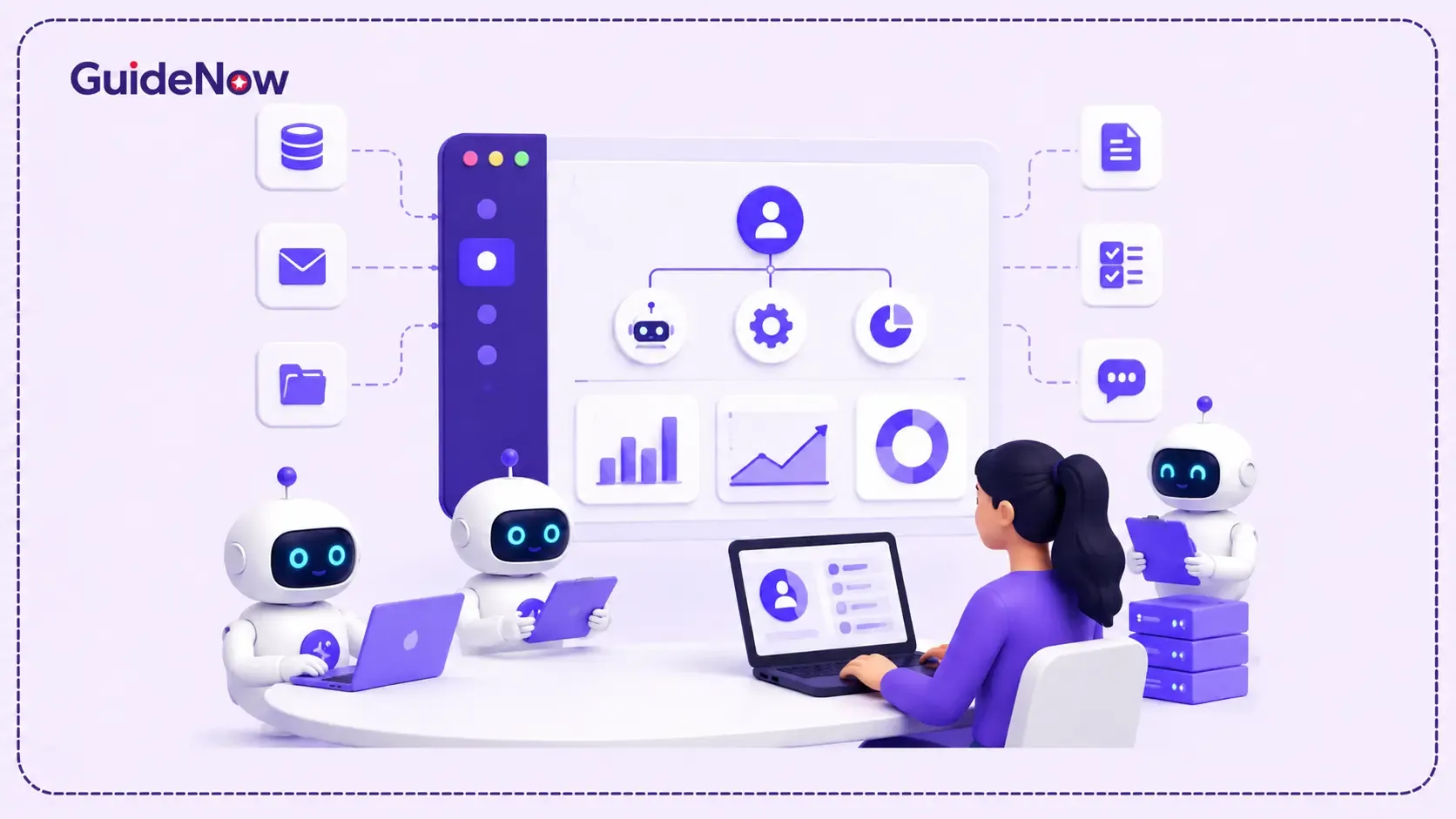
Enterprise leaders are facing a new reality: business growth is no longer constrained by technology availability but by how effectively people and technology work together.
Organizations have spent years investing in automation, cloud platforms, analytics, and digital transformation initiatives. Yet many still struggle with rising operational complexity, talent shortages, and increasing expectations for productivity. This challenge has accelerated interest in the digital workforce-a model where humans and AI-powered systems collaborate to execute work at scale.
Unlike traditional automation initiatives that focus on individual tasks, a digital workforce extends across departments, workflows, and business functions. It combines intelligent technologies with human expertise to create a more adaptive, efficient, and scalable operating model.
This guide explains what a digital workforce is, how it works, why enterprises are adopting it, and what leaders should consider when building an AI-augmented organization.
What Is a Digital Workforce?
A digital workforce is a collection of AI-powered systems, software bots, intelligent assistants, and autonomous technologies that perform business activities alongside human employees.
These digital workers can:
- Process information
- Execute repetitive tasks
- Analyze large datasets
- Generate recommendations
- Support decision-making
- Automate workflows
- Interact with enterprise applications
Unlike conventional automation tools, digital workers can often understand context, adapt to changing inputs, and operate across multiple systems.
The goal is not to replace employees. The goal is to augment human capabilities so employees can focus on strategic, creative, and customer-centric work while machines handle repetitive operational tasks.
This shift has given rise to the modern AI workforce, where organizations combine human intelligence with machine intelligence to improve speed, accuracy, and scalability.
Why Enterprises Are Investing in AI-Augmented Employees
Many organizations initially adopted automation to reduce manual work. Today, the objective is much broader.
Business leaders want to:
- Increase operational efficiency
- Improve customer experiences
- Reduce process bottlenecks
- Scale without proportional hiring
- Accelerate decision-making
- Improve workforce agility
The challenge is that modern work generates enormous volumes of information. Employees spend significant time searching for information, updating systems, responding to requests, and navigating increasingly complex software environments.
Digital workers help absorb this operational load.
Instead of asking employees to do more work, enterprises are redesigning work itself through workforce automation, allowing AI systems to complete routine tasks while humans focus on higher-value activities.
Digital Workforce vs Traditional Automation
Many organizations mistakenly view a digital workforce as simply another form of automation.
The difference is significant.
| Capability | Traditional Automation | Digital Workforce |
| Primary Goal | Automate repetitive tasks | Augment and scale work |
| Decision Making | Rules-based | Context-aware and adaptive |
| Data Processing | Structured data only | Structured and unstructured data |
| Learning Capability | None | Continuous improvement |
| Human Collaboration | Minimal | Built for collaboration |
| Workflow Scope | Single process | End-to-end business processes |
| Intelligence Level | Fixed logic | AI-driven reasoning |
Traditional automation focuses on efficiency.
A digital workforce focuses on outcomes.
This evolution is driven by advances in AI automation, machine learning, generative AI, and enterprise intelligence platforms.
The Technologies Behind a Digital Workforce
A digital workforce is not a single product.
It is an ecosystem of technologies working together.
AI Agents
Modern AI agents can interpret requests, perform tasks, retrieve information, and execute workflows autonomously.
Examples include:
- Customer support assistants
- IT service agents
- HR assistants
- Procurement assistants
- Knowledge management assistants
These systems increasingly function as digital colleagues rather than software tools.
Robotic Process Automation
Robotic process automation remains a foundational technology for digital workforce initiatives.
RPA excels at:
- Data entry
- Invoice processing
- System synchronization
- Form completion
- Report generation
Rather than replacing RPA, AI extends its capabilities by enabling systems to handle exceptions and unstructured information.
Intelligent Automation
Intelligent automation combines AI, machine learning, and process automation to create more adaptive workflows.
This enables systems to:
- Understand documents
- Interpret customer requests
- Detect anomalies
- Recommend actions
- Optimize processes
Enterprise AI Platforms
Modern enterprise AI platforms connect AI models, business systems, and operational data into a unified environment where digital workers can operate securely and at scale.
The Business Case for a Digital Workforce
The strongest digital workforce initiatives are driven by measurable business outcomes rather than technology adoption alone.
Increased Productivity
A digital workforce reduces the amount of time employees spend on repetitive administrative work.
Instead of manually updating systems or processing routine requests, employees can focus on strategic activities that generate greater business value.
This directly improves employee productivity across departments.
Faster Decision-Making
AI-powered systems can analyze large volumes of information in seconds.
This helps leaders:
- Identify trends faster
- Respond to risks earlier
- Make more informed decisions
- Improve operational visibility
Greater Scalability
Organizations can expand operations without increasing headcount at the same rate.
This is particularly valuable in:
- Customer support
- Finance operations
- HR administration
- Supply chain management
- IT operations
Improved Accuracy
Digital workers eliminate many manual processing errors that affect compliance, reporting, and operational performance.
The Rise of AI in the Workplace
The next stage of enterprise transformation is not about replacing employees.
It is about integrating AI in the workplace as a productivity partner.
Employees increasingly interact with:
- AI copilots
- Virtual assistants
- Knowledge agents
- Workflow assistants
- Generative AI tools
These technologies help employees complete work more efficiently while maintaining human oversight and accountability.
The most successful organizations view AI as a capability multiplier rather than a workforce replacement strategy.
Digital Workforce Adoption Is More Than a Technology Project
Many digital workforce initiatives fail because organizations focus exclusively on technology.
The larger challenge is organizational adoption.
This is where digital transformation efforts often stall.
Technology can be implemented successfully yet still fail to deliver value if employees do not integrate it into daily workflows. Research cited by McKinsey has consistently shown that only a small percentage of transformation programs sustain long-term performance improvements after implementation.
A successful digital workforce strategy requires changes in:
- Work design
- Skills development
- Employee enablement
- Governance
- Process ownership
In practice, workforce transformation is as much a people initiative as it is a technology initiative.
Statistics Every Enterprise Leader Should Know
Recent research highlights why digital workforce investments continue to accelerate.
| Research Organization | Key Finding |
| McKinsey | Only 16% of digital transformations achieve and sustain intended performance improvements. |
| Gartner | Less than half of digital initiatives consistently meet business outcome targets. |
| Deloitte | Many leaders cite unclear measurement frameworks as a major barrier to technology adoption success. |
The lesson is clear: success depends not only on deploying technology but also on ensuring people can effectively use it.
Why Employee Enablement Matters in a Digital Workforce
As organizations deploy more AI-powered systems, employees must continuously learn new workflows and tools.
Traditional training models often struggle to keep pace.
Employees typically forget information learned weeks before they need it.
This is why many enterprises are adopting Just in time learning approaches that deliver guidance exactly when employees need it during real work activities. This learning model improves retention, reduces disruption, and accelerates proficiency.
Organizations also increasingly use a digital adoption platform to provide contextual support within enterprise applications.
These platforms help employees navigate complex systems, complete workflows correctly, and reduce reliance on traditional training methods.
As AI adoption accelerates, the relationship between digital workforce initiatives and employee software onboarding becomes increasingly important.
How the Technology Adoption Curve Impacts AI Adoption
Not every employee embraces AI at the same speed.
The Technology adoption curve helps explain why.
Within most organizations, employees fall into several groups:
- Innovators
- Early adopters
- Early majority
- Late majority
- Laggards
Successful digital workforce programs recognize these differences and build adoption strategies accordingly. Organizations that account for varying adoption behaviors typically achieve stronger long-term outcomes than those relying on one-size-fits-all rollout plans.
Building a Sustainable Digital Workforce Strategy
Organizations often begin with isolated automation projects.
However, long-term success requires a broader approach.
Start With Business Outcomes
Focus on measurable goals such as:
- Reduced processing time
- Faster customer response
- Increased productivity
- Lower operational costs
Identify High-Friction Workflows
Look for areas where employees spend significant time on repetitive activities.
These processes typically generate the fastest returns.
Create Human-in-the-Loop Governance
Employees should remain responsible for:
- Strategic decisions
- Exception handling
- Risk management
- Compliance oversight
Prioritize Change Readiness
Technology adoption should be supported through communication, training, and reinforcement programs.
Many organizations also borrow principles from SaaS Onboarding Best Practices, such as role-based guidance and progressive learning experiences, to help employees adopt AI-powered tools more effectively.
Where Enterprise Automation Is Headed Next
The future of enterprise automation is moving beyond isolated workflows toward connected networks of intelligent workers.
Rather than automating a single process, organizations will orchestrate entire business operations through collaborative digital systems.
Future capabilities are expected to include:
- Multi-agent collaboration
- Autonomous workflow execution
- Predictive decision support
- Real-time operational optimization
- Personalized employee assistance
As these technologies mature, the distinction between software and workforce will continue to blur.
The organizations that succeed will not simply deploy AI tools.
They will redesign work around an integrated AI-powered workforce model where humans and intelligent systems operate as a unified team.
Conclusion
The digital workforce represents the next evolution of enterprise operating models.
It moves beyond traditional automation by combining AI, intelligent systems, and human expertise to execute work more efficiently and at greater scale.
Organizations that embrace this approach gain more than operational efficiency. They create a foundation for faster decision-making, stronger employee performance, improved customer experiences, and sustainable growth.
The future of work is not about humans competing with AI. It is about building organizations where human creativity, judgment, and leadership are amplified by intelligent digital workers.
As enterprises continue investing in AI, automation, and workforce transformation, the question is no longer whether a digital workforce will become part of business operations.
The question is how quickly organizations can adapt to this new model of work.
Frequently Asked Questions
1. What is the difference between a digital workforce and workforce automation?
Workforce automation focuses on automating specific tasks or processes, while a digital workforce combines multiple AI-powered technologies and digital workers that collaborate with employees across entire business functions.
2. How do AI agents fit into a digital workforce?
AI agents act as intelligent digital workers that can understand requests, retrieve information, make recommendations, and execute workflows across enterprise systems with minimal human intervention.
3. Can a digital workforce replace human employees?
Most enterprise implementations are designed to augment employees rather than replace them. Digital workers handle repetitive operational work while humans focus on strategic thinking, creativity, relationship management, and decision-making.
4. What industries benefit most from a digital workforce?
Financial services, healthcare, manufacturing, retail, logistics, telecommunications, and technology companies often see significant benefits because they manage large volumes of data, workflows, and repetitive operational processes.
5. How can organizations improve digital workforce adoption?
Successful adoption requires clear business objectives, leadership support, role-based enablement, continuous learning, contextual guidance, strong governance, and ongoing measurement of workforce outcomes. A platform such as GuideNow may support adoption efforts by helping employees navigate new workflows and technologies more effectively.