
A feature launch receives thousands of clicks. Onboarding completion improves by 25%. Product engagement reaches a record high. Yet three months later, leadership asks a question that product teams often struggle to answer: Did any of those improvements increase retention or revenue?
This is where many SaaS organizations hit a measurement gap. Adoption dashboards show activity. Customer success reports show engagement. Revenue teams track renewals and expansion. But few companies have a reliable way to connect these metrics into a single story that explains how product experience influences business growth.
The challenge becomes even greater as product-led growth strategies mature. Improving onboarding, driving feature discovery, and increasing user engagement are valuable outcomes, but they only matter when they translate into higher retention, stronger customer lifetime value, and measurable revenue impact. Without that connection, organizations risk investing in initiatives that generate activity without creating business results.
The most successful SaaS companies approach product experience differently. They focus on identifying the user behaviors that predict retention, the adoption patterns that drive expansion, and the product interactions that influence revenue outcomes. By measuring these relationships, they can move beyond engagement metrics and quantify the true business value of their product investments.
This guide explores how to measure Product Experience Platform ROI, which adoption and retention metrics deserve executive attention, and how to build a framework that connects user behavior directly to business performance.
What Is a Product Experience Platform and Why ROI Matters
A Product Experience Platform is designed to help organizations improve how users interact with software products throughout the customer lifecycle. It enables companies to guide users through onboarding, promote feature discovery, collect behavioral insights, and optimize digital experiences based on actual usage patterns.
While improving user experience is valuable, executive stakeholders typically evaluate investments through measurable business outcomes. This is where ROI becomes critical.
A strong product experience strategy can influence:
- Faster onboarding completion
- Increased feature engagement
- Reduced time-to-value
- Higher customer satisfaction
- Improved retention
- Expansion revenue opportunities
The challenge is connecting these outcomes to financial impact. Without a structured measurement framework, teams often struggle to justify investments in onboarding, in-app guidance, or user enablement initiatives.
The Three Core Dimensions of Product Experience ROI
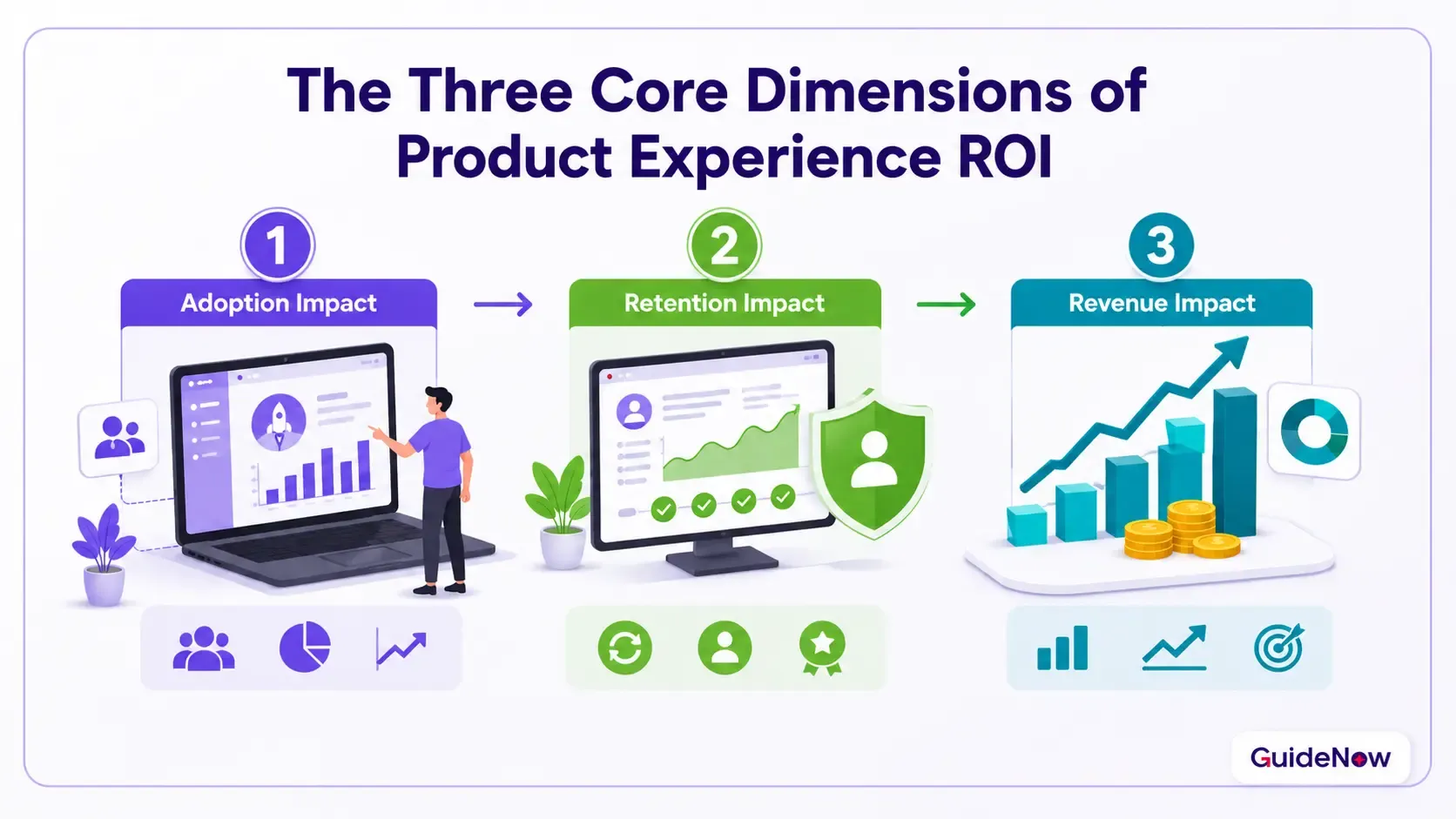
Most organizations evaluate ROI across three interconnected areas:
1. Adoption Impact
Adoption measures how effectively users embrace a product and integrate it into their workflows.
This includes:
- New user activation
- Feature utilization
- User engagement consistency
- Workflow completion rates
Organizations often track Product Adoption Metrics, User Adoption Metrics, and Software Adoption Metrics to understand whether users are realizing value from the platform.
When adoption increases, organizations typically see improvements in customer satisfaction, expansion opportunities, and retention outcomes.
2. Retention Impact
Adoption alone does not guarantee long-term success.
Many users initially engage with software but gradually abandon it when they fail to discover ongoing value.
Retention-focused measurement evaluates:
- Customer longevity
- Engagement consistency
- Renewal likelihood
- Churn reduction
Tracking Customer Retention Metrics, Product Retention Rate, User Retention Analytics, and SaaS Retention Metrics helps organizations determine whether product experiences are creating sustainable value over time.
3. Revenue Impact
The ultimate goal is understanding how product experience influences business performance.
Revenue impact may appear through:
- Increased renewals
- Higher expansion revenue
- Upsell opportunities
- Reduced customer acquisition payback periods
- Lower support costs
These outcomes create a measurable Revenue Impact of Product Adoption that can be tied directly to business growth initiatives.
The Metrics That Matter Most for Product Experience ROI
Many organizations track hundreds of product metrics. The highest-performing teams focus on a smaller set of indicators that directly correlate with business outcomes.
The table below outlines the most important ROI measurement categories.
| ROI Area | Primary Metric | Business Impact | Executive Relevance |
| User Activation | Time-to-Value | Faster onboarding success | Reduces acquisition payback period |
| Adoption | Product Adoption Rate | Increased product utilization | Higher customer engagement |
| Feature Usage | Feature Adoption Rate | Better feature discoverability | Supports expansion opportunities |
| Engagement | Active User Growth | Increased platform dependency | Stronger retention signals |
| Retention | Renewal Rate | Reduced churn | Predictable recurring revenue |
| Customer Success | Support Ticket Reduction | Lower operational costs | Improved profitability |
| Revenue | Expansion Revenue Growth | Increased account value | Revenue acceleration |
| Efficiency | Training Cost Reduction | Lower enablement expenses | Higher ROI realization |
This framework helps organizations move beyond vanity metrics and focus on indicators that executives actually care about.
How Product Experience Analytics Connect Usage to Business Results
One of the biggest challenges in ROI measurement is understanding how user behavior translates into business outcomes.
This is where Product Experience Analytics becomes essential.
Rather than measuring isolated events, modern analytics platforms connect behavioral patterns with customer outcomes.
For example:
- Users who complete onboarding within seven days may renew at higher rates.
- Users who adopt advanced features may generate higher expansion revenue.
- Users who engage with educational content may submit fewer support tickets.
These insights allow organizations to identify the behaviors that predict success and optimize experiences accordingly.
By combining behavioral intelligence with business metrics, teams can better quantify Product Analytics ROI and identify high-impact optimization opportunities.
Measuring Adoption Beyond Basic Login Metrics
Many organizations mistakenly assume that login frequency equals adoption.
In reality, meaningful adoption occurs when users successfully integrate a product into their workflows and achieve desired outcomes.
To measure adoption effectively, organizations should focus on:
Activation Completion
Determine how many users successfully complete critical onboarding milestones.
Examples include:
- Account setup completion
- First workflow creation
- Initial report generation
- Team member invitations
Workflow Engagement
Analyze whether users repeatedly perform high-value actions that indicate long-term usage.
Feature Utilization
Evaluate how frequently users engage with strategic capabilities that drive customer value.
Using Product Usage Analytics, teams can identify areas where adoption stalls and implement targeted interventions to improve engagement.
These insights contribute directly to measuring Product Adoption ROI.
The Relationship Between Adoption and Retention
Retention rarely improves without adoption.
Customers do not renew software because they purchased it. They renew because they consistently realize value from it.
Organizations often discover that churn originates from adoption failures that occur much earlier in the customer journey.
Common examples include:
- Incomplete onboarding
- Poor feature discovery
- Low engagement frequency
- Limited workflow integration
When organizations improve adoption, retention often follows.
This relationship makes Product Experience Management a strategic business function rather than simply a customer success initiative.
Retention-focused organizations continuously analyze user behavior to identify early warning signals and proactively address potential risks before churn occurs.
The Hidden Cost of Software Adoption Challenges
Many software organizations underestimate the financial impact of software adoption challenges.
Poor adoption creates several costly problems:
- Increased support burden
- Higher onboarding costs
- Longer time-to-value
- Lower customer satisfaction
- Reduced expansion opportunities
- Higher churn rates
In many cases, organizations spend significant resources acquiring customers but fail to maximize the value of those investments because users never fully adopt the product.
This makes adoption optimization one of the highest-leverage opportunities available to SaaS businesses.
Statistics That Demonstrate the Business Value of Adoption and Retention
Research consistently shows that retention and customer experience have a substantial impact on business performance.
According to McKinsey, companies that lead in customer experience can achieve revenue growth rates that significantly exceed those of their industry peers because customers are more likely to remain loyal and increase spending over time.
Gartner research has repeatedly highlighted that improving customer retention is often more cost-effective than acquiring new customers, making retention-focused initiatives a major driver of long-term profitability.
These findings reinforce the importance of measuring adoption and retention alongside revenue outcomes when evaluating product experience investments.
How Digital Adoption Platforms Influence ROI
Many organizations use a digital adoption platform to accelerate user onboarding and improve engagement.
These platforms help users navigate software by providing:
- Contextual guidance
- Interactive walkthroughs
- In-app support
- Personalized learning experiences
When implemented effectively, they can reduce friction throughout the user journey and improve onboarding success rates.
A well-designed product tour often becomes one of the first opportunities to influence adoption outcomes, helping users discover value more quickly and reducing abandonment during onboarding.
Building an ROI Measurement Framework
Organizations seeking measurable outcomes should establish a structured ROI framework.
Step 1: Define Business Objectives
Identify the outcomes that matter most.
Examples include:
- Increasing renewals
- Improving expansion revenue
- Reducing onboarding costs
- Accelerating activation
Step 2: Establish Baseline Metrics
Measure current performance before launching initiatives.
Document:
- Adoption rates
- Retention rates
- Revenue metrics
- Support costs
Step 3: Track Behavioral Changes
Monitor how user behavior evolves after implementing onboarding and engagement improvements.
Step 4: Connect Behavior to Outcomes
Identify which behavioral patterns correlate with:
- Renewals
- Upsells
- Expansion revenue
- Customer satisfaction
Step 5: Quantify Financial Impact
Calculate revenue gains, cost savings, and operational efficiencies generated by improved product experiences.
This process creates a repeatable framework for measuring SaaS ROI Metrics and demonstrating value to stakeholders.
The Role of Onboarding in Product-Led Growth
Organizations pursuing product-led growth strategies depend heavily on effective onboarding and adoption.
Without a strong onboarding experience, users may never reach their first moment of value.
Many successful SaaS companies implement saas onboarding best practices such as:
- Guided activation journeys
- Contextual assistance
- Progressive feature education
- Personalized onboarding paths
These approaches improve activation rates while reducing the effort required from customer success teams.
As adoption increases, organizations can more effectively measure Product-Led Growth ROI through improved retention, expansion revenue, and reduced acquisition costs.
Turning Product Experience Data Into Executive-Level Insights
Executives rarely need detailed clickstream reports.
Instead, they want answers to strategic questions:
- Are customers adopting the product?
- Is retention improving?
- Are support costs declining?
- Is revenue increasing?
The most effective reporting frameworks translate behavioral data into business outcomes.
For example:
Instead of reporting feature usage growth, report how feature adoption contributed to renewal improvements.
Instead of reporting onboarding completion rates, report how activation improvements accelerated customer value realization.
This approach helps organizations communicate Product Experience ROI in language that resonates with business leaders.
Conclusion
Measuring ROI from product experience initiatives requires more than tracking engagement metrics. Organizations must establish clear connections between user behavior, retention outcomes, and revenue performance.
A modern Product Experience Platform provides the visibility needed to understand how onboarding, feature adoption, and user engagement influence business growth. By focusing on adoption, retention, and revenue together, organizations can build a more complete picture of product performance and investment value.
The companies that excel in this area do not simply measure activity. They measure outcomes. They identify the behaviors that predict success, optimize experiences around those behaviors, and continuously improve customer value delivery.
As competition in SaaS markets intensifies, organizations that can clearly quantify Product Experience Platform ROI will be better positioned to improve retention, accelerate growth, and maximize long-term customer value.
Frequently Asked Questions
1. What is the best way to measure Product Experience Platform ROI?
The most effective approach is to connect adoption metrics, retention performance, and revenue outcomes within a single measurement framework. Organizations should track activation, feature engagement, renewals, and expansion revenue to understand total ROI.
2. Which metrics are most important for evaluating product adoption?
The most valuable metrics include activation completion, active usage frequency, workflow engagement, feature utilization, onboarding completion, and long-term customer engagement trends.
3. How does product adoption affect revenue growth?
Higher adoption increases customer value realization, which often leads to improved retention, greater expansion opportunities, reduced churn, and stronger recurring revenue performance.
4. Why is retention a critical component of product experience ROI?
Retention directly influences customer lifetime value. Even small improvements in retention can significantly increase profitability because retaining customers is typically less expensive than acquiring new ones.
5. How can organizations improve product experience ROI without increasing customer success costs?
Organizations can use behavioral analytics, guided onboarding experiences, contextual education, and in-app support to improve adoption efficiency. Platforms such as GuideNow represent one example of how organizations explore scalable user enablement approaches without relying entirely on human-led training efforts.