Artificial intelligence is rapidly moving from experimentation to everyday business operations. Organizations across industries are deploying AI copilots, intelligent assistants, workflow automation tools, predictive analytics platforms, and generative AI solutions to improve efficiency and accelerate decision-making.
Yet despite significant investments, many AI initiatives fail to achieve enterprise-wide adoption.
The reason is surprisingly simple: organizations focus on deploying technology while overlooking the people expected to use it.
Recent McKinsey research found a striking disconnect: 70% of employees feel personally ready to use AI, but only 27% of leaders believe their organizations are ready for the workforce, process, and cultural changes required to create enterprise value from AI.
This is where AI Change Management becomes critical.
Organizations that achieve meaningful AI outcomes understand that success is not driven by technology alone. It requires employee readiness, leadership alignment, workflow redesign, capability development, trust-building, and continuous support.
In this guide, you'll learn how to prepare employees for AI-powered tools, avoid common adoption failures, and build a scalable framework that turns AI investments into measurable business value.
What Is AI Change Management?
AI Change Management is the structured process of preparing employees, managers, leaders, and business functions to successfully adopt AI-powered technologies and integrate them into daily workflows.
Unlike traditional software implementations, AI changes how work is performed, how decisions are made, how teams collaborate, and how value is created.
An effective AI transformation requires organizations to address:
- Employee readiness
- Skills development
- Process redesign
- Leadership behaviors
- Communication strategies
- Governance frameworks
- Workforce planning
In simple terms, AI change management ensures people evolve alongside technology rather than being left behind by it.
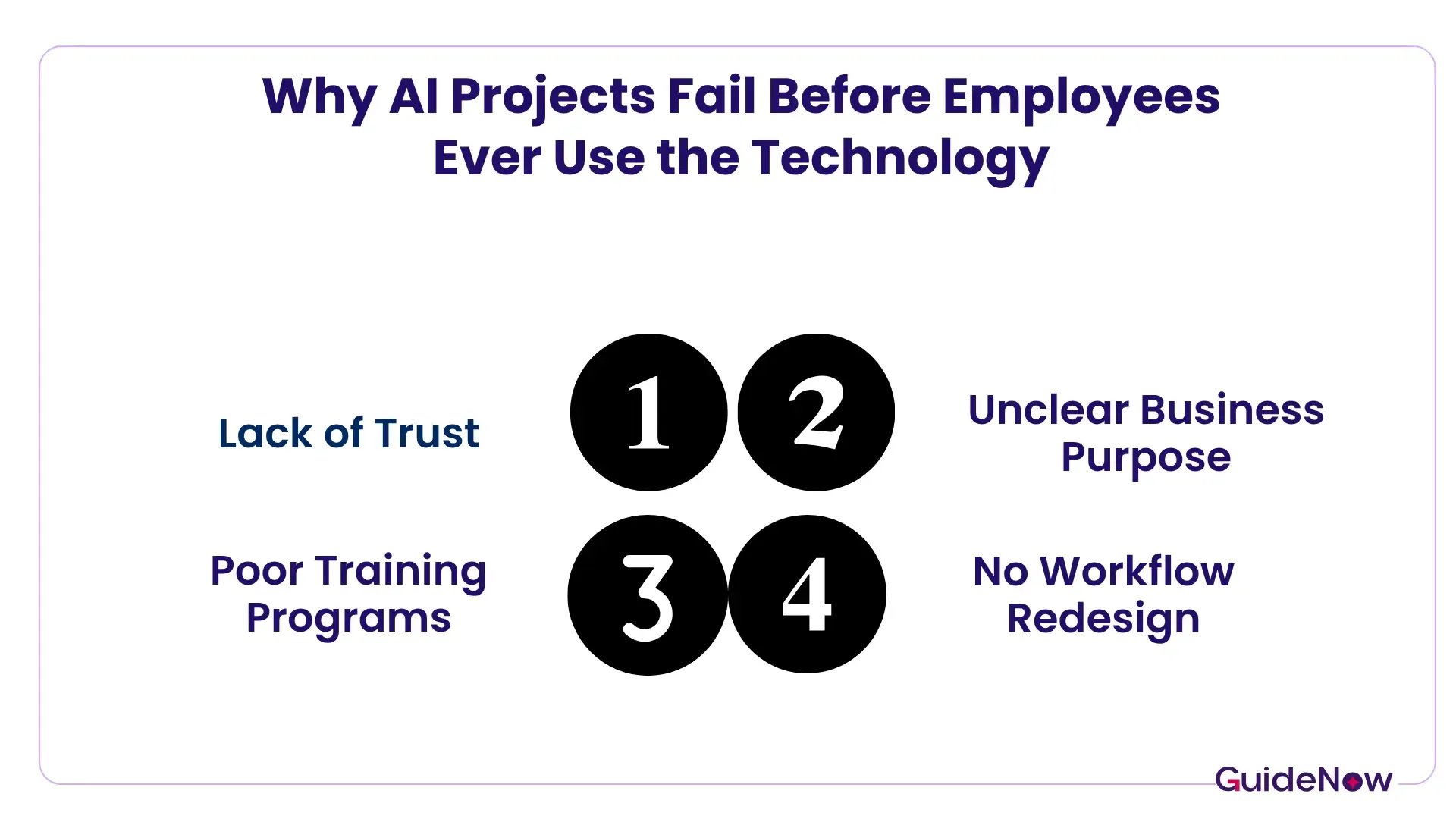
Why AI Projects Fail Before Employees Ever Use the Technology
One of the biggest misconceptions about AI adoption is that implementation automatically creates transformation.
In reality, many AI projects fail long before employees begin using the tools at scale.
The most common reason is that organizations treat AI as a technology initiative instead of an organizational transformation effort.
Lack of Trust
Employees often worry about:
- Job displacement
- Increased monitoring
- Reduced autonomy
- Unclear career paths
When organizations fail to address these concerns, resistance grows.
Unclear Business Purpose
Employees need clear answers to questions such as:
- Why is AI being introduced?
- How will it affect my role?
- What tasks will change?
- What opportunities will it create?
Without clarity, adoption slows significantly.
Poor Training Programs
Providing access to AI tools does not guarantee usage.
Organizations often reinforce learning with contextual guidance such as onboarding tooltips, walkthroughs, and in-app assistance that help employees apply AI tools in real workflows.
No Workflow Redesign
Many organizations simply layer AI on top of existing processes.
This often increases complexity rather than improving productivity.
The AI Readiness Gap: What Enterprise Leaders Are Missing
One of the most important findings in recent AI research is that employee readiness and organizational readiness are not the same thing.
McKinsey's global survey found that approximately 70% of respondents feel personally prepared to use AI, yet only 27% of leaders believe their organizations are ready for the broader people, culture, and operational changes AI requires.
This readiness gap reveals a critical challenge.
Most organizations focus on:
- AI tools
- Infrastructure
- Models
- Automation opportunities
But they underestimate the importance of:
- Leadership alignment
- Workforce capability building
- Organizational culture
- Process transformation
- Change enablement
As a result, many organizations achieve AI activity but fail to achieve AI value.
AI Change Management vs Traditional Change Management
AI introduces a fundamentally different type of change compared to traditional technology projects.
| Traditional Change Management | AI-Driven Transformation |
| Focuses on system adoption | Focuses on work redesign |
| Fixed processes | Continuously evolving workflows |
| One-time training | Continuous learning |
| Technology-centric | Human-AI collaboration |
| Compliance focused | Innovation focused |
| Usage metrics | Business outcome metrics |
| Process standardization | Workforce adaptability |
This distinction explains why organizations increasingly develop a dedicated AI change management strategy instead of relying solely on traditional change methodologies.
The CARE Framework for AI Change Management
To scale AI successfully, organizations need a repeatable approach that guides employees from awareness to adoption.
A practical AI change management framework is the CARE Model.
| Framework Layer | Purpose | Outcome |
| C – Communicate | Explain why AI is being introduced | Reduce uncertainty |
| A – Assess | Measure workforce readiness | Identify adoption barriers |
| R – Reskill | R – Reskill | Increase confidence |
| E – Embed | Integrate AI into workflows | Sustain adoption |
Communicate
Employees need transparency around:
- Business objectives
- Expected outcomes
- Role changes
- Future opportunities
Assess
Organizations should conduct an AI readiness assessment before large-scale deployment.
Reskill
AI literacy should become a core workforce capability.
Embed
The goal is to make AI part of everyday work rather than a separate activity.
How to Conduct an AI Readiness Assessment
Before launching AI initiatives, organizations should evaluate readiness across five dimensions.
Leadership Readiness
Questions include:
- Are leaders aligned on AI objectives?
- Do executives actively support adoption?
- Is sponsorship clearly defined?
Workforce Readiness
Questions include:
- How comfortable are employees with AI?
- What concerns exist?
- Which teams need additional support?
Skills Readiness
Questions include:
- What AI capabilities already exist?
- Which skills gaps require attention?
Process Readiness
Questions include:
- Which workflows can be augmented by AI?
- Which processes require redesign?
Technology Readiness
Questions include:
- Is the data infrastructure prepared?
- Are governance policies established?
Organizations that complete these assessments before deployment often experience faster adoption and fewer implementation challenges.
The Five Stages of Employee Adoption During AI Transformation
Employee adoption rarely happens instantly.
Most employees move through five predictable stages.
Stage 1: Awareness
Employees learn that AI tools are being introduced.
Primary need: communication.
Stage 2: Understanding
Employees begin understanding use cases and potential impacts.
Primary need: education.
Stage 3: Experimentation
Employees test AI tools within limited workflows.
Primary need: guidance.
Stage 4: Integration
AI becomes part of daily activities.
Primary need: reinforcement.
Stage 5: Optimization
Employees actively improve workflows using AI.
Primary need: continuous learning.
Organizations that support employees through all five stages achieve stronger long-term adoption outcomes.
Building an AI Implementation Roadmap That Employees Actually Follow
Many organizations create technically sound deployment plans but fail to develop a people-focused AI implementation roadmap.
A successful roadmap should include both technical and human milestones.
Phase 1: Define Business Outcomes
Identify measurable objectives such as:
- Productivity gains
- Customer experience improvements
- Revenue growth
- Cost reduction
Phase 2: Identify Impacted Roles
Determine which teams will experience the greatest change.
Phase 3: Develop Communication Plans
Create consistent messaging for employees, managers, and executives.
Phase 4: Launch Pilot Programs
Use controlled environments to gather feedback and refine processes.
Phase 5: Scale Incrementally
Expand adoption gradually while measuring engagement and business outcomes.
This structured approach strengthens any AI implementation strategy by aligning workforce readiness with deployment activities.
Training Employees for AI-Powered Workflows
One of the strongest predictors of successful enterprise AI adoption is workforce capability development. A structured employee software onboarding strategy ensures workers understand new AI tools quickly and can integrate them into daily tasks with confidence.
McKinsey research indicates that employees want more AI training and support, and many believe formal education would significantly increase their AI usage.
Foundational AI Literacy
Training should cover:
- AI fundamentals
- Responsible AI
- Data privacy
- Human oversight
Role-Based Learning
Different departments require different learning paths.
Examples include:
- Marketing teams using content generation
- Sales teams using AI research tools
- Customer support teams using AI assistants
- HR teams using talent analytics
Advanced AI Skills
Organizations can later introduce:
- Prompt engineering
- Workflow automation
- AI-assisted decision making
- AI governance practices
Continuous learning consistently outperforms one-time training events.
The Role of Managers in AI Workforce Transformation
Many organizations focus exclusively on executives and employees while overlooking middle managers.
This is a mistake.
Managers play a critical role in AI workforce transformation because they directly influence employee behavior.
Managers help:
- Reinforce adoption
- Answer questions
- Demonstrate use cases
- Address concerns
- Share success stories
Research shows managers frequently act as AI champions, recommending tools and helping teams solve problems using AI technologies.
Organizations that empower managers often achieve significantly faster adoption rates.
How to Measure AI Adoption Beyond Login Rates
Many organizations rely on usage metrics that fail to reflect business impact.
A mature AI adoption framework measures outcomes rather than activity.
Key metrics include:
Employee Metrics
- AI proficiency scores
- Training completion rates
- Employee confidence levels
- Adoption rates
Workflow Metrics
- Task completion time
- Process efficiency
- Error reduction
- Automation rates
Business Metrics
- Revenue impact
- Cost savings
- Customer satisfaction
- Productivity improvements
These measurements provide a more accurate picture of transformation success.
Common AI Adoption Mistakes That Slow Transformation
Organizations repeatedly encounter similar adoption challenges.
Treating AI as an IT Project
AI requires business-wide ownership.
Ignoring Employee Concerns
Fear and uncertainty can derail adoption.
Underinvesting in Training
Employees cannot adopt tools they do not understand.
Lack of Governance
Clear policies are essential for trust and compliance.
Measuring Usage Instead of Outcomes
High login rates do not guarantee business value.
Avoiding these mistakes significantly improves transformation results.
AI Adoption Best Practices for Sustainable Success
Organizations that scale AI successfully tend to follow similar patterns. Many of these principles closely align with established SaaS onboarding best practices, including guided learning, progressive feature adoption, and continuous user support.
Build Trust Early
Trust consistently predicts successful AI transformation outcomes.
Focus on Human-AI Collaboration
Position AI as a capability enhancer rather than a replacement.
Create Internal Champions
Identify early adopters who can support peers.
Encourage Experimentation
Provide safe environments for learning and innovation.
Measure Continuously
Monitor both adoption metrics and business outcomes.
These AI adoption best practices help organizations move beyond pilot programs and achieve sustainable value.
When Organizations Need AI Change Management Consulting
Some organizations benefit from external AI change management consulting support.
This is particularly valuable when:
- Multiple business units are affected
- Workforce resistance is significant
- Leadership alignment is weak
- Internal change resources are limited
- Adoption efforts have stalled
External specialists can accelerate readiness assessments, stakeholder alignment, communication planning, and workforce enablement. Organizations evaluating the best digital adoption platforms often combine change management initiatives with in-app guidance technologies to improve adoption rates and reduce resistance to new AI workflows.
In some organizations, digital adoption platform solutions such as GuideNow can also support employee onboarding and workflow guidance during AI initiatives by helping employees navigate changing processes more effectively through a product experience platform.
Creating an AI Change Management Plan for Long-Term Success
An effective AI change management plan should include:
- Executive sponsorship
- Stakeholder mapping
- Communication strategy
- Workforce impact assessment
- Training programs
- Adoption metrics
- Governance policies
- Continuous improvement cycles
The plan should evolve alongside organizational AI maturity rather than remain static.
Successful organizations treat change management as an ongoing capability, not a one-time project.
Conclusion
The future of AI adoption will not be determined by algorithms, models, or technology platforms alone.
It will be determined by how effectively organizations prepare people for change.
Research consistently shows that employees are often more ready for AI than leaders expect. The real challenge lies in helping organizations redesign workflows, build new skills, establish trust, and create cultures that embrace continuous learning.
A successful AI Change Management program aligns technology, people, processes, and leadership around a shared vision of transformation.
Organizations that invest in workforce readiness today will be better positioned to scale AI, capture enterprise value, and build a competitive advantage in an increasingly AI-driven world.
Frequently Asked Questions(FAQs)
1. What is AI Change Management and why is it important?
AI Change Management is the process of preparing employees and business functions for AI-driven transformation. It is important because technology adoption alone does not create business value—employees must understand, trust, and effectively use AI in their daily work.
2. How do you create an AI adoption strategy for employees?
A successful AI adoption strategy includes workforce readiness assessments, leadership alignment, role-based training, communication planning, governance frameworks, and continuous adoption measurement.
3. What should an AI transformation strategy include?
An effective AI transformation strategy should address technology deployment, workforce capability building, workflow redesign, governance, leadership behaviors, and organizational culture.
4. How does AI organizational change management differ from traditional change management?
AI organizational change management software focuses on redesigning work, developing AI fluency, enabling human-AI collaboration, and supporting continuous learning rather than simply implementing new systems.
5. What is the biggest barrier to enterprise AI adoption?
Research suggests that organizational readiness—not employee willingness—is often the largest barrier. Companies frequently underinvest in leadership alignment, workflow redesign, and workforce enablement, limiting their ability to capture long-term value from AI initiatives.