You know the data exists somewhere. Someone pulled that churn number last quarter. There is a table of clean customer records sitting in a warehouse. A finance analyst built a margin model that half the leadership team still quotes in meetings. The problem was never that your enterprise lacks data.
The problem is that nobody can find it quickly, and when they finally do, nobody is confident enough to act on it without checking with three other people first.
That gap between having data and being able to use it is exactly what an AI data catalog is built to close. Here is how these systems work, what artificial intelligence actually changes about metadata discovery, and how to tell a serious platform from a glorified inventory list.
What Is an AI Data Catalog?
An AI data catalog is a centralized, searchable inventory of every data asset your organization holds, where machine learning handles the discovery, description, classification, and ongoing upkeep of the metadata that people used to maintain by hand.
Think of metadata as the label on the box. It tells you what a dataset contains, who owns it, where it came from, how fresh it is, how often it gets used, and which reports depend on it. Without that label, a table named fct_cust_rev_v3_final is functionally invisible to everyone except the engineer who built it.
Traditional catalogs asked humans to write those labels. AI catalogs generate them by scanning your systems, reading column patterns, learning from query logs, and inferring relationships across sources. The catalog stops being static documentation and starts behaving like a live map of your data estate.
Why Manual Cataloging Stopped Working
Manual documentation fails for a simple reason. It does not scale, and it goes stale the moment someone ships a schema change.
A mid-sized enterprise can hold hundreds of thousands of tables, columns, files, and dashboards spread across warehouses, lakes, SaaS applications, and shared drives. Asking a small stewardship team to describe all of that by hand is not a resourcing problem you solve with one more hire. Every manually written description also starts decaying immediately as pipelines change, columns get renamed, and teams reorganize.
The consequences show up downstream. Gartner found that 63% of organizations either do not have or are unsure whether they have the right data management practices for AI, based on a survey of 1,203 data management leaders. The same research notes that organizations running basic or manual metadata management will struggle to make their data ready for AI at all.
This is the point where data governance and automated cataloging stop being two separate conversations.
How AI Changes Metadata Discovery
Four capabilities do most of the work, and they compound on each other:
Automated harvesting and profiling
Connectors crawl your sources on a schedule and pull in technical metadata automatically: schemas, column types, row counts, null rates, value distributions, and update frequency. Profiling runs continuously, so the catalog reflects what your data looks like today rather than what it looked like on the day it was onboarded.
Semantic tagging and classification
Models read column names, sample values, and usage patterns to infer meaning. A column of nine-digit numbers matching a known format gets flagged as sensitive. A field called cust_ltv gets mapped to your business glossary entry for customer lifetime value. Sensitive data classification that once took a quarter of manual review can run in hours.
Lineage that maps itself
By parsing query logs and pipeline code, the catalog reconstructs how data moves. It shows which source feeds which transformation, and which transformation feeds which dashboard. When an upstream table breaks, you can see every report affected before your stakeholders notice.
Search that understands intent
Instead of guessing table names, you describe what you need. Modern catalogs apply natural language query techniques to interpret a phrase like "monthly recurring revenue by region" and return the certified dataset behind it, ranked by relevance and real usage rather than alphabetical order.
From Discoverable to Trustworthy
Findability is only half the job. A catalog that surfaces fifteen tables named some variation of "revenue" has moved the confusion rather than removed it.
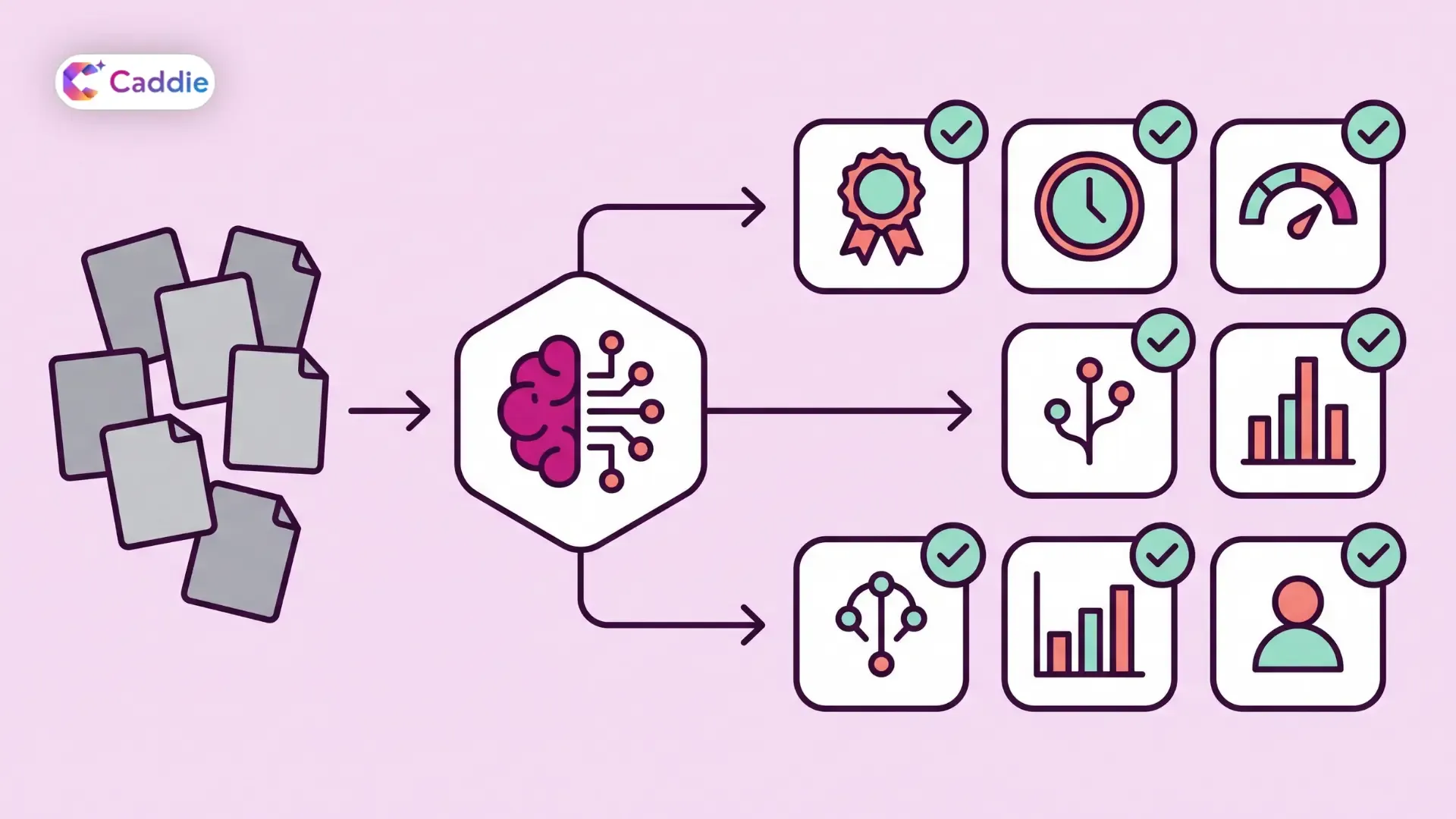
Trust comes from the signals a catalog attaches to each asset:
- Certification status: A steward has formally endorsed this asset as the approved source for a given metric.
- Freshness: When the asset last updated, and whether that matches its expected schedule.
- Quality scores: Automated checks for completeness, validity, and anomalies, shown next to the asset instead of buried in a separate tool.
- Lineage depth: A visible path back to the original source system.
- Usage evidence: Who queries this asset, how often, and which teams already depend on it.
- Ownership: A named person accountable for it, rather than an orphaned table nobody will claim.
The financial case here is well documented. Gartner puts the cost of poor data quality at an average of $12.9 million a year per organization. Much of that is not dramatic failure. It is the slow leakage of rework, contradictory reports, and decisions quietly made on the wrong number.
Where a Catalog Fits Alongside Search and Governance
It pays to be precise about boundaries here, because three categories get blurred constantly in vendor demos.
An enterprise search platform helps you find content: documents, tickets, wiki pages, contracts. A data catalog helps you find and evaluate structured data assets: tables, columns, models, dashboards, and the metadata describing them. The overlap is real, but the objects are different and so are the trust signals that matter.
Governance defines policy. Who may access what, under which classification, retained for how long. The catalog is where that policy becomes visible and enforceable at the level of an individual asset. Plenty of data governance tools now ship catalog features, and plenty of catalogs ship governance features, which is exactly why evaluations get muddy.
Finally, a catalog enables data democratization but does not deliver it on its own. A searchable inventory only matters if people also have the permissions and the literacy to act on what they find.
What to Look For in Data Catalog Software
When you evaluate data catalog software, pressure-test these areas rather than the polish of the demo search bar:
- Connector coverage: Does it reach every system that matters, including legacy databases, file storage, and your BI layer? Gaps tend to become permanent blind spots.
- Metadata activation: Does metadata simply sit there, or does it trigger alerts, access changes, and quality checks? Gartner frames this shift from passive to active metadata as a core step toward AI readiness.
- Classification accuracy: Ask for precision and recall figures on sensitive data detection, not a feature checkbox.
- Lineage fidelity: Column-level lineage is meaningfully harder to build than table-level. Confirm which one you are actually buying.
- Human-in-the-loop workflows: Stewards need to confirm, correct, and override machine suggestions easily. Systems that make this painful degrade within a year.
- Adoption design: If the catalog only lives inside its own interface, usage dies quietly. Look for integration into the tools your teams already open every day.
The Business Case Is Increasingly About AI
Cataloging used to be pitched on compliance and analyst efficiency. Those arguments still hold, but the stakes have shifted.
It is predicted that through 2026, organizations will abandon 60% of AI projects that are not supported by AI-ready data. The firm also expects that by 2027, organizations prioritizing semantics in AI-ready data will increase generative AI model accuracy by up to 80% and reduce costs by up to 60%, pointing specifically to active metadata as the mechanism behind that gain.
Read those together and the conclusion is uncomfortable but clear. Your AI initiatives will inherit whatever state your metadata is in. An assistant that cannot tell the certified revenue table from an abandoned copy will produce confident, well-formatted, wrong answers. Cataloging is no longer back-office hygiene. It is the substrate your self-service analytics and AI programs run on.
Where Caddie Fits
Caddie is not a data catalog and does not replace one. A catalog tells you which data assets exist and whether they can be trusted. Caddie is the layer where people put that data to work, asking questions in plain language across structured sources and documents, and getting visualizations and answers they can act on. Once your catalog has established a trusted set of assets, Caddie helps business users reach decisions on that foundation without filing a report request. Book a Caddie demo to see it on your own data.
Frequently Asked Questions
What is an AI data catalog?
It is a searchable inventory of your data assets where AI automatically discovers, describes, classifies, and maintains metadata, so teams can find and trust data far faster.
How is a data catalog different from data governance?
Governance sets policy for access, quality, and compliance. The catalog is where those policies become visible and enforceable against the specific data assets people search and use.
Does an AI data catalog replace data stewards?
No. AI handles scale by generating suggestions and classifications. Stewards validate, correct, and certify, which is what converts automated metadata into genuinely trusted data discovery
What metadata should a catalog capture?
Technical schemas, business definitions, ownership, freshness, quality scores, sensitivity classification, lineage, and usage patterns. Together these signals let someone judge whether an asset fits their question.
How long does a data catalog implementation take?
Initial connection and automated harvesting often takes weeks. Glossary alignment, certification, and real adoption across teams typically take several months of sustained stewardship effort.