
AI Governance is a complete system of rules, guardrails, and processes that make sure your machine learning models and automated decision-making systems are built and used safely, ethically, and legally. You have to look past traditional static data management to truly grasp what AI Governance is.
It is your game plan for managing dynamic, self-learning systems. It includes the strategies you use to control how much unstructured data goes in, manage complex model training pipelines, and closely watch generative outputs to stop hallucinations, algorithmic bias, and sensitive data leaks.
Under this bigger umbrella sits AI data governance. While traditional data governance focuses on managing static corporate databases, this specialized discipline focuses specifically on the "fuel" that powers your dynamic models. It tells you how to source, clean, and secure your training data. This ensures your private business intelligence or Personally Identifiable Information (PII) does not accidentally become part of a public Large Language Model (LLM).
In a time when AI-native SaaS platforms feed on massive datasets to find insights, governing your data's lifecycle is no longer optional. It is the basic requirement for your enterprise to build trust and survive operationally.
The High Stakes of Unmanaged AI (Why it Matters)
Shifting from traditional software to autonomous, predictive systems brings unprecedented operational risks to your business. Having robust artificial intelligence governance is the only barrier standing between a transformative business tool and a catastrophic brand crisis.
The Privacy Threat in Generative Pipelines
Modern AI architectures, like Retrieval-Augmented Generation (RAG) pipelines and vector databases, thrive on context. However, if one of your employees queries an internal AI assistant, there is a serious risk that the model might grab and expose highly confidential financial records, HR data, or source code to an unauthorized user. Without strict access controls, your LLMs can act like leaky sieves. Proper oversight makes sure you minimize and mask data before the information ever reaches the model's prompt context.
The Bias and Fairness Challenge
Models learn from historical data, and historical data may be flawed. If you use an AI system to screen job applicants, evaluate employee performance, or approve loans, and it is trained on biased datasets, it will scale that discrimination at software speed. This not only violates ethical standards, but it can also severely damage your company’s public reputation. A strong market position requires a defensible product, and algorithmic discrimination is legally and socially indefensible.
Model Drift and Hallucinations
AI models degrade over time. As consumer behaviors shift or economic conditions change, your model trained on data several years old might produce wildly inaccurate business intelligence forecasts now. This is known as model drift. Coupled with the tendency of LLMs to "hallucinate" or confidently invent facts, this highlights the operational cost of poor data quality in production.
The Regulatory Landscape
We have officially moved from theoretical guidelines to hard legal mandates. The EU AI Act represents a huge shift, moving European AI oversight from voluntary ethical guidelines to mandatory legal requirements based on product safety rules. The critical August 2026 deadline brings strict enforcement for your "high-risk" AI systems (such as those used in employment, critical infrastructure, and credit scoring). If you fail to comply, you could face massive fines and get disqualified from public contracts.
At the same time, U.S. standards like the NIST AI Risk Management Framework (AI RMF) and its Generative AI Profile (NIST AI 600-1) have become the definitive playbook for organizations globally. Its core functions are Govern, Map, Measure, and Manage. Navigating this web of global regulation requires you to have proactive, documented oversight.
The Core Pillars of an AI Governance Framework
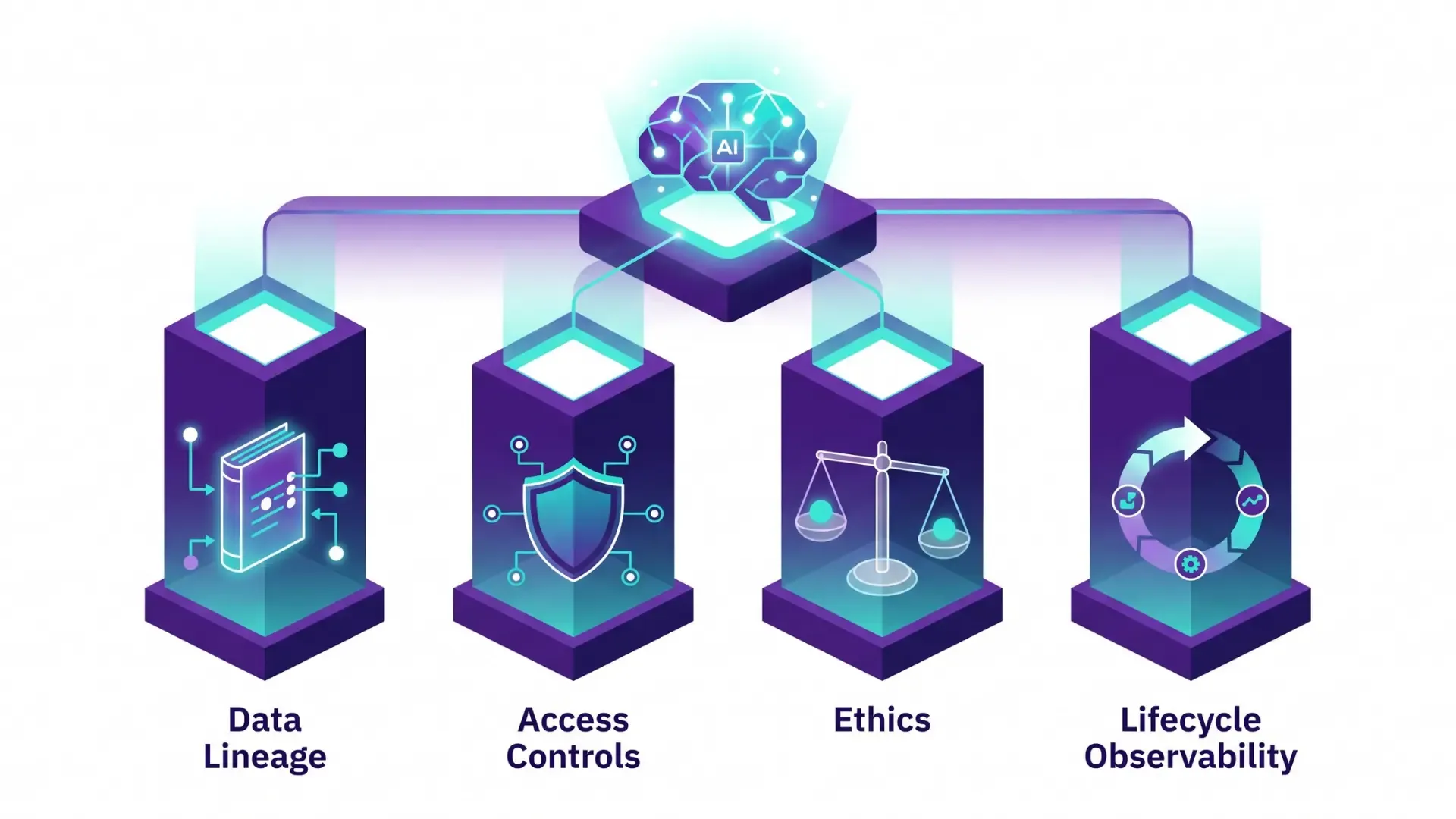
To turn theory into operational reality, you must put a structured AI governance framework in place. This operational model balances your need for rapid innovation with necessary friction. It makes sure your models remain secure, accurate, and aligned with your core business values.
Data Quality & Lineage
You cannot govern what you cannot trace. Having complete traceability from raw data ingestion to the final model output is incredibly important. This pillar focuses on keeping a strict ledger of where your training data came from, how it was changed, and who authorized its use. For your conversational analytics and business intelligence applications, proving the lineage of AI-generated insights is essential for executive trust.
If your model recommends a major strategic pivot, your leaders must be able to audit the exact data points that led to that conclusion. Furthermore, tracking lineage helps you address "copyright washing," where generative models spit out copyrighted material. If your organization gets audited, proving exactly what datasets trained your proprietary models will be the difference between a clean audit and a costly lawsuit.
Security & Contextual Access Controls
Securing your AI requires you to move beyond basic perimeter defense. It demands advanced Role-Based Access Control (RBAC) and Attribute-Based Access Control (ABAC) applied right at your AI gateway. This ensures that the model dynamically filters its responses based on the specific permissions of the user asking the question. Security also means hardening your model artifacts against adversarial attacks. For example, in a prompt injection attack, bad actors attempt to trick your model into bypassing its own safety filters to reveal system prompts or hidden data.
Ethical AI & Explainability
"Black-box" algorithms are a liability to your business. One of the foundational AI governance principles is explainability. This is your ability to understand, audit, and articulate how your model arrived at a specific decision. This pillar requires you to generate compliance artifacts and maintain model cards (detailed documents about your model's intended use, training data, and limitations). You must also actively test for unfair impacts to make sure your AI is fair across all user demographics.
Lifecycle Observability
Deploying an AI model is not the finish line; it is the starting line. Continuous lifecycle observability means you keep monitoring your models in production for drops in performance, data drift, and unexpected behavioral shifts. This includes tracking the "confidence scores" of your model's outputs and setting up automated circuit breakers. If your model's confidence in its financial predictions suddenly drops below a defined threshold, your system should automatically send the task to a human analyst. This real-time telemetry is what separates experimental AI projects from enterprise-grade software.
Redefining Roles: Who Owns the AI Governance Policy?
Technology alone cannot enforce your AI governance policy. The human element (defining who is accountable for the model's behavior) is often the most complex hurdle you will face. The traditional role of the "Data Steward" is rapidly evolving to meet the new demands of machine learning.
The Rise of Specialized AI Roles
Forward-thinking organizations are creating dedicated roles like AI Ethics Officers, Chief AI Officers (CAIO), and Model Risk Managers. These individuals sit at the intersection of data science, legal compliance, and business strategy. They are responsible for vetoing high-risk models, interpreting changing regulations, and translating complex technical vulnerabilities into clear business risk metrics for you.
Cross-Functional Alignment
Governing automated systems cannot happen in an isolated IT or engineering silo. It requires you to build aggressive cross-functional alignment across your teams. Your data engineers must work hand-in-hand with your legal team to ensure your training pipelines are compliant. Consider the role of your media strategy and communications in this ecosystem. Your marketing professionals cannot effectively pitch a new AI-native SaaS product if they do not deeply understand the governance guardrails you have in place.
Your messaging must be legally accurate, transparent, and empathetic when an AI incident occurs or when you launch a high-stakes AI feature. Bridging the gap between the engineers building your models and the communicators selling them is critical for maintaining market trust. When public headlines challenge your AI's output, your communications team must work with your governance council to explain how you are fixing it. This demonstrates to the public that your organization remains firmly in control of its technology.
Best Practices For Now And Beyond
As you navigate an increasingly automated landscape, your organization must adopt proactive strategies to ensure responsible AI governance. Here are some of the best practices defining enterprise leaders today:
Embrace Policy-as-Code
Manual compliance checklists are too slow for the speed of your modern deployment pipelines. The best AI-native platforms embed governance directly into their infrastructure using "Policy-as-Code." This means your compliance rules, data masking protocols, and bias checks are fully automated. They execute dynamically within your machine learning pipeline before you ever deploy a model. By shifting governance "left" to earlier in the development cycle, your data engineers and security teams can collaborate seamlessly without slowing down innovation. If your model fails an automated fairness check, the deployment stops instantly.
The Human-in-the-Loop (HITL) Imperative
Not all decisions should be fully automated. Establishing clear escalation paths and knowing when human oversight is critical is a core tenet of your risk management. For high-stakes decisions, like generating external corporate communications, finalizing financial forecasts, or taking actions that impact human livelihoods, you need a Human-in-the-Loop system. This ensures that one of your domain experts reviews the AI's recommendation before it is actually executed.
Communicating Trust as a Feature
Finally, you should not view rigorous governance merely as a defensive legal necessity; it is a strategic go-to-market advantage for you. In a crowded SaaS market where every competitor claims to have "AI capabilities," your ultimate differentiator is verifiable trust. You must weave your governance posture into your broader brand narrative. By transparently communicating how your company protects customer data, mitigates bias, and ensures model accuracy, you turn your internal governance framework into a compelling, revenue-driving feature that resonates with enterprise buyers.
Conclusion
The era of moving fast and breaking things does not apply to artificial intelligence. The financial, legal, and reputational costs of a rogue AI system are simply too high for you. Implementing a comprehensive governance strategy rooted in strict data lineage, continuous observability, and cross-functional human accountability is the only way you can harness the incredible power of machine learning safely. By shifting from reactive compliance to proactive, responsible management, you can confidently deploy AI solutions that drive innovation. This will help you maintain the absolute trust of your users, regulators, and the broader market.
Frequently Asked Questions (FAQ)
What is AI Governance and why does your business need it?
AI Governance is a structured system of rules and guardrails ensuring your machine learning models operate safely. You need this to prevent hallucinations, protect data, and maintain absolute user trust.
What is the main difference between general data governance and AI data governance?**
Traditional data governance manages static databases. However, AI data governance specifically focuses on securing and cleaning the dynamic "fuel" or massive datasets used to safely train your machine learning models.
How do you implement a successful AI governance framework?
You build an AI governance framework by establishing clear ai governance principles. This means automating data lineage tracking, enforcing strict access controls, maintaining model cards, and ensuring continuous lifecycle observability.
Why should your company prioritize responsible AI governance?
Prioritizing responsible AI governance protects your business from massive compliance fines, algorithmic bias, and reputation damage. Strong artificial intelligence governance turns your internal risk management into a true competitive advantage.
Who is responsible for enforcing an AI governance policy?
Enforcing your AI governance policy requires a cross-functional council. Dedicated leaders like Chief AI Officers work alongside legal teams, data engineers, and communications experts to manage all your technical vulnerabilities.