Modern organizations can no longer rely solely on traditional training programs to build a skilled workforce. As enterprise software, business processes, and workplace technologies evolve rapidly, employees need timely access to knowledge that helps them complete tasks accurately and confidently. Just in time training addresses this need by delivering relevant learning exactly when employees need it, improving knowledge retention, productivity, and software adoption without disrupting daily work.
As enterprise learning evolves, organizations are shifting toward just-in-time learning and learning in the flow of work, enabling employees to access contextual guidance without interrupting their daily responsibilities. This approach improves knowledge retention, accelerates software adoption, and supports better business outcomes.
At the same time, investments in employee learning and development, Digital adoption platforms, and In-app guidance are helping organizations embed learning directly into everyday workflows instead of relying solely on one-time training sessions.
Why Traditional Enterprise Training Is Falling Behind
For decades, enterprise training followed a predictable pattern. Employees attended instructor-led workshops, completed lengthy eLearning courses, reviewed manuals, and were expected to retain everything they had learned for future use.
While this model worked in relatively stable environments, today's digital workplace is significantly different.
Modern organizations frequently introduce:
- New enterprise software
- Updated business processes
- AI-powered workplace tools
- Compliance changes
- Internal workflow improvements
As the pace of change increases, employees often forget much of what they learned long before they actually need to apply it. Research on learning retention has consistently shown that knowledge declines rapidly without timely reinforcement and practical application.
The challenge becomes even greater during digital transformation initiatives. Employees may receive training weeks before a system goes live, leaving them uncertain when it's finally time to perform tasks in production environments.
This creates several common business challenges:
- Slower software adoption
- Increased support tickets
- Lower employee confidence
- Process inconsistencies
- Reduced operational efficiency
- Longer onboarding periods
These challenges are not caused by employees being unwilling to learn. Instead, they highlight a mismatch between when training is delivered and when knowledge is actually required.
What Is Just in Time Training?
Just in time training is a learning approach that delivers relevant information exactly when employees need it to complete a task, solve a problem, or perform a workflow.
Instead of asking employees to memorize large amounts of information in advance, organizations provide immediate access to guidance within the context of work.
For example:
A finance employee learning a new expense management system doesn't need a two-hour training session weeks before using it. Instead, they receive step-by-step assistance the first time they submit an expense report.
A customer support representative adopting a new CRM platform receives contextual instructions while updating customer records rather than searching through documentation.
A new manager completing performance reviews receives guidance directly within the HR system during the review process.
This approach minimizes interruptions, reinforces learning through immediate practice, and improves task completion without overwhelming employees with unnecessary information.
Unlike traditional learning, the objective isn't simply knowledge transfer—it's enabling employees to perform confidently when the need arises.
Why Employees Learn Better in the Flow of Work
One of the biggest shifts in enterprise learning is moving away from event-based training toward learning in the flow of work.
Instead of separating learning from daily responsibilities, organizations integrate learning directly into employees' existing workflows.
This approach aligns with how adults naturally learn.
People typically retain information more effectively when they:
- Face a real problem
- Need immediate answers
- Apply knowledge immediately
- Repeat tasks over time
- Receive contextual reinforcement
Learning becomes part of completing work rather than an isolated activity.
For example, imagine an employee who needs to generate a quarterly financial report for the first time.
Traditional training might require searching through PDFs, contacting IT, or watching recorded webinars.
With contextual learning, the employee receives relevant instructions exactly where the task is being performed, reducing friction and increasing confidence.
This practical learning model supports faster decision-making while minimizing disruption to daily work.
The Business Benefits of Just in Time Training
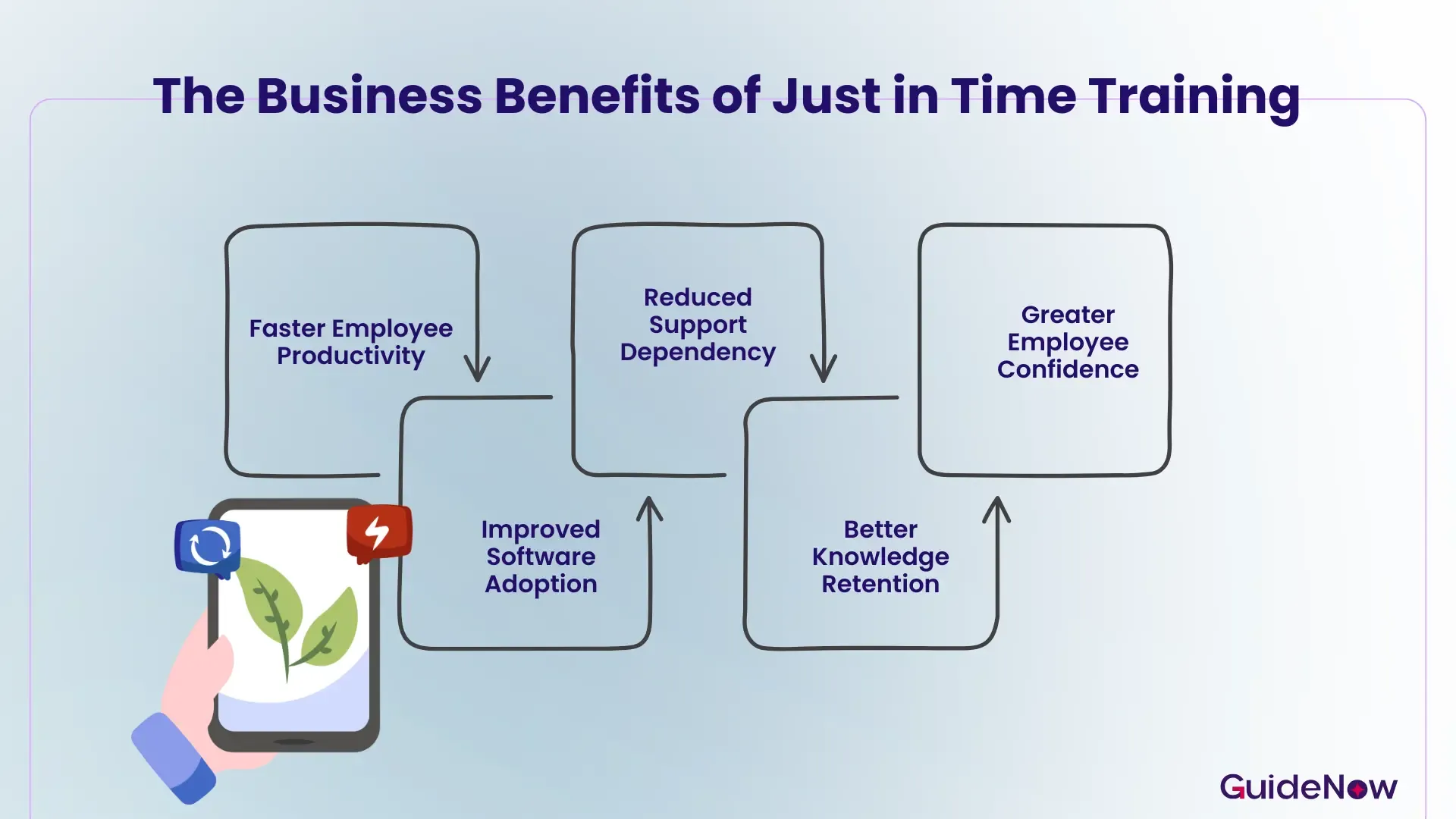
Organizations adopting just in time training often experience measurable improvements across multiple areas of workforce performance.
Faster Employee Productivity
Employees no longer spend excessive time searching through documentation or waiting for assistance.
Instead, they access relevant knowledge immediately, allowing them to complete tasks independently.
This shortens learning curves while helping new hires contribute sooner.
Improved Software Adoption
Many organizations invest heavily in enterprise software but struggle with low adoption rates because employees don't fully understand how to use new systems.
By combining training with real workflows, employees develop confidence through hands-on experience rather than theoretical instruction.
This supports broader Digital Adoption initiatives and encourages consistent software usage across teams.
Reduced Support Dependency
IT departments and internal help desks frequently answer repetitive questions that stem from insufficient guidance rather than technical issues.
Providing employees with contextual assistance during task execution enables them to resolve common questions independently.
As a result, support teams can focus on higher-value initiatives instead of routine requests.
Better Knowledge Retention
Information delivered at the moment of need is naturally easier to remember because employees immediately apply what they've learned.
Each successful task reinforces future performance, reducing the need for repeated formal training sessions.
Over time, this creates stronger long-term capability across the workforce.
Greater Employee Confidence
Uncertainty often discourages employees from exploring new software or changing established processes.
Providing timely guidance reduces anxiety by giving employees reassurance while completing unfamiliar tasks.
Confident employees are more willing to embrace organizational change and adopt new technologies successfully.
How Contextual Learning Changes Enterprise Training
Traditional learning assumes every employee needs the same information at the same time.
Modern workplaces prove otherwise.
Employees encounter different challenges depending on:
- Their role
- Experience level
- Department
- Software usage
- Business processes
- Current task
This is where Contextual learning provides significant value.
Instead of presenting generic courses, organizations deliver information based on the employee's immediate situation.
For example:
- A first-time user receives detailed walkthroughs.
- An experienced employee receives quick reminders.
- Managers access approval guidance.
- Sales teams receive CRM-specific recommendations.
- Finance teams receive compliance prompts during reporting.
By tailoring assistance to real work scenarios, organizations reduce information overload while increasing learning relevance.
This personalized experience supports faster decision-making and improves overall training effectiveness.
Technologies Powering Modern Enterprise Learning
Today's organizations increasingly rely on technology to deliver knowledge at the point of need rather than through isolated training events.
Several categories of solutions support this shift.
Employee training software helps organizations centralize learning resources, monitor completion, and deliver structured education across departments. While valuable for foundational knowledge, many organizations now complement these systems with more contextual approaches.
Similarly, Employee onboarding software has evolved beyond checklists and orientation programs. Modern onboarding experiences guide employees through real tasks during their first days, helping them build confidence through practical application instead of information overload.
For software companies, User onboarding software plays a comparable role by helping new users understand product functionality as they interact with the application. Rather than relying solely on documentation or tutorials, users receive guidance while completing meaningful actions.
These technologies are increasingly supported by In-app guidance, which delivers contextual assistance directly within enterprise applications. Instead of interrupting workflows, guidance appears when users need it most, making learning more immediate and actionable.
Together, these capabilities strengthen organizational Digital adoption platforms, enabling enterprises to improve software utilization, reduce training friction, and create continuous learning experiences. Solutions such as GuideNow illustrate how contextual guidance can become part of a broader adoption strategy without replacing existing learning systems.
Best Practices for Implementing Just in Time Training
Successfully adopting just in time training requires more than digitizing training materials. Organizations should rethink how knowledge is delivered so employees can access relevant guidance without interrupting their workflows.
Consider these best practices:
Identify High-Impact Learning Moments
Start by mapping tasks where employees frequently need help, such as software adoption, compliance processes, customer support workflows, or new employee onboarding. These moments often have the greatest impact on productivity and user confidence.
Deliver Learning Within Applications
Employees shouldn't have to switch between documentation, videos, or support portals while completing their work. Providing In-app guidance within enterprise applications reduces friction and encourages immediate learning.
Keep Learning Short and Actionable
Employees rarely need lengthy explanations during work. Focus on concise instructions, walkthroughs, tooltips, checklists, or step-by-step guidance that helps them complete the current task successfully.
Continuously Improve Based on User Behavior
Learning needs evolve as business processes change. Analyze where employees struggle, abandon workflows, or request support, and refine guidance accordingly to maintain relevance.
Just in Time Training vs. Traditional Enterprise Training
As organizations modernize their learning strategies, the difference between conventional training and contextual learning becomes increasingly clear.
| Aspect | Traditional Enterprise Training | Just in Time Training |
| Learning delivery | Scheduled sessions before work | Knowledge delivered during work |
| Employee experience | Classroom or LMS-based | Embedded within workflows |
| Knowledge retention | Lower due to delayed application | Higher through immediate application |
| Productivity | Employees pause work to learn | Employees learn while working |
| Software adoption | Often inconsistent | Encourages confident software usage |
| Support dependency | High reliance on help desks | Fewer repetitive support requests |
| Personalization | Same content for everyone | Guidance based on context and role |
| Business outcome | Completion-focused | Performance-focused |
For enterprises managing frequent software updates, evolving workflows, and distributed teams, contextual learning often delivers greater long-term value because it aligns learning with real business activities rather than isolated training events.
Why Enterprise Leaders Are Prioritizing Contextual Learning
The shift toward contextual learning is supported by both workforce expectations and business outcomes.
According to LinkedIn's Workplace Learning Report, 94% of employees say they would stay longer at a company that invests in their learning and development. This highlights the growing importance of continuous, accessible learning experiences rather than one-time training programs.
At the same time, learning science reinforces the need for timely reinforcement.
The Ebbinghaus Forgetting Curve suggests that people can forget a significant portion of newly learned information within days if it isn't reinforced or applied. Delivering guidance when employees actually perform a task helps improve retention and practical application.
Together, these insights explain why many organizations are moving away from traditional training toward embedded learning experiences that support employees throughout their daily work.
Real-World Enterprise Use Cases
The value of just-in-time learning extends across departments and industries because every organization has moments where employees need immediate guidance.
Employee Onboarding
New hires often receive a large volume of information during their first week, making it difficult to remember every process. Delivering contextual guidance while they complete real tasks helps reduce confusion and accelerates productivity.
Enterprise Software Rollouts
When organizations introduce new ERP, CRM, HR, or finance platforms, employees typically require ongoing support after the initial training session. Contextual assistance reinforces learning and reduces resistance to change.
Customer Support Operations
Support teams can receive task-specific guidance while navigating ticketing systems, enabling faster issue resolution and more consistent customer experiences.
Compliance and Process Updates
Regulatory changes often require employees to follow new procedures immediately. Contextual learning ensures employees receive updated instructions during the exact workflow where compliance matters most.
Common Mistakes Organizations Should Avoid
While adopting just in time training, organizations should avoid several common pitfalls.
Treating It as a Replacement for Foundational Learning
Contextual guidance works best when combined with foundational education. Employees still need an understanding of business processes, organizational policies, and core concepts before receiving task-specific support.
Providing Too Much Information
Showing lengthy tutorials or excessive instructions during work creates cognitive overload. Guidance should remain concise, relevant, and directly related to the employee's current task.
Ignoring User Feedback
Employees interact with systems differently across departments and experience levels. Regularly collecting feedback helps ensure learning experiences remain practical and effective.
Measuring Training Completion Instead of Performance
Rather than focusing solely on course completion rates, organizations should evaluate metrics such as productivity, software adoption, workflow completion, support ticket reduction, and employee confidence.
The Future of Enterprise Learning
Enterprise learning is evolving from scheduled instruction to continuous performance enablement.
As organizations adopt AI-powered applications, automation, and increasingly complex digital ecosystems, employees need immediate access to knowledge rather than periodic training sessions.
Future learning strategies will increasingly combine:
- AI-assisted recommendations
- Context-aware guidance
- Personalized learning paths
- Workflow intelligence
- Performance analytics
- Continuous skill reinforcement
The goal is no longer to train employees once. Instead, organizations are building environments where learning becomes a natural part of everyday work.
This approach enables businesses to adapt more quickly to technological change while helping employees remain productive, confident, and engaged.
Key Takeaways
- Just in time training delivers knowledge exactly when employees need it.
- Learning embedded within workflows improves knowledge retention and task completion.
- Contextual guidance reduces support dependency while accelerating software adoption.
- Combining foundational education with real-time assistance creates more effective enterprise learning experiences.
- Organizations should measure learning success through business outcomes rather than course completion alone.
Conclusion
Modern enterprises can no longer rely solely on traditional training models that separate learning from work. As software ecosystems become more complex and business processes evolve faster than ever, employees need access to relevant knowledge at the exact moment they need it.
Just in time training addresses this challenge by transforming learning into a continuous, contextual experience rather than a one-time event. By enabling employees to learn while completing real tasks, organizations can improve productivity, strengthen knowledge retention, reduce support dependency, and accelerate digital transformation initiatives.
For organizations investing in modern workplace technologies, combining learning in the flow of work with contextual guidance represents a practical strategy for building a more agile, confident, and future-ready workforce.
Frequently Asked Questions
1. What is contextual learning in enterprise training?
Contextual learning delivers personalized guidance based on an employee's role, task, experience level, and workflow. Instead of generic training, employees receive relevant assistance when they need it, making learning more practical and effective.
2. How does just in time training improve enterprise productivity?
By providing contextual guidance during real tasks, just in time training reduces time spent searching for information, minimizes workflow interruptions, and helps employees complete tasks more efficiently with greater confidence.
3. What is the difference between just in time training and traditional training?
Traditional training delivers information before employees perform their work, whereas just in time training provides relevant guidance while employees are actively completing tasks, making learning more practical and easier to retain.
4. Why is learning in the flow of work important for enterprises?
Learning in the flow of work helps employees develop skills without leaving their daily workflows. This improves productivity, reduces cognitive overload, and supports faster adoption of new business processes and enterprise software.
5. How do Digital adoption platforms support just in time training?
Digital adoption platforms provide contextual guidance, walkthroughs, and workflow assistance within enterprise applications. This enables organizations to deliver timely learning experiences that improve software adoption, employee performance, and overall operational efficiency.