Numbers settle arguments that opinions cannot. If you are defending an analytics budget or replacing a reporting stack, you need current evidence rather than figures recycled from five years ago.
This roundup brings together 60 business intelligence statistics from Gartner, McKinsey, the U.S. Bureau of Labor Statistics, Precisely, and leading market research firms. Read together, they show a business intelligence market growing steadily, AI spending accelerating far faster, and a widening gap between organizations that trust their data and those that only believe they do.
Business Intelligence Market Size Statistics
Analyst scopes differ, so the numbers vary, but the direction is consistent.
- The global business intelligence market was valued at $34.82 billion in 2025, according to Fortune Business Insights.
- That market is projected to reach $37.96 billion in 2026 and $72.21 billion by 2034.
- The implied CAGR across that 2026 to 2034 window is 8.40%.
- North America dominated the global BI market with a 31.00% share in 2025.
- Scoped to software alone, the BI software market was worth $40.1 billion in 2025, says Grand View Research.
- Grand View expects that software market to hit $43.7 billion in 2026 and $81.5 billion by 2033, a 9.3% CAGR.
- Cloud BI held the largest revenue share of the software market at 53.6% in 2025.
- Mobile BI is forecast to be the fastest growing BI technology segment from 2026 to 2033.
- A separate estimate from Mordor Intelligence puts the BI market at $41.16 billion in 2026, reaching $62.38 billion by 2031 at an 8.67% CAGR.
AI and Analytics Spending Statistics
Budgets for BI tools are growing at single digits. Budgets for AI are not. Gartner's September 2026 forecast shows the scale of that divergence.
- Worldwide AI spending is forecast to total $2.7 trillion in 2026, a 49.5% increase year over year (Gartner).
- Gartner projects total AI spending will climb again to $3.64 trillion in 2027.
- AI software spending rises from $288.2 billion in 2025 to $461.6 billion in 2026.
- AI services spending is forecast at $576.5 billion in 2026, growing to $745.7 billion in 2027.
- Spending on AI agents and assistants nearly doubles, from $16.5 billion in 2025 to $29.2 billion in 2026.
- The AI data segment grows almost fourfold, from $826 million in 2025 to $3.1 billion in 2026.
- AI infrastructure alone accounts for $1.48 trillion of 2026 spending.
- Gartner raised its 2026 growth outlook for generative AI models from 110% to 117%.
- The 2026 growth forecast for AI application development platforms was revised upward from 28% to 39%.
- Gartner expects transformation and indirect AI projects to drive a $1.2 trillion AI services opportunity by 2030.
Augmented and AI-Powered Analytics Statistics
The fastest growth sits in augmented analytics, where natural language interfaces replace report requests.
- The global augmented analytics market was valued at $15.26 billion in 2025 (Fortune Business Insights).
- It is projected to reach $20.04 billion in 2026 and $113.43 billion by 2034.
- That represents a 24.20% CAGR, roughly triple the growth rate of the broader BI market.
- North America held a 32.30% share of the augmented analytics market in 2025.
- Using a broader scope, Mordor Intelligence values augmented analytics at $37.96 billion in 2026, reaching $127.18 billion by 2031.
- Mordor puts that market's CAGR at 27.35% through 2031.
- Hybrid deployments grow faster at a 29.75% CAGR, as firms balance cloud agility against data sovereignty needs.
- Google Cloud made Conversational Analytics in BigQuery generally available in July 2026, with Teradata releasing its Autonomous Knowledge Platform the same month.
BI Adoption and ROI Statistics
Adoption is no longer the bottleneck. Turning it into measurable profit is, which is why self-service analytics keeps climbing the priority list.
- McKinsey's 2026 State of AI survey drew on 1,719 participants between May 4 and June 8, 2026.
- Just 37% of organizations can point to AI improving EBIT, essentially unchanged from 2025.
- Only 6% qualify as AI high performers, attributing at least 5% of EBIT to AI, also flat year over year.
- Roughly one in five organizations now find AI running costs capping how far they can push adoption.
- Almost a third of organizations have skipped a software purchase, choosing to build the same capability internally with agentic coding tools.
- Respondents most often report AI-driven cost reductions in supply chain management, service operations, and manufacturing.
- Among data leaders, 52% cite AI as the primary influence on their data programs (Precisely and Drexel LeBow).
- 85% of surveyed leaders report that their organization has adopted agentic AI in some form.
Data Quality, Trust, and Governance Statistics
Here the confidence gap shows up most clearly, and why data governance has become a competitive variable rather than a compliance chore.
- The Precisely and Drexel LeBow study surveyed more than 500 senior data and analytics leaders across the U.S. and EMEA.
- 87% say they have the infrastructure needed for AI, yet 42% also name infrastructure as a biggest obstacle.
- 86% claim they have the skills for AI, while 41% cite skills as a biggest obstacle.
- 88% claim data readiness, but 43% call data readiness a biggest obstacle.
- Most organizations say they connect AI to business goals, yet only 31% have metrics tied to KPIs.
- 43% of leaders cite data readiness as the single most significant barrier to aligning AI with business objectives.
- More than half name data quality as their most common data integrity priority.
- Formal governance lifts data trust sharply: 71% report high trust with a program in place, against 50% without.
- 63% have established some form of AI governance.
- 32% of leaders with strategy and governance already in place expect positive AI ROI within 6 to 11 months.
Business Intelligence Trends Shaping 2026 to 2030
Gartner's latest predictions show where decision intelligence is heading, and most of it runs through governance and semantics.
- Three in four hiring processes will test candidates for workplace AI proficiency by 2027, according to the firm.
- Through 2027, generative AI and agents will prompt a $58 billion market shakeup by creating the first real challenge to mainstream productivity tools in 30 years.
- Physical-world AI agents will produce ten times the data volume of every digital AI application put together by 2029.
- By 2030, 50% of organizations will use autonomous AI agents to turn governance policies into machine-verifiable data contracts.
- By 2030, half of all AI agent deployment failures will stem from insufficient AI governance platform runtime enforcement.
- Executive soft skills become the differentiator by 2030, shaping 60% of organizations that pull ahead on AI.
- Semantic layers earn the same critical-infrastructure status as data platforms and security stacks by 2030.
- About 50% of content risk roles will migrate from legal and cybersecurity into AI engineering by 2028.
- By 2030, a new wave of unicorns will emerge with $2 million in annual recurring revenue per employee, driven by capital efficiency.
Business Intelligence Talent and Skills Statistics
Demand for analytics talent is outrunning supply, which is why tools that let non-specialists answer their own questions keep gaining ground.
- Data scientist roles projected to expand 35% between 2025 and 2035, far outpacing the wider job market. (U.S. Bureau of Labor Statistics).
- About 24,800 data scientist openings are projected each year, on average, over that decade.
- Across 2024 to 2034, BLS projects data scientist employment to rise 33.5% (BLS Economics Daily).
- Information security analysts are projected to grow 28.5% from 2024 to 2034, the fastest growing computer occupation (BLS Monthly Labor Review).
- Data scientists, actuaries, and operations research analysts are all projected to grow at least 20%, placing them among the 15 fastest growing occupations.
- 51% of organizations cite skills as a top need for AI initiatives, yet only 38% feel very prepared on staff skills and training (Precisely).
What These Business Intelligence Statistics Mean for You
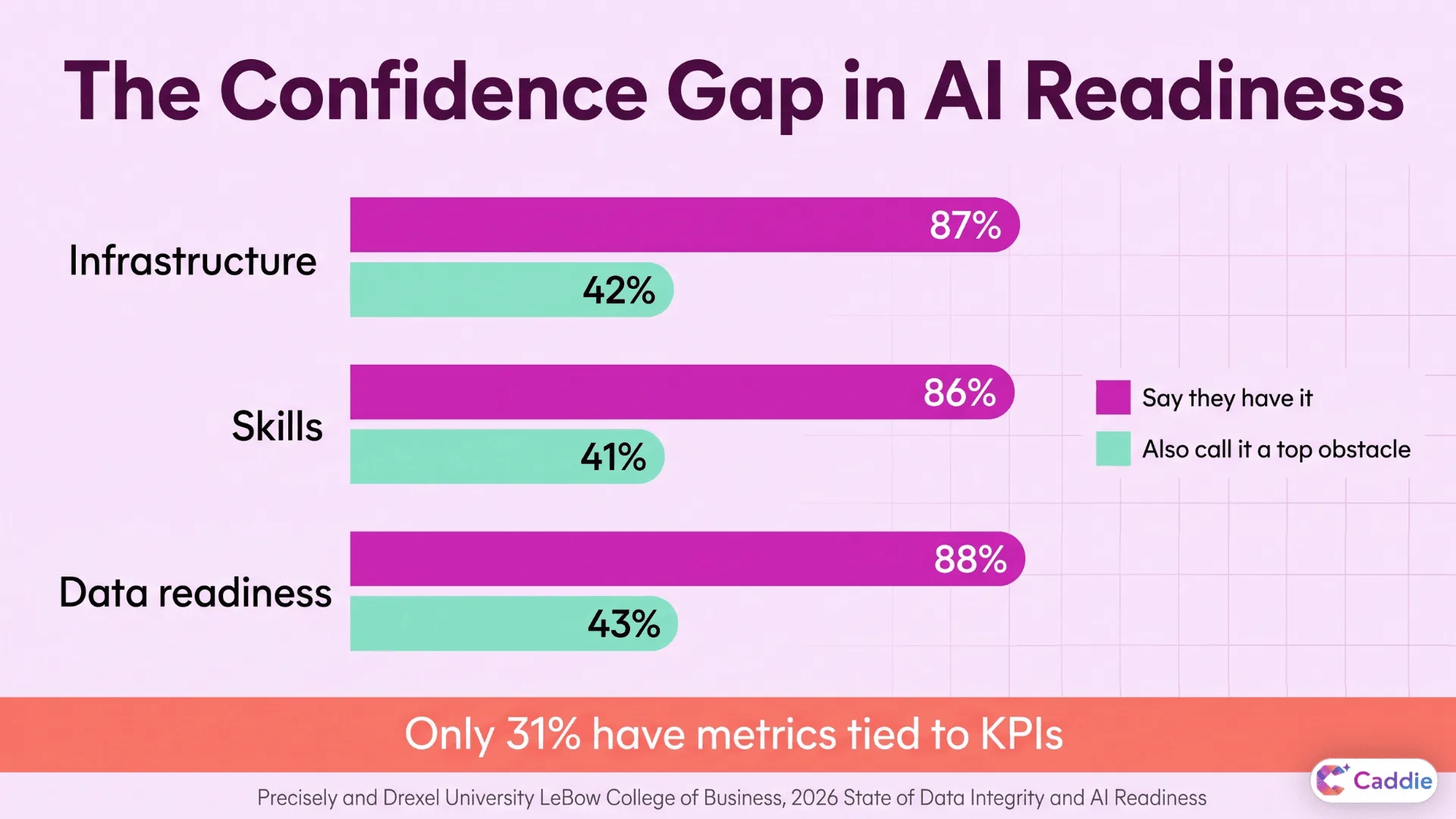
Read across all figures and one pattern emerges. Spending is not the constraint. Trust is. Leaders are overwhelmingly confident they are ready for AI-driven analytics, yet the same leaders name data readiness, skills, and infrastructure as their biggest obstacles, and only three in ten measure anything against a KPI.
So start your next analytics investment with governed data and a clear measurement plan. Then make answers easy to reach for the people who make decisions, rather than adding another dashboard nobody opens.
How Caddie Helps You Act on These Numbers
Caddie is an enterprise AI assistant that lets your teams ask business questions in plain language and get answers from live data, including the PDFs, policies, and spreadsheets traditional BI tools never reach. It connects databases and documents in one place, returns charts and tables instantly, and respects the access controls you already have through SSO, MFA, and role-based permissions. Instead of waiting days on a report request, your finance, operations, and leadership teams get supporting evidence in seconds.
See Caddie work on your own data: schedule a demo.
Frequently Asked Questions
How big is the business intelligence market in 2026?
Fortune Business Insights projects the global BI market at $37.96 billion in 2026, while Grand View Research values BI software specifically at $43.7 billion.
Is AI spending growing faster than BI spending?
Yes. Gartner forecasts worldwide AI spending at $2.7 trillion in 2026, up 49.5%, while BI market growth sits in single digits.
What percentage of companies see profit impact from AI?
McKinsey found 37% of organizations report AI contributing positively to EBIT in 2026, with only 6% qualifying as AI high performers.
Why do most AI analytics initiatives stall?
Data readiness is the top barrier. Precisely found 43% of leaders cite it, and only 31% track metrics tied to business KPIs.
How fast is demand for analytics talent growing?
The U.S. Bureau of Labor Statistics projects 35% growth in data scientist employment from 2025 to 2035, with 24,800 annual openings.