Your company knows more than it can remember. Somewhere in your systems sits the reason you rewrote the refund policy two years ago and the analysis that killed a product idea before it got expensive. It all exists. Almost none of it is findable by the person who needs it on a Tuesday afternoon.
That gap between what your organization knows and what it can recall on demand is what AI knowledge management sets out to close. It is not a better filing cabinet. It is a layer that reads what you already have, organizes it without waiting for anyone to tag it, and surfaces the right piece when a question comes up.
What AI Knowledge Management Actually Means
AI knowledge management is the use of machine learning and language models to capture, organize, maintain, and deliver what your organization collectively knows. Traditional knowledge management depends on people to file things correctly and keep them current. AI shifts that burden onto the system, so your knowledge base no longer depends on whether anyone had a spare hour last quarter.
Explicit Knowledge and Tacit Knowledge
Explicit knowledge is everything already written down: policies, procedures, contracts, tickets, retrospectives, decks. It is easy to store and surprisingly hard to find.
Tacit knowledge lives in people's heads. It is judgment, context, the reason a process works the way it does. It is easy to use, hard to capture, and it walks out the door with every resignation.
AI helps with the first directly and the second indirectly, by mining the places tacit knowledge leaks into text anyway. Ticket threads, review comments, and long email chains are full of reasoning nobody formalized, and extracting it is where institutional knowledge AI earns its keep.
Why Traditional Knowledge Bases Stall
You have probably watched a wiki die. It launches with enthusiasm, collects a few hundred pages, then quietly rots. Contributions are voluntary, the category structure ages badly, and owners change roles without handing anything over. People stop trusting it, then stop checking it, then rebuild work that already existed.
It's not a people problem, it's a money problem. Maintaining a knowledge base costs real time and money that your budget never accounts for. When AI automatically classifies and summarizes that content, it finally makes that spending worthwhile, which is why you need knowledge management software designed to work with AI from the start, not AI pasted on top of it afterward.
Why Institutional Knowledge Keeps Slipping Away
The scale of the problem is well documented. Atlassian's State of Teams 2026 research, based on a survey of 12,035 global knowledge workers and 173 Fortune 1000 executives, found that 85% of knowledge workers use AI at work but only 29% have embedded it in their flows of work. The same research estimates the resulting fragmentation costs the Fortune 500 $161 billion each year. People have AI. They are using it beside their work rather than inside it.
There is a foundation problem underneath. Gartner found that 63% of organizations either do not have or are unsure whether they have the right data management practices for AI, based on a third quarter 2024 survey of 248 data management leaders, and predicts that through 2026 organizations will abandon 60% of AI projects unsupported by AI-ready data. If your knowledge is scattered and unlabeled, an AI layer on top inherits every one of those problems.
How AI Organizes Institutional Knowledge
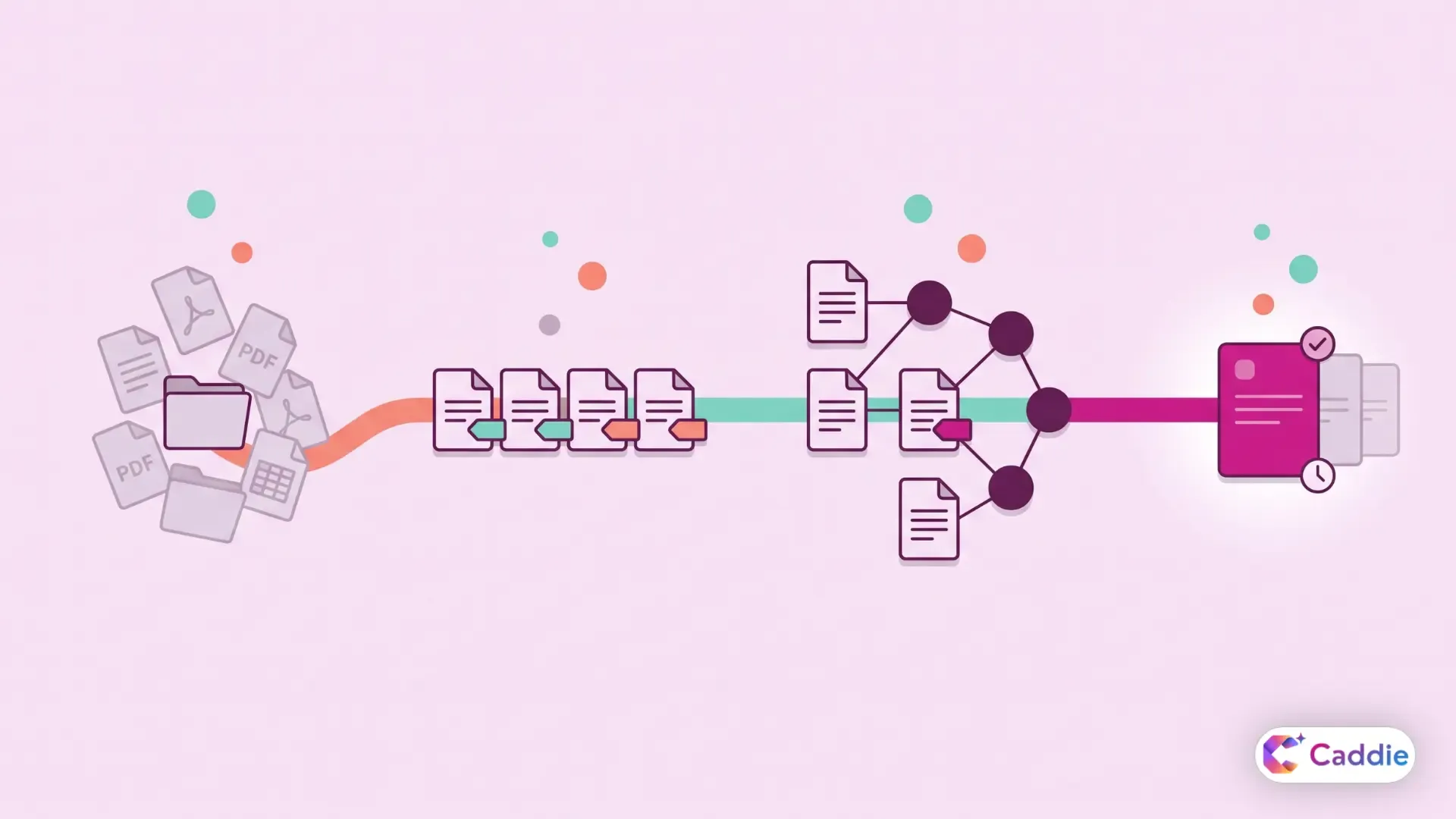
Organizing is the unglamorous half of the job, and it decides whether anything else works. Four capabilities do most of the lifting.
Classification and Automatic Tagging
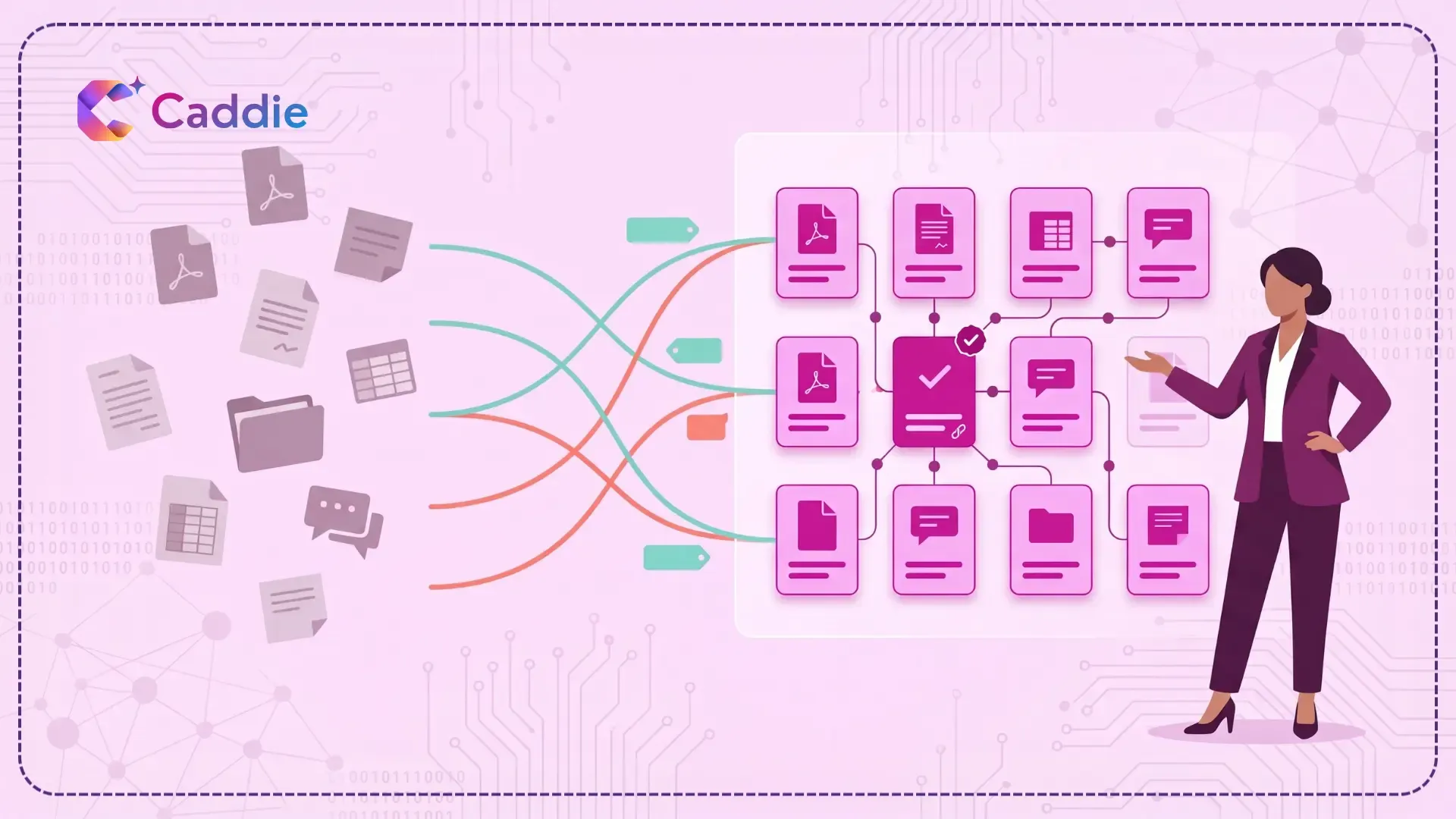
Every document carries signals about what it covers, who owns it, which customer or product it touches, and how sensitive it is. Using natural language processing, a knowledge layer reads those signals and applies metadata at ingestion, across thousands of files, without anyone filling in a form. You get a consistently labeled library instead of a folder tree built by one person in 2019.
Entity and Relationship Extraction
Tagging tells you what a document is about. Extraction tells you what it connects to. AI pulls named entities out of your content, including customers, contracts, products, and systems, then links the ones that mean the same thing across sources. The renewal clause, the support escalation, and the churn risk note stop being three unrelated files and become one account story.
Summarization and Deduplication
Most enterprises hold several versions of the same truth: three onboarding guides, two expense policies, a dozen decks saying the same thing. AI can cluster near duplicates, summarize each, and flag which version is canonical. That cleanup usually improves answer quality more than any model upgrade.
Freshness Scoring and Gap Detection
Knowledge decays, and a policy updated in 2023 looks identical to one updated last week. AI can score content by age, contradiction, and usage, then flag what is stale. It can also log the questions nobody could answer, giving your team a content roadmap based on demand rather than guesswork. Gartner's February 2026 survey of 321 customer service and support leaders found that 58% aim to upskill agents into knowledge management specialists, recognizing that AI systems and self-service both depend on accurate, continually updated content.
How AI Surfaces Knowledge at the Moment You Need It
Organizing knowledge nobody retrieves is just tidier storage. Surfacing is the half your users experience.
Questions Instead of Folders
You do not think in directory paths, you think in questions. A well-built knowledge layer lets you ask what the escalation path is for a tier one outage and returns the answer, not fourteen documents with "escalation" in the title. That shift makes these systems usable by people who will never learn your filing structure.
Answers That Show Their Work
An answer you cannot verify is the one you will not rely on twice. Every response should link to the passage it came from, and the system should say plainly when it does not know rather than filling the gap with something plausible. This is where your AI governance standards become a product requirement. Test that behavior during a pilot with your own hard questions, not vendor sample data.
Delivery Inside the Flow of Work
Knowledge that makes you stop, open another tab, and search will lose to asking the nearest colleague. Delivery has to reach people where the work happens: a chat tool, a ticket queue, a phone during a site visit. Atlassian found the top 14% of teams, the ones seeing real returns from AI, are 2.3 times more likely to fully trust AI to surface and contextualize relevant information.
What Separates Real AI Knowledge Base Tools From a Chatbot on Your Files
Plenty of products point a language model at a document store and call it knowledge management. Four things separate the serious ones. They respect permissions at query time, so nobody sees content their source system would deny them. They cite sources on every answer. They write back, improving tags and logging unanswered questions rather than only reading. And they are judged on whether answers get used and trusted, not on how many documents were indexed.
Where This Differs From Enterprise Search
The two overlap, and the distinction matters during procurement. Enterprise search is a retrieval problem: connect to systems, index them, return ranked results. AI knowledge management is a lifecycle problem: organize what exists, keep it current, retire what is wrong, deliver it in context. Search is one component of it, not a substitute.
Governance Comes Before Rollout
An AI knowledge layer inherits whatever discipline your content already has. If sensitive files sit in open folders, faster retrieval makes that exposure worse. Settle your data governance basics first: who owns each domain, which sources are authoritative, and how access is enforced per user.
There is a newer wrinkle. As AI-generated content flows into your repositories, provenance gets harder to establish. Gartner predicts that by 2028, 50% of organizations will adopt zero-trust data governance as unverified AI-generated data grows. Knowing who wrote a document, and when, is becoming part of knowing whether it is true.
How to Start Without Boiling the Ocean
Pick one high-frequency question set. Support escalations, procurement policy, and onboarding work well because the questions repeat and the cost of getting them wrong is visible. Connect only the two or three sources that genuinely hold those answers, then run a two-week accuracy check with real questions from real people.
After that, expand by demand. Let the unanswered question log decide what comes next, and pair the rollout with the access design your data democratization plan already defines, so reach grows without governance falling behind.
Where Knowledge Management Meets Your Numbers
Most real questions cross a line. Asking why margin fell in the Northeast needs the supplier contract that explains it and the revenue figures that prove it. A knowledge layer retrieves documented context. Computing fresh metrics from live data is the job of conversational analytics platforms that query and calculate. Decide which owns which half before you buy either.
Frequently Asked Questions
What is AI knowledge management?
It is the use of AI to capture, organize, maintain, and deliver organizational knowledge automatically, replacing manual tagging and filing with systems that classify content and answer questions in plain language.
How is AI knowledge management different from a knowledge base?
A knowledge base stores what people write. AI knowledge management also organizes, summarizes, connects, and refreshes that content, then delivers answers to questions instead of returning a list of documents.
Can AI capture tacit knowledge from employees?
Not directly, but it extracts reasoning already recorded in tickets, chats, reviews, and meeting notes. That surfaces much of the context experts never formally documented before leaving a role.
What do AI knowledge base tools need to be trusted?
Permission-aware retrieval, citations on every answer, clear handling of low confidence, and current content. Without those four, adoption drops quickly once people catch a single wrong answer.
How long does an AI knowledge management rollout take?
A focused pilot on two or three sources can return useful answers within weeks. Broader rollout with permission validation and tuning usually takes one to two quarters.