If Chameleon is not fully aligned with the way your SaaS product needs to guide users, the best Chameleon Alternatives depend on the gap you are trying to solve. Some teams need simpler product tours. Others need stronger product analytics, more flexible onboarding, broader enterprise adoption capabilities, or contextual assistance that supports users while they complete real workflows.
Chameleon is built around in-product experiences such as tours, tooltips, checklists, banners, surveys, launchers, and targeted experiences. It is particularly suited to teams that want to design highly customized experiences inside a web product.
But SaaS onboarding has become more than showing users where features are located. Teams increasingly need to help users understand what to do, when to do it, and how to complete the task successfully.
That distinction matters when evaluating alternatives.
For example, GuideNow is worth considering when the requirement extends from conventional product tours into contextual, workflow-oriented assistance. Other platforms may be better suited to product analytics, lightweight onboarding, or enterprise-wide software adoption.
This guide compares the leading options by use case, onboarding approach, analytics, implementation needs, and product complexity so you can identify the right fit rather than simply choosing the platform with the longest feature list.
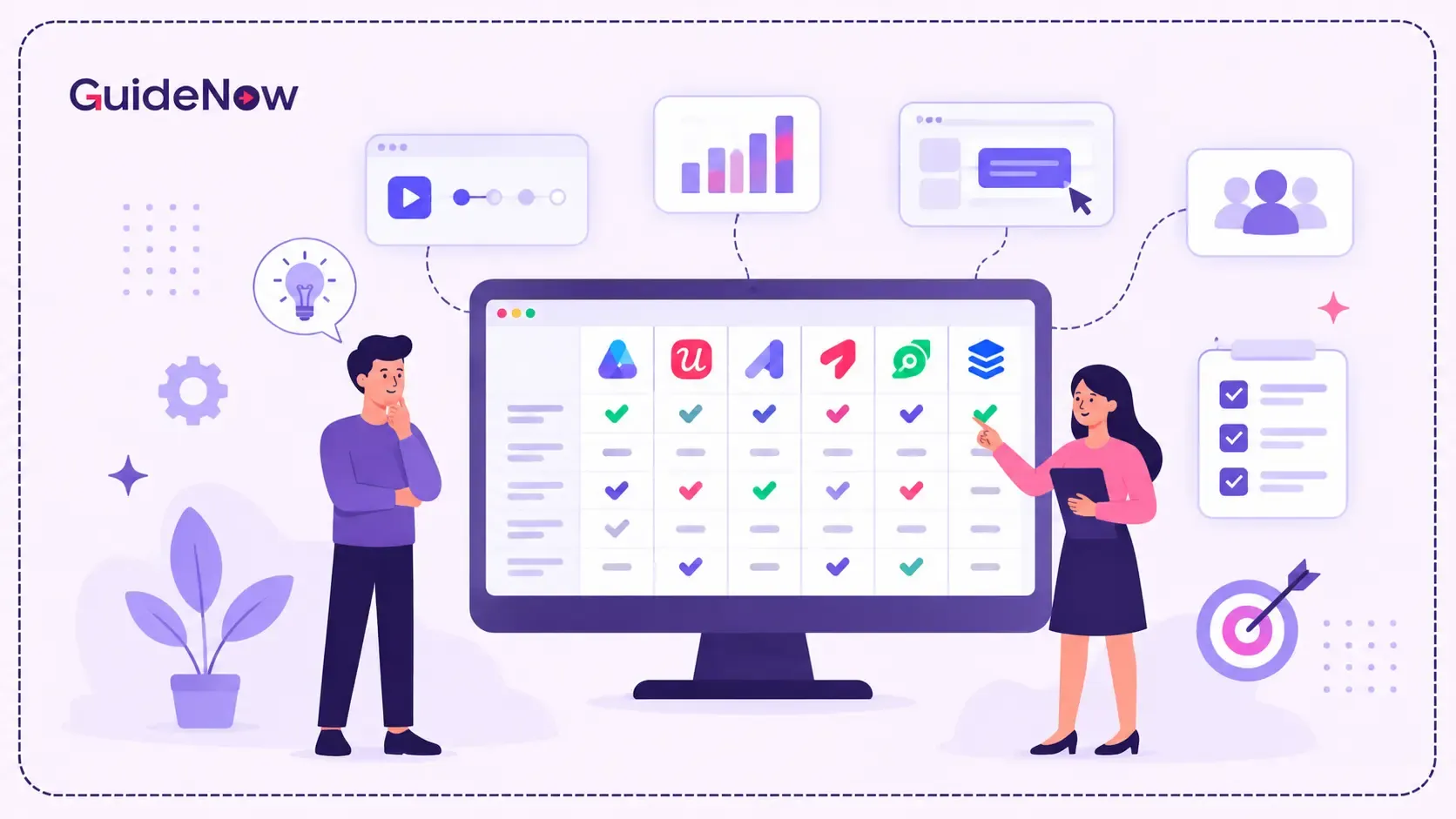
Best Chameleon Alternatives in 2026: Quick Comparison
| Platform | Best suited for | Primary strength | Consider it when |
| GuideNow | Contextual software guidance | In-app guidance and workflow assistance | Users need help completing tasks, not just learning interfaces |
| Userpilot | Product-led SaaS | Adoption analytics and personalized experiences | Product usage data should drive onboarding |
| UserGuiding | No-code onboarding | Fast guided experiences | You need to launch onboarding with minimal development |
| Appcues | SaaS activation | Activation and lifecycle experiences | You want structured onboarding and engagement journeys |
| Pendo | Product analytics | Analytics + in-product experiences | Behavioral insights need to inform onboarding decisions |
| WalkMe | Enterprise adoption | Enterprise digital adoption | You manage complex applications and employee workflows |
| Whatfix | Enterprise workflow adoption | Cross-application guidance | Users work across multiple business systems |
The platforms are not interchangeable. A lightweight SaaS onboarding requirement and an enterprise workflow-adoption requirement can look similar during a demo but require very different capabilities in production.
Why Evaluate Chameleon Alternatives in 2026?
The reason to evaluate alternatives should not simply be that another platform has more features.
Chameleon already supports product tours, tooltips, checklists, surveys, launchers, resource centers, and targeted experiences. Its product-tour guidance is designed for onboarding, feature adoption, support, and introducing product changes.
The more important question is whether that approach matches your users' actual behavior.
Consider three different situations:
Scenario 1: Feature discovery
A new user needs to know where a particular feature is located.
A traditional tour or tooltip can solve this effectively.
Scenario 2: Workflow completion
A user understands where the feature is but does not know the sequence of actions required to complete a business task.
This requires more contextual guidance.
Scenario 3: Ongoing software adoption
An organization needs to support users across multiple applications, roles, workflows, and changing processes.
This moves closer to a broader adoption platform. As organizations adopt more software across departments, understanding the enterprise technology adoption curve can help teams identify where users are likely to face adoption friction and what level of guidance they may need.
Therefore, the right Chameleon Alternatives should be evaluated according to the complexity of the user problem—not simply the number of onboarding components available.
1. GuideNow — Best for Contextual Workflow Guidance
GuideNow is the strongest option to evaluate when your onboarding challenge is less about presenting a product tour and more about helping users navigate software while completing actual tasks.
Its platform combines interactive tours, tooltips, hotspots, banners, contextual pop-ups, onboarding experiences, and adoption analytics. It also supports AI-powered guidance and no-code experience creation.
Why choose GuideNow as a Chameleon alternative?
The distinction is primarily about the type of user assistance you want to provide.
Chameleon is particularly strong for creating customizable in-product experiences and product tours. Its current product capabilities include tours, checklists, banners, surveys, resource centers, and other targeted experiences.
GuideNow can be considered when the desired experience is more contextual:
- Guide users through multi-step tasks
- Provide assistance at the point where users need it
- Explain functionality without sending users to separate documentation
- Support different roles or user contexts
- Provide guidance around complex software workflows
- Combine onboarding with ongoing in-product assistance
- Measure whether users are progressing through guided experiences
This makes the evaluation less about replacing one product-tour builder with another and more about choosing an approach that matches the complexity of the product.
When should you consider GuideNow?
GuideNow is worth evaluating if:
- Your product has complex workflows
- Users frequently need contextual help after onboarding
- Product tours alone do not solve adoption friction
- You want no-code creation of guided experiences
- Different users need different guidance
- Your onboarding strategy extends beyond the first login
It should not automatically be considered the right choice for every SaaS team. For a simple three-step onboarding flow, a lighter product may be sufficient.
A Key Adoption Problem: Users Often Need More Than a Tour
The distinction between a product tour and contextual assistance becomes more important when software becomes complex.
Gartner reported in 2024 that 60% of technology users said new applications were introduced without explaining why or how the applications would help them. More than half also reported that new applications required too much time and effort, disrupted daily work, or negatively affected productivity.
Gartner — 3 Pillars to Ramp Up User Adoption and Unlock Customer Value
This suggests that onboarding should not be judged only by whether users saw or completed a tour.
A better question is:
Did the guidance help users accomplish the outcome they came to the product for?
That is particularly important for products with multiple workflows, role-based functionality, or a steep learning curve.
2. Userpilot — Best for Product-Led Adoption Analytics
Userpilot is a strong option for SaaS product teams that want onboarding closely connected to product usage and feature adoption.
Its platform combines contextual experiences with segmentation, product analytics, feedback, session replay, and behavioral targeting.
Why consider Userpilot?
The main advantage is the connection between what users do and what experience they receive.
For example, a product team could identify users who have not adopted an important feature and create a targeted experience for that segment.
This makes Userpilot particularly relevant when onboarding is part of a broader product-led growth strategy.
Best fit
Consider Userpilot when your primary requirement is:
Behavior-driven onboarding + product adoption measurement.
It may be less appropriate if your central problem is complex cross-application workflow guidance rather than product analytics.
3. UserGuiding — Best for No-Code Product Tours
UserGuiding is designed for teams that want to create guided product experiences without making every onboarding change dependent on developers.
Its product-tour capabilities include tooltips, modals, multi-page tours, conditional branching, personalized experiences, and targeting. The company also emphasizes no-code creation through its Chrome extension.
Why consider UserGuiding?
Its strongest use case is speed.
A SaaS team can use it when the primary objective is to create:
- New-user walkthroughs
- Feature introductions
- Checklists
- Contextual tooltips
- Product announcements
- Guided flows
This makes it a practical option for smaller product teams that do not need a broad enterprise adoption platform.
Best fit
Choose UserGuiding when ease of creation and fast deployment are more important than deeper workflow or enterprise adoption capabilities.
4. Appcues — Best for SaaS Activation
Appcues is focused on helping SaaS teams create onboarding and activation experiences across the product lifecycle.
It is particularly relevant when onboarding is treated as an ongoing journey rather than a single introductory walkthrough.
Why consider Appcues?
The platform can support different activation patterns, including welcome experiences, onboarding flows, checklists, and feature-focused engagement.
This makes it suitable for teams that want to influence what users do after signup rather than simply explain the interface.
Best fit
Consider Appcues when your primary objective is user activation and lifecycle engagement within a SaaS product.
5. Pendo — Best for Product Analytics and Onboarding
Pendo is a strong choice for teams that want product analytics to play a central role in their onboarding strategy.
Its platform connects product analytics with in-app guides, allowing teams to understand user behavior and then use those insights to target experiences. Pendo supports analytics such as funnels, paths, retention, and feature adoption.
Why consider Pendo?
The important difference is analytical depth.
Instead of asking only:
“Did users complete onboarding?”
product teams can investigate:
“What did users do afterward?”
That can help identify whether an onboarding experience is actually associated with feature adoption or retention.
Best fit
Pendo is particularly suitable for mature product organizations where behavioral analytics and onboarding decisions need to work together.
AI Is Changing How Teams Think About In-Product Guidance
AI is also changing the evaluation criteria for onboarding platforms.
McKinsey's 2024 Global Survey found that 65% of respondents said their organizations were regularly using generative AI in at least one business function, nearly double the percentage from the previous survey. By the following year's survey, that figure had risen to 71%.
McKinsey — The State of AI: How Organizations Are Rewiring to Capture Value
For onboarding teams, the implication is not that every onboarding experience needs AI.
Instead, AI should be evaluated based on whether it improves a specific part of the user journey—for example, generating guidance, identifying friction, supporting contextual assistance, or helping users find answers.
That is a more useful evaluation criterion than simply asking whether a vendor has added an “AI” label to its product.
6. WalkMe — Best for Enterprise Digital Adoption
WalkMe is designed for organizations dealing with broader software adoption challenges rather than only SaaS product onboarding.
It becomes relevant when users need support across complex enterprise applications, business processes, and organizational change.
Why consider WalkMe?
A large organization may need to:
- Guide employees through enterprise applications
- Support software rollouts
- Reduce dependence on classroom training
- Improve proficiency after implementation
- Guide complex business processes
- Measure adoption across applications
Those requirements are considerably broader than creating a welcome tour.
Best fit
WalkMe is best evaluated when enterprise-wide digital adoption is the objective.
For a small SaaS product that only needs onboarding tours, its broader scope may be unnecessary.
7. Whatfix — Best for Complex Enterprise Workflows
Whatfix is another platform aimed at broader digital adoption platform and enterprise software usage.
Its platform combines in-app guidance, self-help, analytics, and AI capabilities and supports multiple application environments.
Why consider Whatfix?
Whatfix becomes particularly relevant when users move between several applications to complete a business process.
For example, a workflow might involve:
CRM → ERP → reporting system → approval application
A traditional onboarding flow is generally designed around one product experience.
Enterprise adoption platforms can address a wider application ecosystem.
Best fit
Consider Whatfix when your organization needs cross-application workflow guidance and enterprise software adoption rather than primarily customer onboarding.
What Type of Onboarding Platform Do You Actually Need?
Before choosing among the alternatives, classify your onboarding problem.
If users cannot find important features
Prioritize tours, tooltips, checklists, and contextual prompts.
If users cannot complete workflows
Look for contextual guidance that can support users throughout a task rather than only during initial onboarding.
If users are not adopting important features
Prioritize segmentation, behavioral analytics, experimentation, and targeted experiences.
If product teams cannot understand onboarding performance
Choose a platform with meaningful analytics around funnels, adoption, engagement, and user behavior.
If employees work across several enterprise applications
Evaluate broader digital adoption platforms rather than traditional product-tour tools.
This approach prevents a common purchasing mistake: selecting a platform because its feature list looks impressive without determining whether those features solve the actual adoption problem.
How to Compare Chameleon Alternatives Before Buying
A vendor demo should not be your only evaluation method.
Create one realistic onboarding scenario and ask every vendor to demonstrate it.
1. Can the platform guide a real workflow?
Do not test only a three-step welcome tour. Use a workflow that represents the hardest part of your product.
2. Can experiences adapt to different users?
Test different roles, plans, product behaviors, and stages of adoption.
3. What happens when users leave the expected path?
A good onboarding experience should account for users skipping steps, moving between pages, or returning later.
4. Can you measure the outcome?
Look beyond impressions and completion rates. Evaluate whether the platform helps you understand activation, feature usage, task completion, and friction.
5. How much engineering support is required?
Ask who can build, edit, publish, test, and maintain experiences after implementation.
6. What happens when the product changes?
This is often overlooked. A guidance element that works today may break after a UI redesign. Maintenance requirements should therefore be part of the evaluation.
Which Chameleon Alternative Should You Choose?
The right choice depends on what is missing from your current onboarding approach.
If your priority is simple product tours, UserGuiding or Appcues may be sufficient.
If you need behavioral product analytics, Userpilot or Pendo may be a stronger fit.
If your organization needs enterprise-wide software adoption, WalkMe or Whatfix may make more sense.
If users need contextual assistance while completing complex software workflows, GuideNow is worth evaluating as an alternative to a conventional tour-focused approach.
The important distinction is that replacing Chameleon should not mean finding another tool with an identical feature checklist. It should mean identifying the adoption problem that your current approach does not solve and evaluating platforms against that specific problem.
Conclusion
The best Chameleon Alternatives in 2026 are not necessarily the platforms with the most onboarding features. They are the platforms that best match the way your users learn, navigate, and adopt your software.
Chameleon remains a strong option for teams focused on customizable in-product experiences. But organizations with different requirements may benefit from taking a broader view.
Userpilot and Pendo are relevant when product analytics and behavioral adoption are central. UserGuiding and Appcues work well for focused SaaS onboarding and activation. WalkMe and Whatfix are designed for more complex enterprise adoption environments.
GuideNow belongs in the evaluation when the challenge is moving beyond introductory tours toward contextual guidance for real software workflows.
Ultimately, the best platform is the one that helps users move from “I know where this feature is” to “I can successfully accomplish what I came here to do.”
That is the standard SaaS teams should use when evaluating their onboarding technology in 2026.
Frequently Asked Questions
1. What should enterprises look for when choosing a Chameleon alternative?
Enterprises should evaluate Chameleon alternatives based on workflow guidance, contextual assistance, analytics, scalability, integrations, implementation effort, security, and ongoing maintenance. The key is to test each platform against real user workflows and adoption challenges—not just product-tour capabilities.
2. Why would a SaaS company look for an alternative to Chameleon?
Teams may evaluate alternatives when their requirements extend beyond customizable product tours—for example, deeper product analytics, broader enterprise adoption, complex workflow assistance, different implementation requirements, or more contextual support after initial onboarding.
3. Is GuideNow a direct replacement for Chameleon?
It can be evaluated as an alternative, but the two platforms should not be treated as identical products. Chameleon has a strong focus on customizable in-product experiences such as tours, tooltips, checklists, surveys, and launchers. GuideNow is relevant when the requirement includes contextual guidance around software workflows and ongoing assistance.
4. What should I compare when choosing between onboarding platforms?
Compare the platforms across experience-building capabilities, segmentation, analytics, workflow support, integrations, implementation effort, maintenance, scalability, security, and AI capabilities. Most importantly, test them against an actual user workflow rather than a generic demo.
5. Are product tours enough for modern SaaS onboarding?
Not always. Product tours are useful for feature discovery and orientation, but complex products may also require contextual assistance, behavioral targeting, analytics, checklists, self-help, and workflow-specific guidance. The appropriate combination depends on the complexity of the product and the actions users need to complete.