Artificial intelligence has moved far beyond experimentation. Enterprise leaders are investing heavily in copilots, workflow automation, predictive analytics, generative AI, and intelligent assistants to improve employee productivity and accelerate decision-making.
Yet many organizations face the same frustrating reality: a successful pilot never becomes a successful enterprise-wide initiative.
The proof-of-concept delivers promising results. Stakeholders are excited. Initial users report productivity gains. Then momentum slows. Adoption plateaus. Business units disengage. The project remains stuck in perpetual pilot mode.
This gap between experimentation and enterprise-scale value has become one of the biggest barriers to Enterprise AI Adoption today.
The challenge is rarely the technology itself. More often, organizations struggle with governance, operational readiness, employee enablement, workflow integration, executive alignment, and measurement frameworks.
This article explores why enterprise AI initiatives stall after pilot programs and provides a practical roadmap for turning isolated AI experiments into scalable business outcomes.
The Enterprise AI Adoption Gap: Why Pilots Succeed but Scaling Fails
Many AI pilots are intentionally designed for success.
They involve:
- Small user groups
- Controlled datasets
- Dedicated project teams
- Limited risk exposure
- Clear use cases
In this environment, AI can demonstrate impressive results quickly.
The problem begins when organizations attempt to expand usage across departments, business units, regions, or workflows.
What worked for 50 users often breaks down for 5,000 users.
This is where AI adoption challenges emerge.
Teams discover that scaling requires far more than deploying a model or purchasing an AI platform. It requires organizational change, governance structures, process redesign, and operational discipline.
The result is a growing number of enterprises that have dozens of AI pilots but only a handful of production-grade AI initiatives delivering measurable business value.
The State of Enterprise AI: What the Data Shows
Recent industry research highlights the growing disconnect between AI experimentation and enterprise-wide execution.
| Enterprise AI Metric | Finding |
| Organizations using AI in at least one business function | 88% |
| Organizations reporting measurable enterprise-wide AI value | Less than half |
| Leaders citing governance and risk concerns as scaling barriers | Significant majority |
| AI initiatives that fail to progress beyond pilot stage | Common across industries |
| Organizations prioritizing AI transformation in strategic planning | Rapidly increasing |
According to McKinsey's Global Survey on AI, AI usage has expanded rapidly across business functions, but organizations continue to struggle with converting experimentation into enterprise-scale value. Organizations achieving the strongest outcomes consistently align AI initiatives with business processes, governance, workforce readiness, and operational execution rather than focusing solely on technology deployment.
Similarly, Gartner research frequently identifies governance, change management, and operational integration as key factors separating successful AI programs from stalled initiatives.
The lesson is clear: AI success is not determined by model accuracy alone. Enterprise execution determines long-term value.
Why AI Projects Lose Momentum After the Pilot Phase
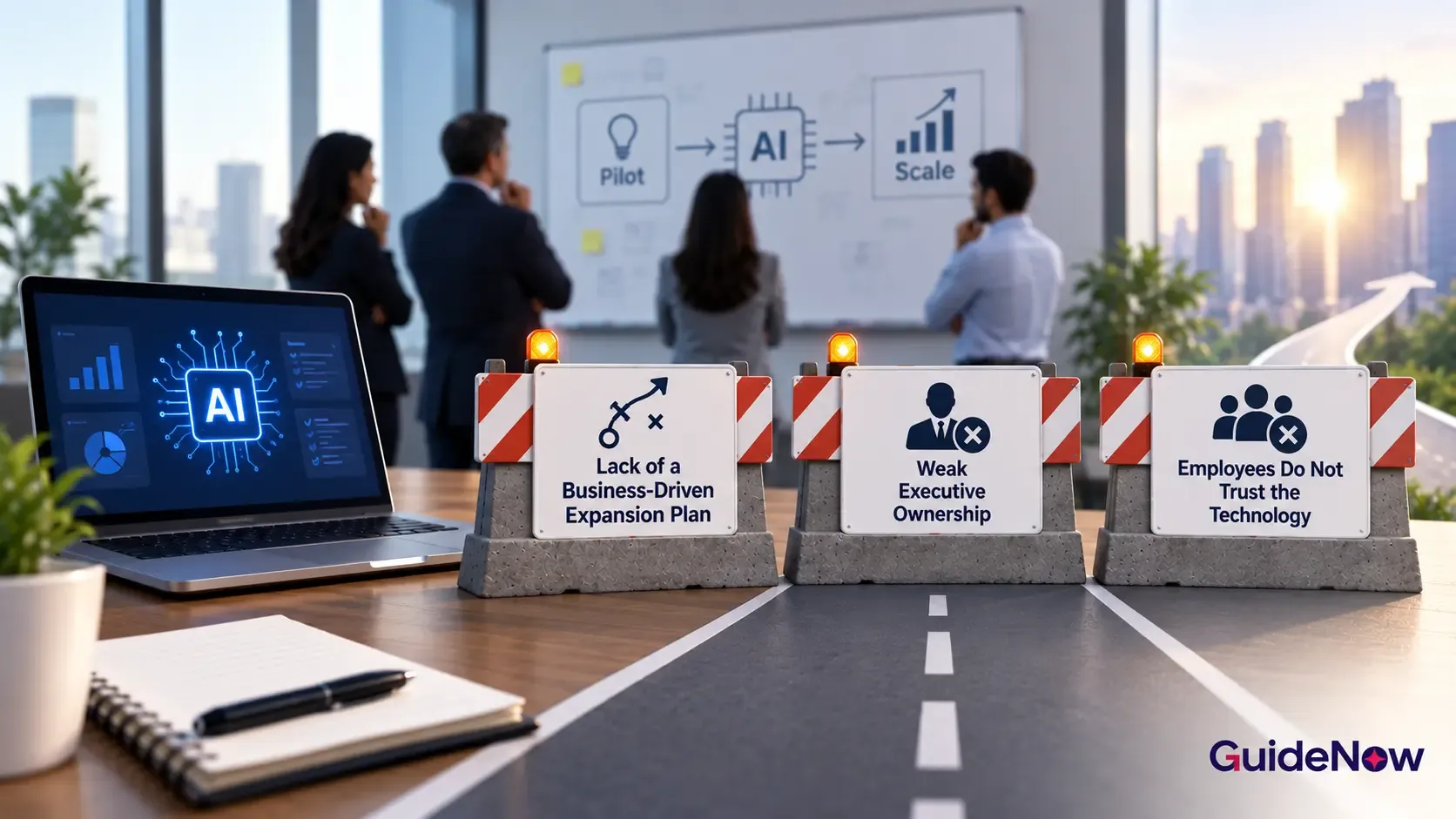
Lack of a Business-Driven Expansion Plan
Many pilots begin with a technology-first mindset.
A team identifies an AI capability, launches a proof-of-concept, and demonstrates technical feasibility.
What often gets overlooked is a roadmap for scaling business impact.
Without answers to questions such as:
- Which departments adopt next?
- What workflows change?
- How will value be measured?
- Who owns adoption?
the initiative quickly loses direction.
This is one of the most common reasons why AI projects fail in enterprises despite promising pilot results.
Organizations need a scaling strategy before deployment begins—not after the pilot succeeds.
Weak Executive Ownership
AI initiatives frequently start within innovation teams, IT departments, or data science groups.
While these teams can prove technical viability, enterprise scaling requires executive sponsorship.
When leadership ownership is unclear:
- Funding becomes inconsistent
- Priorities shift
- Adoption efforts lose visibility
- Business units hesitate to commit
Successful AI programs have executive champions who connect AI investments directly to business objectives.
Without leadership accountability, pilots remain isolated experiments.
Employees Do Not Trust the Technology
Trust remains one of the biggest barriers to widespread AI adoption.
Employees often worry about:
- Job displacement
- Loss of decision-making authority
- Increased monitoring
- Data privacy concerns
- Unclear expectations
Even when AI tools perform well, user resistance can prevent meaningful adoption.
Building trust requires transparency, communication, education, and clear explanations of how AI supports rather than replaces employees. Effective AI change management programs help organizations address employee concerns, build trust, and ensure smoother adoption of AI-powered workflows.
Organizations that ignore these concerns often experience adoption stagnation long before technical limitations become an issue.
The Hidden Operational Challenges That Prevent Scaling
Technology rarely causes enterprise AI failures.
Operational readiness is usually the real issue.
Data Quality Problems
AI systems depend on accurate, consistent, and accessible data.
When organizations attempt to scale, they often discover:
- Duplicate records
- Inconsistent formats
- Siloed systems
- Poor data governance
As deployment expands, these issues become increasingly costly.
Many Enterprise AI implementation efforts stall because organizations underestimate the complexity of preparing enterprise data environments.
Workflow Misalignment
One of the biggest mistakes organizations make is layering AI on top of broken processes.
AI can accelerate work.
It cannot automatically fix inefficient workflows.
Before scaling, leaders should evaluate:
- Process bottlenecks
- Decision-making paths
- Approval structures
- Cross-functional dependencies
Organizations that redesign workflows alongside AI adoption consistently achieve stronger outcomes than those simply adding AI features to existing processes.
Lack of Operational Ownership
Many AI projects sit between departments.
IT owns infrastructure.
Data teams own models.
Business teams own outcomes.
When ownership is fragmented, accountability disappears.
Successful organizations assign clear operational ownership for adoption, governance, performance measurement, and ongoing optimization.
A Practical Framework for Scaling Enterprise AI Successfully
Organizations that succeed at Scaling AI in the enterprise typically follow a structured approach rather than expanding opportunistically.
The following framework can help.
Phase 1: Align AI with Business Outcomes
Before scaling, identify:
- Revenue objectives
- Cost reduction targets
- Productivity goals
- Customer experience improvements
- Risk mitigation outcomes
AI initiatives should always support measurable business priorities.
Phase 2: Establish Governance Early
Strong AI governance for enterprises prevents many scaling problems before they emerge.
Governance should address:
- Data usage policies
- Security requirements
- Compliance obligations
- Model monitoring
- Human oversight responsibilities
Governance should not slow innovation.
It should enable safe and repeatable scaling.
Phase 3: Prepare the Workforce
Employees need more than access to AI tools. Successful employee software onboarding ensures users understand how AI integrates into their roles and daily responsibilities.
- Role-specific training
- Practical use cases
- Clear expectations
- Workflow guidance
- Ongoing support
Organizations can further improve adoption by using interactive onboarding checklists that guide employees through key tasks and learning milestones during AI rollouts.
Organizations that treat workforce enablement as a continuous process achieve significantly higher adoption rates. Many enterprises use a Digital adoption platform to provide in-app guidance, contextual support, and real-time assistance that accelerates software adoption across teams.
Phase 4: Integrate AI into Core Workflows
The highest-performing organizations embed AI directly into daily operations.
Examples include:
- CRM workflows
- Customer support systems
- Supply chain management
- HR operations
- Financial processes
The more naturally AI fits into existing work, the more sustainable adoption becomes. Many of these principles align with proven SaaS onboarding best practices, where users receive contextual guidance, step-by-step assistance, and continuous support throughout their adoption journey.
Phase 5: Measure and Optimize Continuously
Scaling is not a one-time project.
Organizations should track:
- Adoption rates
- Productivity improvements
- Process completion rates
- Time savings
- Business outcomes
Continuous measurement allows leaders to identify friction points and optimize adoption over time.
This structured AI adoption framework helps organizations move beyond experimentation and build long-term enterprise value.
Pilot-Only Organizations vs AI-Scaled Organizations
The difference between stalled and successful AI initiatives often comes down to organizational execution.
| Pilot-Only Organizations | AI-Scaled Organizations |
| Focus on technology demonstrations | Focus on business outcomes |
| Limited executive involvement | Strong leadership sponsorship |
| Minimal governance | Structured governance model |
| Isolated use cases | Integrated workflows |
| One-time training | Continuous enablement |
| Success measured by deployment | Success measured by outcomes |
| Short-term experimentation | Long-term operational strategy |
This distinction explains why many organizations invest heavily in AI yet struggle to realize meaningful returns.
Building a Sustainable AI Transformation Strategy
A successful AI transformation strategy extends beyond technology deployment.
It requires coordinated changes across:
- People
- Processes
- Technology
- Governance
- Culture
Organizations should think of AI as an operating model shift rather than a software implementation project.
The strongest programs focus on creating repeatable systems for identifying use cases, validating business value, scaling successful initiatives, and continuously improving performance.
When AI becomes part of how work gets done—not just another tool—the likelihood of enterprise-wide success increases dramatically.
Choosing the Right Enterprise AI Solutions
Technology selection still matters.
However, organizations often overemphasize platform capabilities while underestimating adoption requirements.
The best Enterprise AI solutions typically provide:
- Strong integration capabilities
- Security and compliance controls
- Scalability
- Governance support
- Workflow compatibility
- Adoption analytics
Technology should fit existing business processes and strategic objectives rather than forcing organizations to redesign operations around the tool itself.
In many organizations, platforms such as GuideNow are also used to support employee guidance and workflow adoption during AI rollouts, helping users adapt to changing processes without disrupting productivity. Features such as onboarding tooltips, in-app walkthroughs, and contextual prompts help employees learn new processes without interrupting their daily work.
Creating an Effective AI Implementation Strategy
Every successful AI implementation strategy begins with a simple principle:
Scale outcomes, not technology.
Organizations should prioritize:
- High-value business problems.
- Executive alignment.
- Governance readiness.
- Workforce enablement.
- Operational integration.
- Continuous measurement.
This approach reduces risk while increasing the likelihood of sustained adoption.
It also helps organizations avoid many common AI deployment challenges that emerge during expansion efforts.
Conclusion
The biggest obstacle to Enterprise AI Adoption is not model performance, infrastructure, or vendor selection.
It is the ability to transform successful pilots into sustainable business operations.
Organizations often assume that technical success automatically leads to enterprise success. In reality, scaling AI requires governance, workforce readiness, workflow integration, executive ownership, and continuous optimization.
The enterprises generating the highest AI returns are not necessarily deploying the most advanced models. They are building repeatable systems that align AI initiatives with business outcomes, operational processes, and employee adoption.
As AI investments continue to grow, the organizations that master scaling—not just experimentation—will be the ones that create lasting competitive advantage.
Frequently Asked Questions
1. What is the biggest barrier to Enterprise AI Adoption after a successful pilot?
The most common barrier is the lack of a structured scaling plan. Many organizations prove technical feasibility during pilots but fail to establish governance, workforce readiness, workflow integration, and executive ownership required for enterprise-wide adoption.
2. How long does it typically take to scale an AI pilot across an enterprise?
Timelines vary based on organizational complexity, but most successful enterprise AI programs require several months to establish governance, integrate workflows, train users, and measure outcomes before achieving broad adoption.
3. What metrics should organizations track when scaling AI initiatives?
Key metrics include user adoption rates, workflow completion rates, productivity improvements, time savings, operational efficiency gains, business outcome achievement, and overall return on investment.
4. Why do employees resist AI adoption even when the technology works?
Resistance often stems from concerns about job security, transparency, trust, decision-making authority, and unclear expectations. Effective communication and workforce enablement are essential for overcoming these barriers.
5. How can organizations reduce enterprise AI adoption challenges during scaling?
Organizations can reduce risk by establishing governance early, aligning AI initiatives with business objectives, integrating AI into existing workflows, providing role-based enablement, and continuously measuring adoption and performance outcomes.